Saint Joshua
Successor of Moses; dates unknown
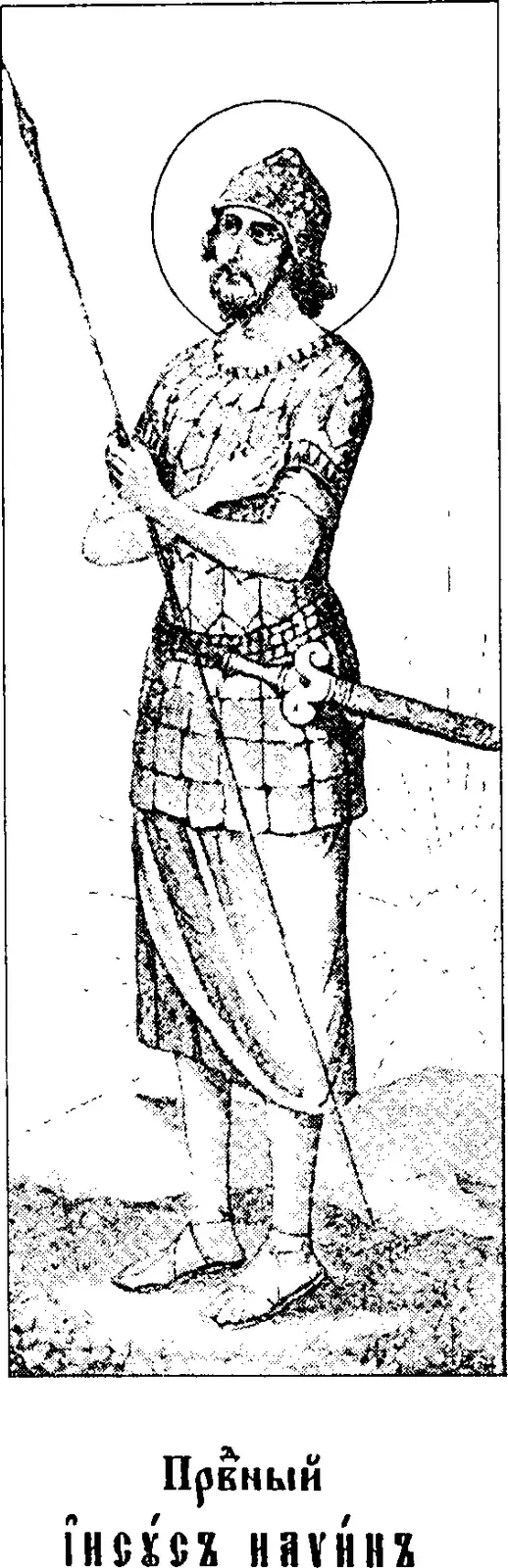
- Known for
- Serving as Moses' aide, and leading Israel across the Jordan into the promised land after his death 11214
- Died
- At the age of 110; buried at Timnath-serah in the hill country of Ephraim 19
Saint Joshua, son of Nun, was the young aide who stayed in the tent of meeting when Moses left it, and the man God chose to finish what Moses began: to bring Israel across the Jordan into the land sworn to their fathers. 61014 His name, given him by Moses, means "the Lord saves," the same name that comes into Greek as Jesus, and the Fathers read his whole life as a figure of Christ. 18 The Church commemorates him on September 1. 2
The aide of Moses
He first appears with a sword in his hand. When Amalek attacked Israel at Rephidim, Moses told Joshua to pick men and go out to fight, while Moses himself stood on the hilltop holding up the staff of God. As long as Moses' hands were raised Israel prevailed; when they grew tired, Aaron and Hur held them up until sunset, "and Joshua mowed down Amalek and his people with the edge of the sword." 4 The Catholic Encyclopedia counts this battle as the beginning of his story. 1
The Bible calls him Moses' "aide" and his "assistant," and shows him close beside his master. 56 He went up the mountain of God with Moses when the elders were told to wait below. 5 When Moses spoke with the Lord face to face in the tent of meeting and then went back to the camp, "his young assistant, Joshua, son of Nun, would not move out of the tent." 6
He was not always right. When two men named Eldad and Medad began to prophesy in the camp, Joshua, "who from his youth had been Moses' aide," wanted them stopped. Moses answered him: "Are you jealous for my sake? Would that all the people of the LORD were prophets!" 7
The scout who would not despair
Moses sent twelve men, one from each tribe, to reconnoiter Canaan. Joshua went for Ephraim, still called by his first name, Hoshea, and it was then, Numbers says, that "Hoshea, son of Nun, Moses called Joshua." 8 The New American Bible notes that the two forms are variants of one name meaning "the LORD saves," and that Joshua later became "Jeshua," the Hebrew pronunciation of the name "Jesus." 8 The Catholic Encyclopedia gives the meaning as "Jahweh is salvation." 1
The scouts came back after forty days with a cluster of grapes so large that two men carried it on a pole, and with a report that frightened the whole people: the towns were fortified and the inhabitants were giants, beside whom "we felt like mere grasshoppers." 8 That night the people wailed and talked of choosing a leader to take them back to Egypt. 9
Joshua and Caleb tore their garments. "The country which we went through and explored is a fine, rich land," they said. "If the LORD is pleased with us, he will bring us in and give us that land... the LORD is with us. Therefore, do not be afraid of them." The community answered by threatening to stone them. 9 Of the whole generation that grumbled, the Lord said, none would enter the land "except Caleb, son of Jephunneh, and Joshua, son of Nun." 9
Chosen to succeed Moses
When Moses was told he would see the land but not enter it, he asked the Lord to set a man over the community, "that the LORD'S community may not be like sheep without a shepherd." 10 The Lord answered: "Take Joshua, son of Nun, a man of spirit, and lay your hand upon him." Moses did it before the priest Eleazar and the whole assembly. 10 The Catholic Encyclopedia says that "the words of the choice show the character of the chosen." 1
Deuteronomy repeats the charge twice, once from Moses and once from the Lord himself: "Be brave and steadfast, for it is you who must bring the Israelites into the land which I promised them on oath. I myself will be with you." 11 And after Moses died in the land of Moab, "Joshua, son of Nun, was filled with the spirit of wisdom, since Moses had laid his hands upon him; and so the Israelites gave him their obedience." 12
Across the Jordan
The Book of Joshua opens with the Lord speaking to him directly: "My servant Moses is dead. So prepare to cross the Jordan." The words that follow are repeated like a refrain: "I will be with you as I was with Moses: I will not leave you nor forsake you... be firm and steadfast! Do not fear nor be dismayed, for the LORD, your God, is with you wherever you go." 14
The river was in flood with the spring harvest. As soon as the priests carrying the ark of the covenant stepped into the water, the flow from upstream stopped, and "all Israel crossed over on dry ground" while the priests stood in the riverbed until the whole nation had passed. 15 The New American Bible introduction says the purpose of the whole book is to show "God's fidelity in giving to the Israelites the land he had promised them." 13
Near Jericho, Joshua looked up and saw a man standing before him with a drawn sword. He asked whether he was friend or enemy. "Neither," came the answer. "I am the captain of the host of the LORD." Joshua fell prostrate, and was told to remove his sandals, "for the place on which you are standing is holy." 16
Jericho, and the hard pages
Jericho fell, in the Catholic Encyclopedia's phrase, "without a blow." 1 For six days the soldiers circled the city once a day behind seven priests blowing ram's horns before the ark; on the seventh they circled it seven times, the people shouted, and the wall collapsed. 17 The New American Bible notes that the horns and the shouting were a customary feature of ancient warfare, used here "as a test of the people's obedience and of their faith in his promise." 17 Rahab, who had hidden Joshua's spies, was brought out with all her family and spared. 17
The rest of the chapter is hard reading. The city was placed under the ban, and every living thing in it was put to the sword. 17 The Catholic Encyclopedia faced the charge of cruelty directly in 1910, pointing to the treatment of the conquered in other ancient records and to Augustine, who held that the abominations of the Canaanites merited the punishment God gave them by Israel's hand. 1 The New American Bible introduction reads the conquest differently, as "a prophecy of the spiritual conquest of the world through the Church." 13 This page reports both and does not try to settle it.
In the battle for the Gibeonites, Joshua prayed before all Israel: "Stand still, O sun, at Gibeon, O moon, in the valley of Aijalon!" 18 Sirach praises him as the man who "by his power" stopped the sun, "so that one day became two," and adds that God answered him with hailstones. 20 The New American Bible note on Joshua 10 allows that reading, but says it is "equally probable" that Joshua asked for the sun to be darkened, and that the prayer was answered by the hailstorm and a long darkness. 18
"As for me and my household"
Joshua's last act was not a battle. He gathered the tribes at Shechem and renewed the covenant. "Decide today whom you will serve," he told them; "as for me and my household, we will serve the LORD." When the people answered that they would serve the Lord, he warned them that they might not be able to, "for he is a holy God," and they answered again, "We will still serve the LORD." 19
He died at the age of a hundred and ten and was buried on his own land at Timnath-serah, in the hill country of Ephraim. "Israel served the LORD during the entire lifetime of Joshua," the book ends, "and that of the elders who outlived Joshua." 19 Sirach remembers him as a "valiant leader" and "assistant to Moses in the prophetic office," formed "as his name implies" to be the savior of God's people. 20
Who wrote the book that bears his name is an old question. The Catholic Encyclopedia says that most of the Fathers took Joshua himself to be the author, while other Catholic writers gave it to someone who lived shortly after him, and that all of them held the editing to be earlier than the Exile. 1 The New American Bible introduction says the book "was built up by a long and complex process of editing traditional materials." 13
What is Saint Joshua the patron saint of?
Saint Joshua's feast day
Saint Joshua's feast day is September 1. The current Roman Martyrology commemorates him on that day as the son of Nun and servant of the Lord who was filled with the spirit of wisdom when Moses laid his hands on him, and who after Moses' death led Israel across the Jordan into the promised land. 2 The 1897 English edition of the Martyrology also enters him on September 1, together with Gideon: "In Palestine, of the Saints Josue and Gedeon." 3
Praying with Saint Joshua
For most of his life Joshua was the second man. He fought while Moses prayed, waited in the tent after Moses had gone, and was corrected by Moses when he tried to protect his master's place. 467 The command he received when his turn came was simply to keep the law Moses had given him and not to swerve from it. 14
His courage at Kadesh cost him something. He and Caleb said the land was good and that the Lord was with them, and the people picked up stones. 9 He then spent forty years in the desert with the generation that would not go in, because of a decision he had argued against. 9
The word he heard most often was "be firm and steadfast," and it came with a promise, not an explanation. 1114 At Jericho he was given an order that made no military sense, and at the river he watched priests step into a flood. 1517
His last words to Israel were a choice put plainly, made first by himself, with his family, before he asked anyone else to make it. 19
Saint Joshua, pray for us.
Sources
- 1.Walter Drum, "Josue (Joshua)," The Catholic Encyclopedia, Vol. 8 (New York: Robert Appleton Company, 1910).
- 2.Roman Martyrology, entries for September 1, Santo del giorno, Conferenza Episcopale Italiana (in Italian).
- 3.The Roman Martyrology, September 1 (Baltimore: John Murphy & Co., 1897).
- 4.Exodus 17, New American Bible, with notes, Libreria Editrice Vaticana.
- 5.Exodus 24, New American Bible, Libreria Editrice Vaticana.
- 6.Exodus 33, New American Bible, Libreria Editrice Vaticana.
- 7.Numbers 11, New American Bible, Libreria Editrice Vaticana.
- 8.Numbers 13, New American Bible, with notes, Libreria Editrice Vaticana.
- 9.Numbers 14, New American Bible, Libreria Editrice Vaticana.
- 10.Numbers 27, New American Bible, Libreria Editrice Vaticana.
- 11.Deuteronomy 31, New American Bible, Libreria Editrice Vaticana.
- 12.Deuteronomy 34, New American Bible, Libreria Editrice Vaticana.
- 13.Introduction to the Book of Joshua, New American Bible, Libreria Editrice Vaticana.
- 14.Joshua 1, New American Bible, Libreria Editrice Vaticana.
- 15.Joshua 3, New American Bible, with notes, Libreria Editrice Vaticana.
- 16.Joshua 5, New American Bible, Libreria Editrice Vaticana.
- 17.Joshua 6, New American Bible, with notes, Libreria Editrice Vaticana.
- 18.Joshua 10, New American Bible, with notes, Libreria Editrice Vaticana.
- 19.Joshua 24, New American Bible, Libreria Editrice Vaticana.
- 20.Sirach 46, New American Bible, Libreria Editrice Vaticana.
Saints to turn to next
Others in this collection who are turned to for some of the same things.