Saint Joseph Barsabbas
First century
- In Scripture
- Acts 1:23, as one of the two men proposed to replace Judas among the Twelve 1
- Died
- Date and place unknown; in Judea, according to the 1897 Martyrology 6
- Not to be confused with
- Judas called Barsabbas, chosen to carry the letter of the Council of Jerusalem in Acts 15 9
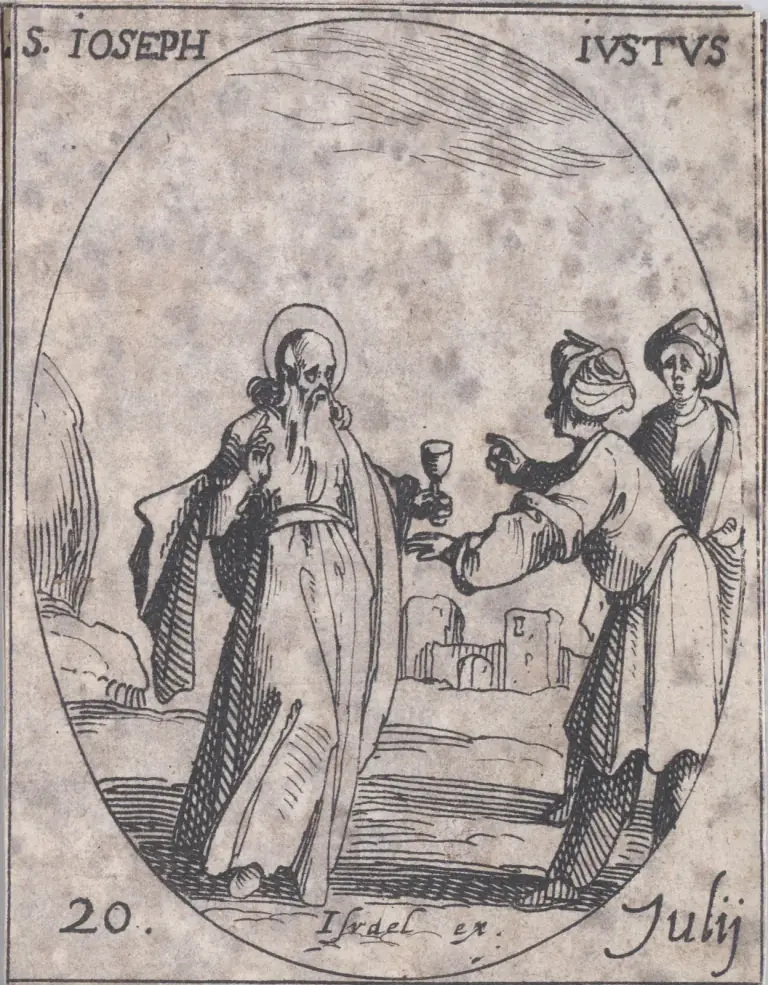
Saint Joseph Barsabbas, surnamed Justus, is the disciple who was proposed with Matthias to take the place of Judas among the Twelve, and was not chosen. 1 The Acts of the Apostles names him once and then says nothing more about him; later tradition says he went on preaching, and an early story told by Papias says he drank poison and was not harmed. 126 His feast is July 20. 67
The election in Acts 1
After the Ascension the apostles returned to Jerusalem and gathered in the upper room with Mary, the women and the brothers of Jesus. 1 "During those days Peter stood up in the midst of the brothers (there was a group of about one hundred and twenty persons in the one place)." 1 Judas was dead, and Peter said that another must take his office. 1
He set one condition. The new apostle had to be "one of the men who accompanied us the whole time the Lord Jesus came and went among us, beginning from the baptism of John until the day on which he was taken up from us," so that he could "become with us a witness to his resurrection." 1 The note in the New American Bible suggests the need to replace Judas came from the number twelve itself, which recalls the twelve tribes of Israel. 1
Two men met the condition. "So they proposed two, Joseph called Barsabbas, who was also known as Justus, and Matthias." 1 The community prayed: "You, Lord, who know the hearts of all, show which one of these two you have chosen." 1 "Then they gave lots to them, and the lot fell upon Matthias, and he was counted with the eleven apostles." 1
That is everything Scripture says about Joseph. He is named first, he has three names where Matthias has one, and he is not mentioned again. 1
Who he was
What the text does establish is the condition he met: he had followed Jesus from the baptism by John to the Ascension, and he had seen the risen Lord. 1 Jacque Eugène Jacquier, writing about Matthias in the Catholic Encyclopedia, describes the two candidates simply as "two disciples." 8
Eusebius of Caesarea, in his Church History, records a tradition that both men belonged to the seventy disciples. He reports it as hearsay: Matthias "and the one who was honored by being made a candidate with him, are likewise said to have been deemed worthy of the same calling with the seventy." 3 Alban Butler's Lives of the Saints states it without qualification: "He was one of the seventy-two disciples of our Lord." 5
Butler also explains the surname. The saint, "from his extraordinary piety, was surnamed the Just." 5 Acts itself says only that he "was also known as Justus." 1
He should not be confused with another Barsabbas in Acts. When the Council of Jerusalem wrote to the church at Antioch, the apostles and presbyters chose "Judas, who was called Barsabbas, and Silas, leaders among the brothers," to carry the letter. 9 None of the sources read for this page says whether the two men were related.
What Chrysostom noticed
Saint John Chrysostom, in his third homily on Acts, read the passage closely. Why only two candidates? "That the feeling of disappointment might not reach further, extending to many." 4 He thought the order of the names meant something too: "it is not without reason that he puts Matthias last; he would show, that frequently he that is honourable among men, is inferior before God." 4
Then he says the thing for which Joseph is remembered in his homily. Matthias filled the place, "but the other candidate was not annoyed; for the apostolic writers would not have concealed" such a failing, having recorded the indignation of the leading apostles themselves more than once. 4 His argument is from silence: had Joseph resented the result, Luke would have said so. 4
Butler, citing the homily, goes a step further and says Joseph "was not displeased, but rejoiced in the Lord to see the preference given to St. Matthias." 5 Chrysostom himself turned the passage on those among his hearers who were seeking office in the Church: "If you believe that the election is with God, be not displeased." 4
The cup of poison
The one story told about Joseph after Acts comes from Papias, bishop of Hierapolis and a contemporary of Philip's daughters, by way of Eusebius. 2 Papias said he had heard wonderful things from the daughters of the apostle Philip, and "he tells another wonderful story of Justus, surnamed Barsabbas: that he drank a deadly poison, and yet, by the grace of the Lord, suffered no harm." 2 Eusebius then identifies this Justus with the man of Acts 1:23. 2
Eusebius passes the story on without vouching for its teller. In the same chapter he says that Papias "appears to have been of very limited understanding, as one can see from his discourses." 2 Butler repeats the miracle "as Papias, and from him Eusebius, testify." 5 The 1897 English edition of the Roman Martyrology says that he received no injury from the poison "because of his confidence in the Lord." 6
After the lot fell
The sources agree that Joseph did not drop out of the work and disagree about where it took him. The 1897 Martyrology says that he went on preaching and growing in virtue, "after having sustained from the Jews many persecutions for the faith of Christ, happily ended his life in Judea." 6 Butler has him preach "the gospel to many nations" after the disciples dispersed. 5 The current Roman Martyrology, in the text published by the Italian bishops, says that although the lot fell to Matthias he gave himself just the same to the ministry of preaching and sanctification, and names no place. 7
No source read for this page gives the year or the manner of his death.
What is Saint Joseph Barsabbas the patron saint of?
Saint Joseph Barsabbas's feast day
Saint Joseph Barsabbas's feast day is July 20. The current Roman Martyrology, as the Italian bishops print it, keeps on that day the commemoration of Joseph called Barsabbas and surnamed the Just, disciple of the Lord, whom the apostles proposed together with Saint Matthias. 7 The 1897 English Martyrology has him on the same day, and so does Butler. 56
Both Martyrologies call him "blessed" in the entry itself, the current one in Italian and the 1897 one in English: "the birthday of blessed Joseph, surnamed the Just." 67 The index of the 1897 edition lists him as "Joseph, St., surnamed the Just," and Butler heads his entry "St. Joseph Barsabas." 56
Praying with Saint Joseph Barsabbas
Joseph met every condition the apostles set. He had been there from the Jordan to the Mount of Olives, and he had seen the risen Christ. 1 The community prayed, the lot fell on someone else, and his name drops out of the story. 1
Chrysostom saw no sign of resentment in the text and took that silence as evidence. 4 The Martyrology's summary says the same thing in another way: he went on doing the work of a disciple as if nothing had been taken from him. 67
Nobody knows what that cost him, and the sources do not pretend to. What they keep is his name, his reputation for justice, and an old story of a cup of poison that did him no harm. 125
Saint Joseph Barsabbas, pray for us.
Sources
- 1.Acts of the Apostles 1, with notes, New American Bible. The Holy See.
- 2.Eusebius of Caesarea, Church History, Book III, chapter 39, translated by Arthur Cushman McGiffert, Nicene and Post-Nicene Fathers, Second Series, vol. 1 (Buffalo: Christian Literature Publishing Co., 1890), as hosted by New Advent.
- 3.Eusebius of Caesarea, Church History, Book I, chapter 12, translated by Arthur Cushman McGiffert, Nicene and Post-Nicene Fathers, Second Series, vol. 1 (Buffalo: Christian Literature Publishing Co., 1890), as hosted by New Advent.
- 4.Saint John Chrysostom, Homily 3 on the Acts of the Apostles, translated by J. Walker, J. Sheppard and H. Browne, revised by George B. Stevens, Nicene and Post-Nicene Fathers, First Series, vol. 11 (Buffalo: Christian Literature Publishing Co., 1889), as hosted by New Advent.
- 5.Alban Butler, "St. Joseph Barsabas, C.," July 20, in The Lives of the Fathers, Martyrs, and Other Principal Saints, Vol. VII (New York: P. J. Kenedy, 1908), Project Gutenberg eBook #49604.
- 6.The Roman Martyrology, July 20 (Baltimore: John Murphy Company, 1897), and its index, "Joseph, St., surnamed the Just, July 20."
- 7.Roman Martyrology, entry for July 20, "Beato Giuseppe, Barsabba il Giusto, discepolo del Signore," Santo del giorno, Conferenza Episcopale Italiana (in Italian).
- 8.Jacque Eugène Jacquier, "St. Matthias," The Catholic Encyclopedia, vol. 10 (New York: Robert Appleton Company, 1911).
- 9.Acts of the Apostles 15, with notes, New American Bible. The Holy See.
Saints to turn to next
Others in this collection who are turned to for some of the same things.
- Saint Agnes of Montepulcianoc. 1268 - April 1317Work and vocationDiscernment
- Saint Albert ChmielowskiAugust 20, 1845 - December 25, 1916DiscernmentWork and vocation
- Saint Andrew Avellino1521 - November 10, 1608DiscernmentWork and vocation
- Saint Angela MericiMarch 21, 1474 - January 27, 1540Work and vocationDiscernment