Saints Jonas and Barachisius
Martyred in Persia, c. 327
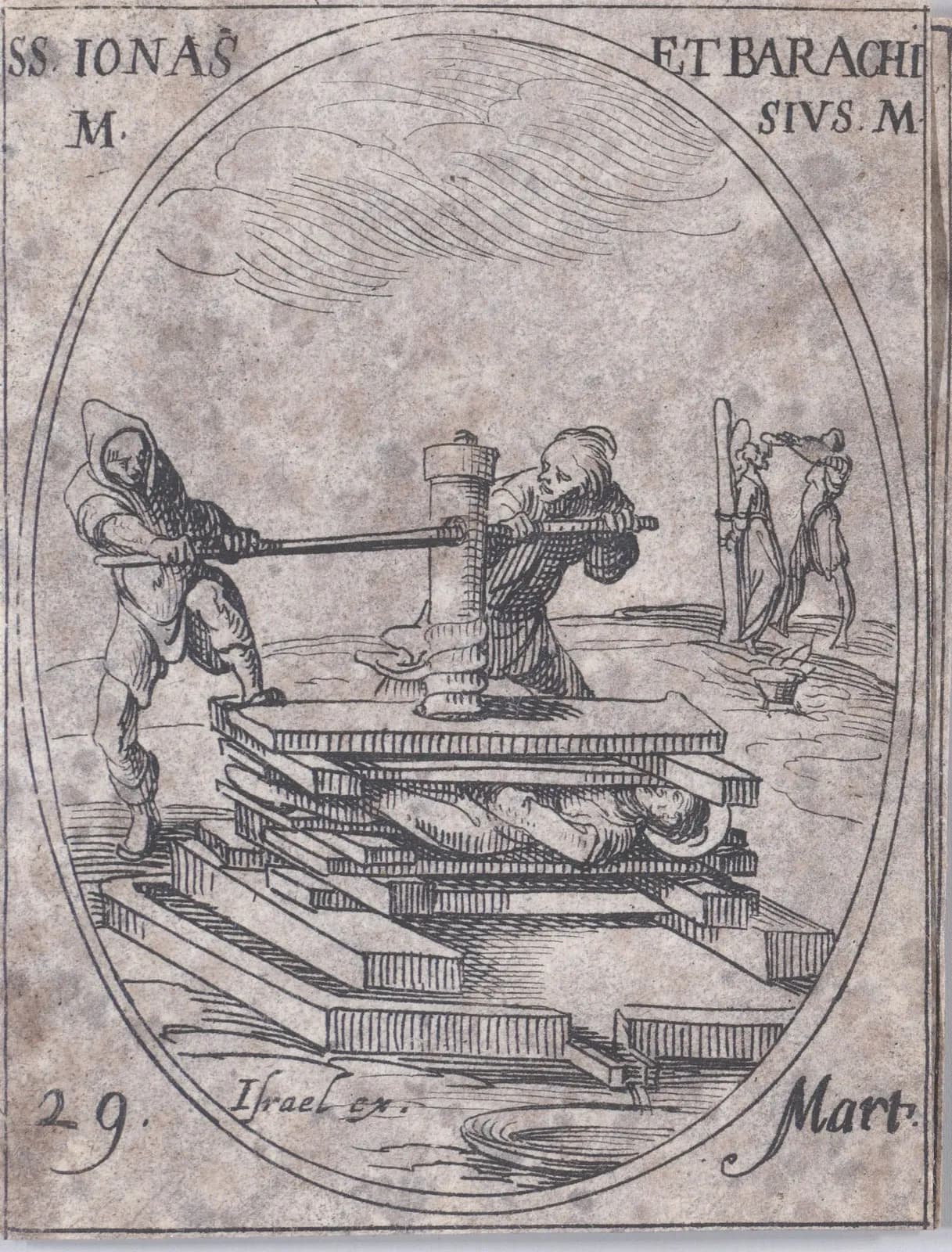
- Also called
- Jonah and Berikjesu, in the East 2
Saints Jonas and Barachisius were brothers, monks from Beth-Asa in Persia, who were tortured to death under King Shapur II for having gone to a prison to encourage nine condemned Christians to die bravely. 12 Their Acts were written by a horseman of the king's guard who, he says, was present at their interrogations and tortures. 1 The Roman Martyrology listed them on March 29; its 2004 edition does not. 12
Shapur's first persecution
Shapur II ruled Persia from 309 to 379, according to the Norwegian bishops' saints database (katolsk.no), and while Constantine was bringing peace to the Church in the Roman Empire, Christians across the border were being persecuted for their faith. 2 Alban Butler, abridging their Acts in his Lives of the Saints, opens with the king's decree: "KING SAPOR, in the eighteenth year of his reign, raised a bloody persecution against the Christians, and demolished their churches and monasteries." 1 katolsk.no adds that the faithful were to be made to sacrifice to the sun and to fire, rewarded if they gave way and tortured if they did not. 2
Jonas and Barachisius were brothers and monks from the small village of Beth-Asa. 12 When they heard that Christians lay under sentence of death in a nearby town, they went there "to encourage and serve them." 1 Butler calls the town Hubaham; katolsk.no calls it Bardiaboc, and in its entry on the other martyrs places it near Dahuk in present-day Iraq. 123
The nine in prison
katolsk.no names the nine whom the brothers found already condemned: Zanitas, Lazarus, Maruthas, Narses, Elias, Habib, Sembeeth, Mares and Sabas. 23 Its entry on them gives the brothers' words in the prison: they did not fear, but stood firm in the name of the Crucified, in the fight in which they too would receive the crown their brothers had won. 3 The nine were executed. 13
Then the brothers were denounced to the same judges, for having urged the others to die. 12 The president asked them mildly to obey "the king of kings, meaning the king of Persia," and to worship the sun, moon, fire and water. 1 Their answer, in Butler's summary, was "that it was more reasonable to obey the immortal King of heaven and earth than a mortal prince." 1 The Magi were offended to hear their king called mortal, and on their advice the brothers were separated. 12
Jonas
Barachisius was shut in a narrow cell, and Jonas was kept back for questioning. 1 When he would not sacrifice, he was laid face down over a stake and beaten with clubs and rods, praying all the while: "I thank you, O God of our father Abraham. Enable me, I beseech you, to offer to you acceptable holocausts." 1 He ended with a confession of faith: "The sun, moon, fire, and water I renounce: I believe and confess the Father, Son, and Holy Ghost." 1 Butler says he was then set in a frozen pond with a cord tied to his foot; katolsk.no says he was bound and left outdoors all night in the winter frost. 12
In the morning the Magi asked how he had passed the night. "From the day I came into the world," he answered, "I never remember a night more sweet and agreeable: for I was wonderfully refreshed by the remembrance of Christ's sufferings." 1 Told that his brother had renounced Christ, he said, "I know that he hath long ago renounced the devil and his angels." 1 When they urged him to save himself, he compared his life to grain: "Our life is a seed sown to rise again in the world to come, when it will be renewed by Christ in immortal light." 1
The judges had his fingers and toes cut off and scattered, and mocked him that he could wait for the harvest to reap new hands from the seed. 1 "Other hands I do not ask," he said. "God is present, who first framed me, and who will give me new strength." 1 He was tortured further, his tongue was cut out, and at last he was crushed in a wooden press and his body sawn apart and thrown into a dry cistern, with guards set over it so that the Christians could not take the relics. 12
Barachisius
Barachisius had been brought out during that first night, after the judge's supper, and told that his brother had sacrificed. 1 He answered that it was impossible, and spoke of God with such eloquence that the Magi said to one another that if he were allowed to speak in public he would draw many from their religion; from then on, Butler says, they questioned him only at night. 1 Red-hot plates and hammers were laid under his arms with the warning that if he shook them off he denied Christ. 1 "I fear not your fire," he replied; "nor shall I throw off your instruments of torture. I beg you to try without delay all your torments on me. He who is engaged in combat for God is full of courage." 1
After Jonas was dead, the judges told Barachisius to spare his own body. 1 "This body I did not frame, neither will I destroy it," he said. "God its maker will again restore it and will judge you and your king." 1 Hormisdatscirus turned to Maharnarsces and said, "By our delays we affront the king. These men regard neither words nor torments." 1 Barachisius was pierced with sharp reeds and rolled on the ground, put into the same press, and killed with boiling pitch and brimstone poured into his mouth. 12 katolsk.no says he died the day after his brother. 2
The eyewitness and the date
An old friend of the brothers bought the remains of all eleven martyrs for five hundred drachmas and three silk garments, and swore never to tell of the purchase. 12 Butler calls him Abtusciatus and katolsk.no Habdisotes. 12 The Acts close by naming their author, "Esaias, son of Adabus of Arzun, in Armenia, of the troop of royal horsemen, who was present at their interrogatories and tortures, and who wrote the history of their conflicts." 1 katolsk.no's entry on the nine thinks the friend who buried them and the author of the Acts were very probably the same man. 3
Butler and katolsk.no say the Acts were written in Chaldaic and published by Stephen Evodius Assemani, katolsk.no adds in Rome in 1748, and that the Greeks "much adulterated" them in Metaphrastes. 12 They also note an old argument over dates: Ruinart and Tillemont held that Shapur began no persecution before his fortieth year, and Assemani argued from these Acts for his eighteenth. 12
Butler gives the day as the 24th of December, 327. 1 katolsk.no's entry on the nine dates the start of the persecution to 326 and the nine martyrs' deaths to that year or the next, the brothers dying two days after them, and notes that others place the whole story in 344. 3
What are Saints Jonas and Barachisius the patron saints of?
Saints Jonas and Barachisius's feast day
Saints Jonas and Barachisius are kept on March 29. 125 Butler writes that "the Roman Martyrology mentions them on the 29th of March," and katolsk.no gives the same date, sometimes together with their companions. 12 ACI Prensa's Spanish calendar of saints also lists them on March 29. 5
The current Roman Martyrology does not include them. katolsk.no says they are not in its newest edition, of 2004, and the Italian bishops' page for March 29, which follows the current Martyrology, does not list them. 24 In the Eastern Church they are remembered on March 28, and the nine companions on their own on March 27. 23
Praying with Saints Jonas and Barachisius
Nobody had arrested Jonas and Barachisius when they walked into that town. 12 They went because nine strangers were going to die and should not have to do it alone, and the help they brought cost them their own lives. 13
Most of what they say in the Acts is short. Jonas, after a night in the frost, calls it the sweetest of his life; with his fingers gone, he says he does not ask for others. 1 Barachisius tells the judges to begin. 1 Butler sums them up in one line: under their worst tortures "they thought they bought heaven too cheap." 1
Butler, closing the chapter, turns their story toward the sickbed, calling times of suffering "the times of the greatest spiritual harvest." 1 The brothers had used the same image of a harvest, of a seed sown so that it can rise. 1
Saints Jonas and Barachisius, pray for us.
Sources
- 1.Alban Butler, "SS. Jonas, Barachisius, and Their Companions, Martyrs," March 29, in The Lives of the Fathers, Martyrs, and Other Principal Saints, Vol. I (New York, 1895), Project Gutenberg eBook #20450.
- 2."De hellige Jonas og Barachisius av Persia (d. 327)," Den katolske kirke (katolsk.no), Catholic Diocese of Oslo (in Norwegian).
- 3."Den hellige Zanitas av Bardiaboch og åtte ledsagere (d. 326)," Den katolske kirke (katolsk.no), Catholic Diocese of Oslo (in Norwegian).
- 4.Roman Martyrology, entries for March 29, as printed in "Santo del giorno," Conferenza Episcopale Italiana (in Italian).
- 5."Santos Jonás y Baraquicio, Mártires," Santoral, ACI Prensa (in Spanish).
Saints to turn to next
Others in this collection who are turned to for some of the same things.