Saint Jonah the Prophet
Eighth century B.C.; date of death unknown
- Name
- Usually taken to mean "dove"; Saint Jerome read it as "complaining" 1
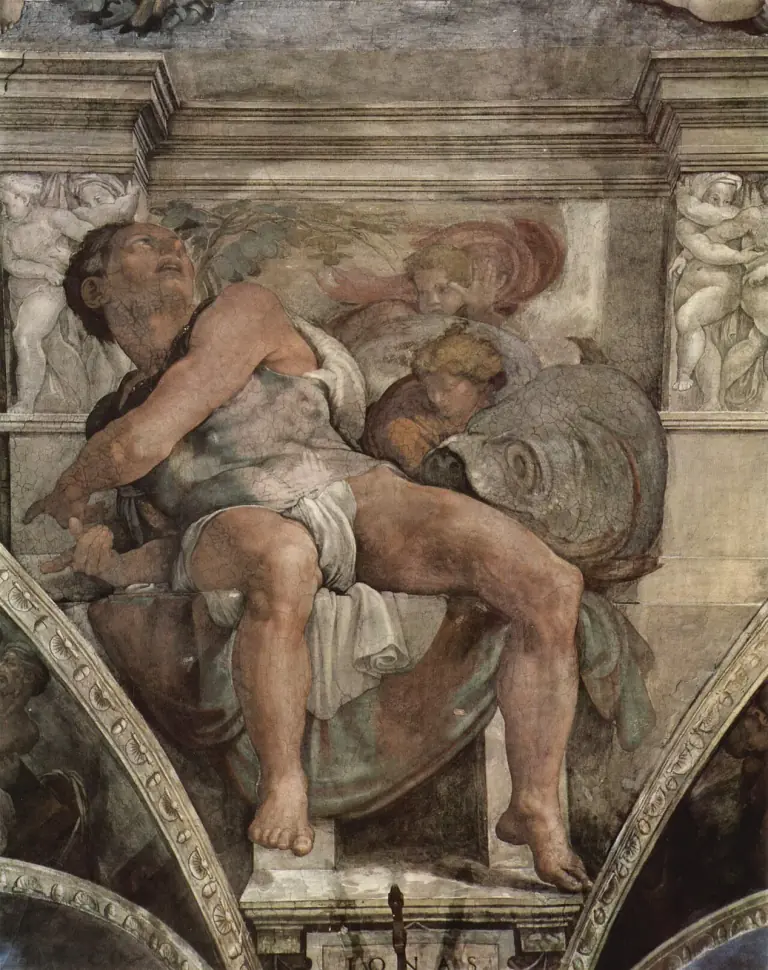
Saint Jonah was the prophet who was sent to Nineveh, ran the other way, spent three days and three nights in the belly of a great fish, and then preached so well that the whole city repented. 456 Christ named him as the sign of his own death and resurrection. 9 The Church remembers him on September 21. 2
Who was the prophet Jonah?
Outside the short book that bears his name, the Old Testament mentions him once. 1 The Fourth Book of Kings says that Jeroboam II, king of Israel, "restored the borders of Israel from the entrance of Emath, unto the sea of the wilderness, according to the word of the Lord the God of Israel, which he spoke by his servant Jonas the son of Amathi, the prophet, who was of Geth, which is in Opher." 8 That places him in the northern kingdom in the eighth century before Christ, and gives him a prophecy of good news for a king whom the same chapter says "did that which was evil before the Lord." 18
Geth in Opher is Gath-hepher, a town in the territory of Zebulun, and the 1910 Catholic Encyclopedia thinks it was probably his birthplace; his grave was still pointed out there in the time of Saint Jerome. 1 The name is usually taken to mean "dove," but the encyclopedia finds it "not unlikely" that Jerome was right to read it as "complaining," given the prophet's complaints in the last chapter. 1
The flight to Tharsis
The book opens with a command: "Arise, and go to Ninive the great city, and preach in it: for the wickedness thereof is come up before me." 4 Nineveh was the capital of Assyria. 4 Jonah went the other way. He "rose up to flee into Tharsis from the face of the Lord," went down to Joppe, paid his fare and boarded a ship. 4 The Douay note says some take Tharsis to be Tarsus in Cilicia, others Tartessus in Spain, others Carthage. 4 Pope Francis, telling the story in 2017, put it simply: Nineveh was in the area of Iraq, "and he fled to Spain, he seriously fled." 11
Why he ran, the book does not say until the end. 7 Francis supplied the background: to an Israelite, Nineveh "was a threatening reality, the enemy which placed Jerusalem itself in peril," a city to be destroyed, "certainly not to be saved." 11 The prophet knew the Lord's goodness and his desire to forgive, and that is why he fled. 711
A great storm came up, and while the sailors cried each to his own god, Jonah lay in the hold "and fell into a deep sleep." 4 They cast lots, the lot fell on him, and he told them to throw him overboard: "for I know that for my sake this great tempest is upon you." 4 They rowed hard for land first and could not reach it. 4 When they threw him in, the sea grew calm, and "the men feared the Lord exceedingly." 4
Three days in the belly of the fish
"Now the Lord prepared a great fish to swallow up Jonas: and Jonas was in the belly of the fish three days and three nights." 5 From there he prayed, and the book gives the prayer as a psalm: "I cried out of my affliction to the Lord, and he heard me: I cried out of the belly of hell, and thou hast heard my voice." 5 Then "the Lord spoke to the fish: and it vomited out Jonas upon the dry land." 5
Saint Cyril of Jerusalem, in his Catechetical Lectures, read the psalm as spoken by a man who knew he was a figure of someone else. Jonah says he is in hell though he is inside a fish, Cyril observes, "for he was a type of Christ, who was to descend into Hades." 13 Cyril did not pretend the comparison was flattering at every point: Christ was sent to preach repentance, and so was Jonah, "but whereas the one fled, not knowing what should come to pass; the other came willingly." 13
The repentance of Nineveh
The word of the Lord came to him "the second time," and this time he went. 6 He walked a day's journey into the city and cried, "Yet forty days, and Ninive shall be destroyed." 6 The people believed God, proclaimed a fast and put on sackcloth "from the greatest to the least." 6 The king himself put on sackcloth and sat in ashes. 6
His decree ends with a question: "Who can tell if God will turn, and forgive: and will turn away from his fierce anger, and we shall not perish?" 6 Francis heard in it the same hope that had made the pagan sailors pray, and noted that the king, "like the ship's captain, gives voice to hope." 11 "And God saw their works, that they were turned from their evil way: and God had mercy with regard to the evil which he had said that he would do to them, and he did it not." 6
An angry prophet and a withered vine
The book does not end with the city saved. It ends with the prophet furious about it. 7 "I beseech thee, O Lord, is not this what I said, when I was yet in my own country? therefore I went before to flee into Tharsis: for I know that thou art a gracious and merciful God, patient, and of much compassion, and easy to forgive evil." 7 Then he asked to die. 7
He went out east of the city, built himself a shelter and sat to see what would happen. 7 God made a plant grow over his head for shade, and Jonah was "exceeding glad" of it; the next morning God sent a worm, the plant withered, and a burning wind and the sun beat on his head until he again wished he were dead. 7
The last word is God's, and it is a question. If Jonah grieved for a plant he had not planted, "shall not I spare Ninive, that great city, in which there are more than a hundred and twenty thousand persons that know not how to distinguish between their right hand and their left, and many beasts?" 7 The book never gives Jonah's answer. 7
The sign of Jonas
When some of the scribes and Pharisees asked Christ for a sign, he answered: "An evil and adulterous generation seeketh a sign: and a sign shall not be given it, but the sign of Jonas the prophet. For as Jonas was in the whale's belly three days and three nights: so shall the Son of man be in the heart of the earth three days and three nights." 9 He went on: "The men of Ninive shall rise in judgment with this generation, and shall condemn it: because they did penance at the preaching of Jonas. And behold a greater than Jonas here." 9 Saint Luke gives the same saying in a shorter form. 10
The current Roman Martyrology's commemoration of Jonah says that his famous coming out of the belly of the fish is read in the Gospel as a foreshadowing of the Lord's Resurrection. 2 Pope Francis, preaching on the Luke reading in 2013, contrasted the sign with what he called "the Jonah syndrome," the attitude of a believer who has no zeal for the conversion of others and says of sinners that they can sort it out for themselves. 12 "The true sign of Jonah," he said, "is the one that gives us confidence in being saved by the blood of Christ." 12
History or parable?
The 1910 Catholic Encyclopedia states that "Catholics have always looked upon the Book of Jonah as a fact-narrative," while noting that some recent Catholic writers leaned toward reading it as fiction. 1 Its case rests on Jewish tradition, on the Fathers, and above all on the words of Christ, who set his own three days in the earth beside Jonah's three days in the fish. 1 "Christ contrasts fact with fact," it argues, "not fancy with fancy, nor fancy with fact." 1
It conceded that the book names no Assyrian king, and answered that this shows only that it is not history "according to later canons of historical criticism." 1 It also noted that the book nowhere claims to have been written by Jonah, and that most modern scholars date its composition much later than his lifetime, probably to the fifth century B.C. 1 Pope Francis, a century later, called the book "a type of parable that bears a great lesson, that of the mercy of God who forgives." 11 This page reports both readings and does not choose between them.
What is Saint Jonah the patron saint of?
Saint Jonah's feast day
Saint Jonah's feast day is September 21. The Roman Martyrology, in the text published by the Italian bishops, commemorates him on that day as the prophet, son of Amittai, whose name is on a book of the Old Testament. 2 The 1897 English edition of the Martyrology also had him on September 21: "In the land of Saar, of St. Jonas, prophet, who was buried in Geth." 3 In both, he shares the day with Saint Matthew the Apostle. 23
Praying with Saint Jonah
Jonah is an odd saint. He refused his mission, slept through a storm he had caused, delivered a one-line sermon, and then sulked because it worked. 467 Pope Francis called him "a rather anomalous figure" among the prophets, one who tried to avoid the Lord's call. 11 The Church keeps his feast anyway. 2
His one long prayer was made in the worst place in the story. From the belly of the fish he describes himself as cast away out of God's sight, and in the same breath says he will see the holy temple again. 5 Francis drew from the sailors and from Nineveh a plainer lesson: people facing death turn to God for help, and God does not despise that kind of prayer. 11
The book ends with an unanswered question about a city full of people who do not know their right hand from their left, and many beasts. 7 It leaves the reader where it leaves Jonah, outside Nineveh, being asked whether God may be merciful to his enemies. 7
Christ took this reluctant man as the sign of his own burial and rising, and said that the people of Nineveh, who repented at Jonah's preaching, would stand in judgment on those who did not repent at his. 910 Cyril saw the difference as clearly as the likeness: one fled, and the other came willingly. 13
Saint Jonah the Prophet, pray for us.
Sources
- 1.James F. Driscoll, "Jonas" (printed by New Advent as "Jonah"), The Catholic Encyclopedia, vol. 8 (New York: Robert Appleton Company, 1910).
- 2.Roman Martyrology, entry for September 21, "San Giona, profeta," Santo del giorno, Conferenza Episcopale Italiana (in Italian).
- 3.The Roman Martyrology, September 21 (Baltimore: John Murphy & Co., 1897).
- 4.Jonas (Jonah) 1, with notes, Douay-Rheims Bible, Challoner revision, as hosted by drbo.org.
- 5.Jonas (Jonah) 2, Douay-Rheims Bible, Challoner revision, as hosted by drbo.org.
- 6.Jonas (Jonah) 3, Douay-Rheims Bible, Challoner revision, as hosted by drbo.org.
- 7.Jonas (Jonah) 4, with notes, Douay-Rheims Bible, Challoner revision, as hosted by drbo.org.
- 8.4 Kings (2 Kings) 14, Douay-Rheims Bible, Challoner revision, as hosted by drbo.org.
- 9.Matthew 12, Douay-Rheims Bible, Challoner revision, as hosted by drbo.org.
- 10.Luke 11, Douay-Rheims Bible, Challoner revision, as hosted by drbo.org.
- 11.Pope Francis, General Audience, "Christian hope - 7. Jonah: hope and prayer," January 18, 2017, Libreria Editrice Vaticana.
- 12.Pope Francis, Morning Meditation in the Chapel of the Domus Sanctae Marthae, "The Jonah Syndrome," October 14, 2013, as reported by L'Osservatore Romano, weekly edition in English, n. 42.
- 13.Cyril of Jerusalem, Catechetical Lecture 14, sections 17-20, Nicene and Post-Nicene Fathers, Second Series, vol. 7 (Buffalo: Christian Literature Publishing Co., 1894), as hosted by New Advent.
Saints to turn to next
Others in this collection who are turned to for some of the same things.