Saint John of the Cross
June 24, 1542 - December 14, 1591
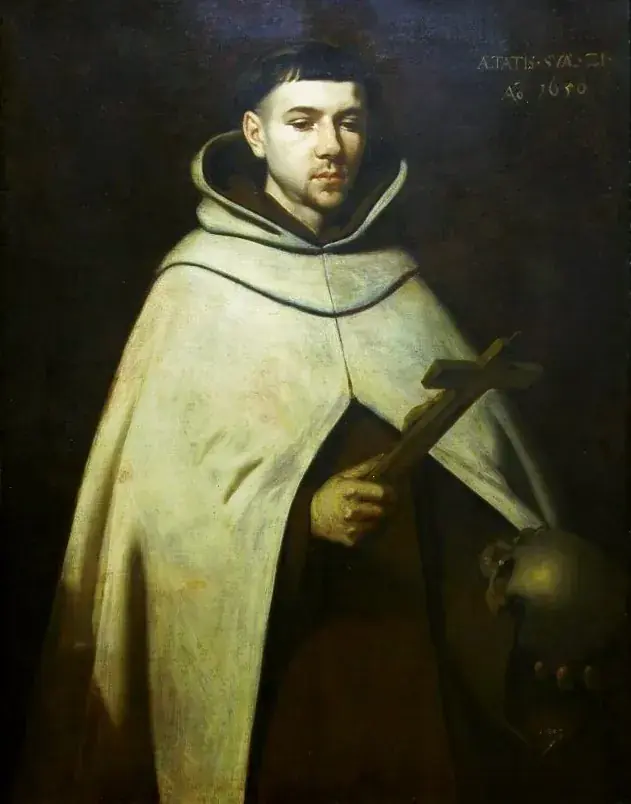
- Patron saint of
- Mystics 2
- Feast day
- December 14 2
- Born
- Fontiveros, near Avila in Old Castile, 1542 1
- Died
- Near Jaen, December 1591 1
- Imprisoned
- At Toledo in 1577 on false charges; escaped August 1578 1
- Canonized
- 1726, by Pope Benedict XIII 1
- Doctor of the Church
- Declared 1926 by Pope Pius XI, titled Doctor mysticus 1
Saint John of the Cross was locked in a cell by his own religious brothers for trying to reform their order, and wrote some of the greatest poetry in the Spanish language while he was in it. He is the Church's authority on what happens when prayer stops feeling like anything - the state he named the dark night, and the reason people who are losing their grip on God are sent to him.
A poor family in Old Castile
John was born in 1542 at Fontiveros, near Avila. His father Gonzalo came from a noble Toledo family and was disowned for marrying Catalina, a humble silk weaver. 1 The family lived in severe hardship, and John grew up poor in a way that was not chosen.
He studied at the Jesuit college at Medina del Campo from the age of eighteen, and in the summer of 1563 began his novitiate with the Carmelites, taking the name Juan de Santo Matia. 1
Teresa
In 1567, after his ordination, he met Teresa of Avila. She explained her plan for reforming Carmel, and he joined it. 1 On 28 December 1568 they opened the first reformed community of friars at Duruelo, and he took the name by which he is known. 1
He was twenty-six. Teresa was in her fifties and had been arguing with the order for years. What she needed was a man of the reform with unimpeachable interior credentials, and she had found one.
Toledo
The reform made enemies inside the order. In 1577 John was seized and imprisoned at Toledo on false charges, and "subjected to physical and moral deprivations." 1 He was held in a cell for months.
He composed the Spiritual Canticle there. 1 He escaped on the night of 16-17 August 1578. 1 The most beautiful thing he wrote was made in the worst place he was ever put, and that fact is inseparable from what he went on to teach.
The dark night
His major works are The Ascent of Mount Carmel, The Dark Night, The Spiritual Canticle and The Living Flame of Love. 1 Together they map the soul's purification and its union with God.
The dark night is his most borrowed and most misunderstood idea. It is not depression and it is not the absence of God. Benedict XVI describes it as God's passive purification, in which the Holy Spirit "consumes every impurity." 1 The lights going out is the work being done, not the work failing - which is precisely the reassurance a person in that state cannot generate on their own.
He died near Jaen in December 1591, was canonized by Benedict XIII in 1726, and was declared a Doctor of the Church by Pius XI in 1926 with the title Doctor mysticus. 1
What is Saint John of the Cross the patron saint of?
John of the Cross is the patron saint of mystics. 2 In practice he is the patron of anyone whose prayer has gone dark and who needs to be told what that means.
Saint John of the Cross' feast day
Praying with Saint John of the Cross
John wrote for the stretch when prayer stops feeling like anything at all. His claim is that the dryness can be God at work rather than God absent, a purification the soul does not perform on itself. 1 Knowing which of the two you are in is the one thing a person in that state cannot work out alone, and it is what he is for.
He was imprisoned by his own Carmelite brothers for trying to reform Carmel, held on false charges, and treated badly. 1 If the opposition in your life is coming from inside the Church, or inside your own community, he knows that particular injury from the inside.
He composed the Spiritual Canticle in the cell. 1 Not afterward, in recovery, with perspective. In it.
Franciscan Media does not soften him, and neither will this. We tend to be rich, soft, comfortable, it says, and we run from the cross; his message is loud and clear, and it is do not, if you really want to live. 2 He is consoling in the harder sense of the word.
Saint John of the Cross, pray for us.
Sources
Saints to turn to next
Others in this collection who are turned to for some of the same things.
- Saint Bridget of Swedenc. 1303 - July 23, 1373PrayerSuffering and illness
- Saint Claude de la Colombiere1641 - February 15, 1682PrayerSuffering and illness
- Saint Gregory of Narekc. 945 - c. 1003PrayerSuffering and illness
- Saint Pio of PietrelcinaMay 25, 1887 - September 23, 1968Suffering and illnessPrayer