Saint Gregory of Narek
c. 945 - c. 1003
- Born
- In a village on the shores of Lake Van, between 945 and 950 1
- Orphaned
- He and his brother were raised by a scholarly uncle, a monk at Narek 1
- Ordained
- 977, in the monastery where he had been educated 1
- His book
- The Book of Lamentations, which he called "an encyclopedia of prayer for all nations" 1
- Declared a Doctor of the Church
- By Pope Francis in 2015, though he belonged to the Armenian Apostolic Church 1
Saint Gregory of Narek wrote a long mystical poem he described as "an encyclopedia of prayer for all nations", and it has since been translated into thirty languages. 1 He spent his whole life in one Armenian monastery and is buried inside its walls. 1 In 2015 Pope Francis declared him a Doctor of the Church - a monk of a Church that has not been in communion with Rome since the fifth century. 1
Lake Van
He was born in a village on the shores of Lake Van between 945 and 950. "When his parents died, Gregor and his older brother were raised by a scholarly uncle who had them educated at the Narek monastery where he was a monk." 1
Franciscan Media notes what Narek was - "a prominent center of learning located in what is now Turkey" - and what happened next, which is nothing dramatic at all. "Gregor too entered the monastery and was ordained in 977." 1 He was educated there as an orphan and stayed for life.
"Little else is known about Saint Gregory of Narek's, other than he died in the early 11th century and was buried within the walls of the Narek monastery where he had spent his life." 1 The USCCB names his rank: Abbot, and Doctor of the Church. 2
An encyclopedia of prayer
He was a professor of theology, wrote a mystical commentary on the Song of Songs, and then wrote the book. 1
"A long mystical poem called the Book of Prayer or the Book of Lamentations. He described his poem as 'an encyclopedia of prayer for all nations.'" 1 It is the claim of a monk in a mountain monastery in the tenth century, writing in a language almost nobody outside Armenia read, that what he was making was for everyone.
"This classic of Armenian literature has been translated into 30 languages." 1 He was not wrong. Franciscan Media adds a detail that shows how far it traveled: "The Russian text of the Book of Lamentations was set to music in 1985." 1
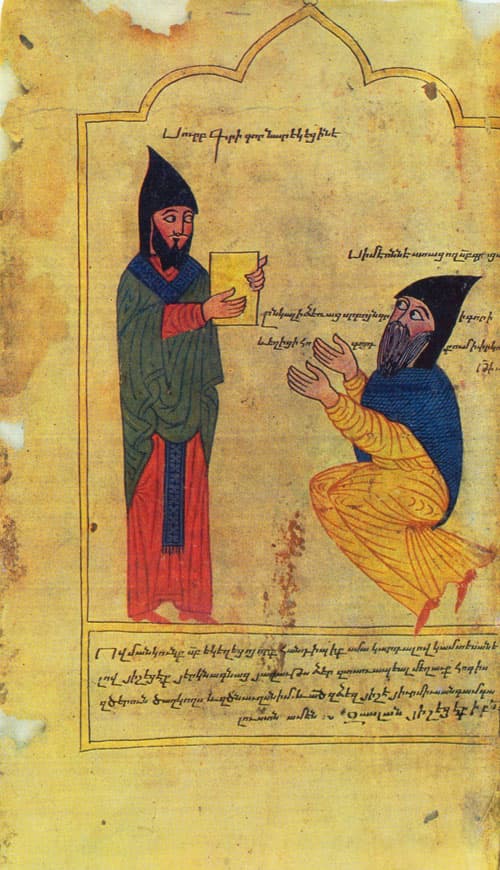
The portrait on this page comes from a copy of that book - a miniature painted in 1391 by the master Tserun at Vaspurakan, showing Gregory handing the volume to the patron who commissioned it. 3
A Doctor from outside
In 2015, as the hundredth anniversary of the Armenian genocide was being observed, "Pope Francis concelebrated a Mass at the Vatican with Patriarch Nerses Bedros XIX Tarmouni and declared the monk, poet, and saint of the Armenian Apostolic Church, Gregory of Narek, a Doctor of the Church." 1
Franciscan Media spells out why that is remarkable, and the profile keeps it rather than glossing over a division. "As opposed to the Armenian Catholic Church that began in the 17th century, the earlier Armenian Apostolic Church did not accept the Council of Chalcedon's 451 teaching that Christ was fully divine and fully human." 1
Gregory belonged to that earlier Church. He is a Doctor of the Catholic Church who was never a Catholic in the sense the word has had since the fifth century.
What made it possible had been laid down long before: "In 1996, St. John Paul II and Apostolic Catholicos Karekin I signed a declaration confirming the common faith of their two Churches." 1 Franciscan Media draws the conclusion the day suggests: "Prayer often unites groups of people who have seen themselves as very distinct - even enemies." 1
What is Saint Gregory of Narek the patron saint of
He belongs to Armenia and to poets, and to anyone who prays badly and keeps at it - the Book of Lamentations is a book of prayers made out of failure and complaint rather than of achieved serenity. 1
No source cited here gives a formal patronage. What the USCCB gives is his rank, which is itself a claim: Abbot, and Doctor of the Church. 2
Saint Gregory of Narek's feast day
The feast of Saint Gregory of Narek is February 27. 12 Franciscan Media states it - "His liturgical feast is celebrated on February 27" - and the USCCB carries the readings for it as an optional memorial in the dioceses of the United States. 12
Its own column runs him on March 27, a month later, which is a publishing slot and not the feast. Vatican News does not list him on February 27; its Saint of the Day calendar is selective, and an absence there is not evidence against a date.
Praying with Saint Gregory of Narek
Almost nothing is known about him. 1 Orphaned, educated by an uncle, ordained at about thirty, died in his fifties, buried in the wall of the house he had lived in since childhood. There is no conversion, no journey, no martyrdom and no office. There is a book.
And the book is a book of lamentations - not a treatise, not a rule, not a defense of anything. A man in a monastery wrote down his prayers, and they were mostly complaints and pleading, and a thousand years later they exist in thirty languages and somebody set them to music.
"An encyclopedia of prayer for all nations." 1 He said that about his own work, in a mountain monastery, in Armenian. It is either the most arrogant sentence a monk ever wrote or an accurate description, and the translation count suggests which.
Then 2015, which he had nothing to do with. A pope declared him a Doctor of the Church across a division that was already four hundred years old when Gregory was born and is still not closed. 1 He was made a teacher of a Church he was never in, on the anniversary of his people being destroyed. Whatever he is patron of, it includes the possibility that the walls you live inside are not final.
Saint Gregory of Narek, pray for us.
Sources
- 1."Saint Gregory of Narek," Saint of the Day, Franciscan Media.
- 2."Readings for the Optional Memorial of Saint Gregory of Narek, Abbot and Doctor of the Church," 27 February, United States Conference of Catholic Bishops.
- 3.Master Tserun, miniature of Gregory of Narek and the patron Simeon, Book of Lamentations, Vaspurakan, 1391, Matenadaran MS 1874, f. 1v.
Saints to turn to next
Others in this collection who are turned to for some of the same things.
- Saint Joseph of CupertinoJune 17, 1603 - September 18, 1663PrayerStudy and teachingSuffering and illness
- Saint Peter Damian1007 - February 21, 1072Study and teachingPrayer
- Saint Bridget of Swedenc. 1303 - July 23, 1373PrayerSuffering and illness
- Saint Claude de la Colombiere1641 - February 15, 1682PrayerSuffering and illness