Saint Joseph of Cupertino
June 17, 1603 - September 18, 1663
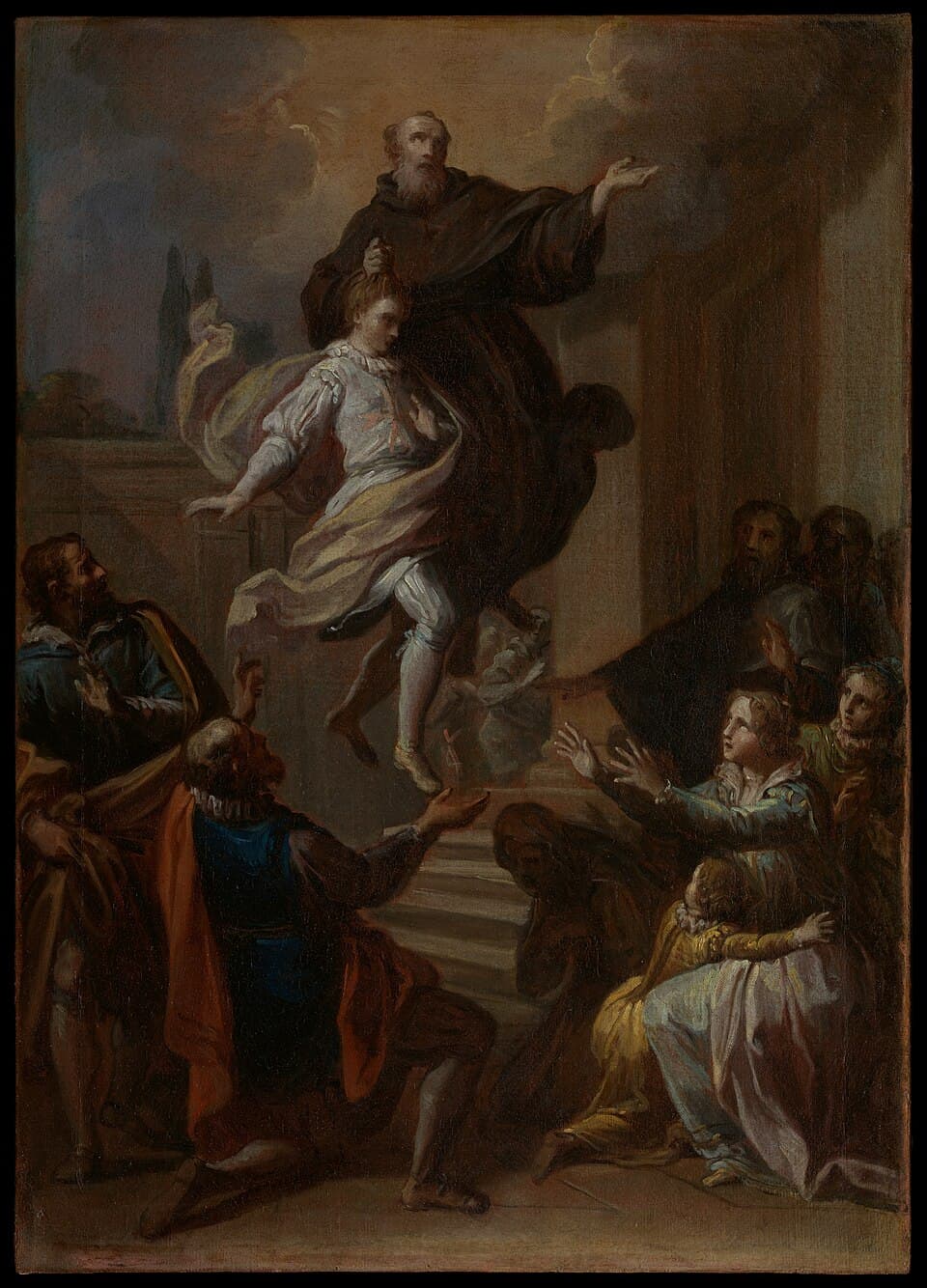
- Patron saint of
- Pilots, air travelers and astronauts, per Franciscan Media 2
- Feast day
- September 18. Mershman gives it outright, and it is the day he died 1
- Born
- In a stable at Cupertino, 17 June 1603, after creditors drove his mother from the house 1
- Refused by
- The Conventual Franciscans, for ignorance, and then dismissed by the Capuchins, whose work his ecstasies made impossible 1
- Kept out of choir
- For thirty-five years, and out of the refectory, processions and the church itself 1
- Investigated by
- The Inquisition. Franciscan Media: "the examiners exonerated him" 2
- On record
- Seventy incidents of levitation, counted in the inquiry before his canonization 2
Saint Joseph of Cupertino was born in a stable because his father's creditors had taken the house, was called Open Mouth by the other children, could barely read, and was thrown out of one religious order and refused by another. 1 He got in as a stable hand. 1 He is remembered because he left the ground when he prayed - and for thirty-five years his community would not let him into the church. 1
Bocca Aperta
His father Felice Desa was a poor carpenter who died before Joseph was born, leaving debts. Mershman: "the creditors drove the mother, Francesca Panara, from her home, and she was obliged to give birth to her child in a stable." 1 He was born on 17 June 1603 at Cupertino, a village between Brindisi and Otranto.
At eight he had an ecstatic vision at school, and it happened again and again. The other children noticed. "Seeing him gape and stare on such occasions, lost to all things about him, [they] gave him the sobriquet 'Bocca Aperta'" - Open Mouth. 1
Mershman adds something that complicates the picture of a naturally gentle mystic: "At the same time he had a hot and irascible temper which his strict mother strove hard to overcome." 1 A bad-tempered boy who kept going blank.
He was apprenticed to a shoemaker. At seventeen he applied to the Conventual Franciscans "and was refused on account of his ignorance." 1 The Capuchins took him as a lay brother in 1620 and let him go again, because "his continual ecstasies unfitted him for work." 1 He could not hold a place in either order.
"His mother and his uncles abused him as a good-for-nothing, but Joseph did not lose hope." 1 By persistence he got permission to work in the stable at the Franciscan convent of La Grotella, near his own village - Franciscan Media calls it "a brief assignment caring for the friary mule." 2 He was taken back where he had been born, into another stable.
It worked. He showed "great virtues, humility, obedience, and love of penance to such an extent that he was admitted to the clerical state in 1625", and was ordained priest on 28 March 1628. 1 Franciscan Media: "Though studies were very difficult for him, Joseph gained a great deal of knowledge from prayer." 2
Mershman puts the same thing more strongly: he "was able to read but poorly, yet infused by knowledge and supernatural light he not only surpassed all ordinary men in the learning of the schools but could solve the most intricate questions." 1 The encyclopedia is reporting what his biographers claimed; what is not in dispute is that he could barely read.
What set him off
Mershman gives an inventory of the triggers, and it is the most vivid paragraph in the article. "Everything that in any way had reference to God or holy things would bring on an ecstatic state: the sound of a bell or of church music, the mention of the name of God or of the Blessed Virgin or of a saint, any event in the life of Christ, the sacred Passion, a holy picture, the thought of the glory in heaven, all would put Joseph into contemplation." 1
A bell was enough. He could not attend an ordinary service without the service itself removing him from it.
And once he was gone he could not be reached. "Neither dragging him about, buffeting, piercing with needles, nor even burning his flesh with candles would have any effect on him - only the voice of his superior would make him obey." 1 People tried all of those. The one thing that brought him back was being told to come back by the man he had vowed to obey.
"Frequently he would be raised from his feet and remain suspended in the air." 1 Franciscan Media records that the inquiry before his canonization documented seventy such incidents. 2
Thirty-five years out of the choir
This is the part that is usually left out, and it is the reason he is worth reading about.
A friar who levitates during Mass is a problem for the Mass. Mershman: "Since such occurrences in public caused much admiration and also disturbance in a community, Joseph for thirty-five years was not allowed to attend choir, go to the common refectory, walk in procession or say Mass in church, but was ordered to remain in his room, where a private chapel was prepared for him." 1
Read that as a sentence about a life rather than a rule. For thirty-five years he did not eat with his brothers, did not sing the Office with them, did not walk in their processions, and did not say Mass in their church. He was a Franciscan kept apart from the Franciscans, by obedience, for the whole of his adult life.
Franciscan Media describes the crowds his gift drew and why it was a burden: "some people came to see this much as they might have gone to a circus sideshow." 2 He was an attraction.
It got worse. "Evil-minded and envious men even brought him before the Inquisition, and he was sent from one lonely house of the Capuchins or Franciscans to another." 1 Franciscan Media: "He was reported to and investigated by the Inquisition; the examiners exonerated him", and "The friars transferred Joseph several times for his own good and for the good of the rest of the community." 2
Through all of it, Mershman says, "Joseph retained his resigned and joyous spirit, submitting confidently to Divine Providence." 1 Franciscan Media is more candid about the cost: his gift "led him to be humble, patient, and obedient, even though at times he was greatly tempted and felt forsaken by God." 2
He fasted severely - "seven Lents of forty days each year, and during many of them tasted no food except on Thursdays and Sundays" - and wore iron chains. 12 He died at Osimo on 18 September 1663, was beatified by Benedict XIV in 1753 and canonized in 1767. 12
What is Saint Joseph of Cupertino the patron saint of?
Saint Joseph of Cupertino is the patron saint of pilots, air travelers and astronauts. 2 The reason is the obvious one and it is not a joke: he is the saint who left the ground, and when people began to do the same by machine they gave him to them.
He is also, and more usefully, the patron of students - particularly students who are struggling, and candidates facing examinations. He was refused entry to an order "on account of his ignorance", could barely read, and found study so hard that his path to the priesthood was a matter of persistence rather than aptitude. 12 A student who is failing has a patron who failed.
And he belongs to anyone whose difference has made them a spectacle. People came to watch him as they would go to a sideshow, and his own community had to keep him out of the church for their sake and his. 12
Saint Joseph of Cupertino's feast day
The feast of Saint Joseph of Cupertino is September 18. Mershman gives it in his opening line - "died at Osimo 18 September, 1663; feast, 18 September" - so the feast falls on the anniversary of the death. 1 Franciscan Media presents him on the same day. 2
His body is in the church at Osimo, in the Marche, where he had been moved in the last of the transfers. 1 He was beatified by Benedict XIV in 1753 and canonized in 1767, a little over a century after he died. 12
Praying with Saint Joseph of Cupertino
Take the extraordinary part out and what remains is a man who was repeatedly told he was not good enough. Refused for ignorance, dismissed for uselessness, called a good-for-nothing by his own mother and uncles, admitted at last to shovel out a stable. 1 Every door he got through, he got through on the fourth or fifth attempt. That is available to anybody, and it is the half of him that usually goes unmentioned because the flying is more interesting.
The flying, meanwhile, ruined his life in the ordinary sense. It kept him out of choir and refectory and church for thirty-five years, brought him before the Inquisition, and turned him into something people came to gawp at. 12 It is a useful corrective to the idea that mystical gifts are rewards. His was a burden his superiors had to manage, and he spent his adult life being moved from house to house because of it.
What he did with that is the thing to imitate. He obeyed. The one thing that could reach him in ecstasy was his superior's voice, and when his superiors shut him away he accepted it. 1 Franciscan Media is honest that this was not serene - he "was greatly tempted and felt forsaken by God." 2 Obedience that costs nothing is not obedience.
And he is the patron of students who cannot do the work. A man who could barely read is invoked before examinations by people who can. 12 There is nothing condescending in that. He knew exactly what it is to sit in a room full of people who find it easy, and to be told, in so many words, that he was too stupid to be admitted.
Saint Joseph of Cupertino, pray for us.
Sources
Saints to turn to next
Others in this collection who are turned to for some of the same things.
- Saint Gregory of Narekc. 945 - c. 1003PrayerStudy and teachingSuffering and illness
- Saint Catherine of AlexandriaDied c. 310Study and teachingSuffering and illness
- Saint Dominic SavioApril 2, 1842 - March 9, 1857PrayerSuffering and illness
- Saint Therese of LisieuxJanuary 2, 1873 - September 30, 1897PrayerSuffering and illness