Saint John of Sahagún
1419 or c. 1430 - June 11, 1479
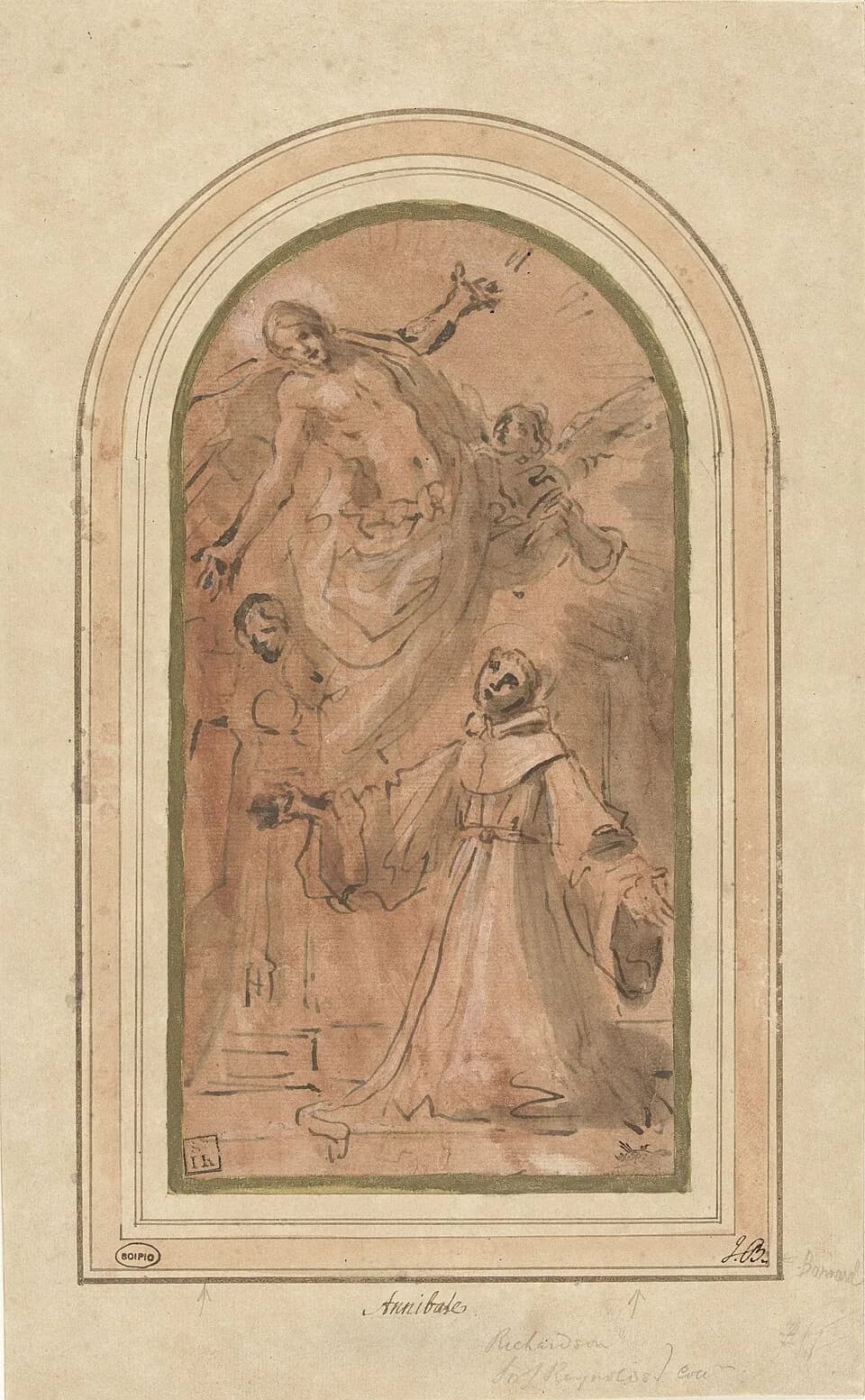
Saint John of Sahagún was a fifteenth-century Spanish priest who gave up a comfortable set of church incomes, joined the Augustinian friars at Salamanca, and spent his last years preaching against the violence and greed of the city's nobles and making peace between its feuding families. 123 His own order credits his efforts with a solemn peace treaty signed by Salamanca's rival factions in 1476. 2 He died there on June 11, 1479, probably poisoned, and is the patron of the city and diocese of Salamanca. 134
A benefice he did not want
He was born at Sahagún, in the Kingdom of Leon, the eldest of seven children of John Gonzalez de Castrillo and Sancia Martinez. 1 Francis Mershman, who wrote the Catholic Encyclopedia article in 1910, gives the year as 1419; the New Catholic Encyclopedia says 1429 and the Midwest Augustinians around 1430. 123 The Benedictines of his home town gave him his first schooling. 13
His father, following the custom of the time, obtained for him the income of a nearby parish, Dornillos. 1 Mershman says this "caused John many qualms of conscience." 1 The Augustinians say he refused the position outright "because he saw it as contrary to God's way," and that his family was very disappointed. 2
Alfonso de Cartagena, Bishop of Burgos, then took him up. Mershman says the bishop "took a fancy to the bright, high-spirited boy," educated him in his own house, gave him several church incomes, ordained him priest in 1445 and made him a canon of the cathedral. 1 He did not keep them. "Out of conscientious respect for the laws of the Church," Mershman writes, he resigned everything but the chaplaincy of St. Agatha. 1 The New Catholic Encyclopedia says simply that he "soon renounced his plural benefices." 3
Salamanca, and the Duke of Alba
He went to the University of Salamanca for four years. 13 Mershman says he took a degree in divinity; the New Catholic Encyclopedia says he studied canon law. 13 For nine years he served the chapel of the College of St. Bartholomew. 1
He preached there as he would for the rest of his life, at the nobility as much as at anyone. The Augustinians record that the Duke of Alba complained: "Father, you do not know how to control your tongue." 2 John's answer, as they give it: "Sir Duke, tell me why did I walk into that Pulpit: To proclaim the truth to all who would listen, or to shamefully praise you? A preacher must be prepared in his soul to speak the truth, both in denouncing and correcting shortcomings and in praising virtue, to such a point that he is willing in that cause even to face death." 2
A vow on the operating table
He had to undergo an operation for a stone, and during the illness he vowed that if he lived he would become a religious. 1 The New Catholic Encyclopedia also says the vow was made before an operation. 3 He recovered in 1463 and asked to join the Hermits of St. Augustine at the church of St. Peter in Salamanca. 1 Parsch, excerpted by Catholic Culture, says he gave the better of his two garments to a nearly naked beggar on the way in, and that the house was then "universally respected because of its strict rule and discipline." 4 He made his profession on August 28, 1464. 1
The friars soon made him master of novices, and in 1471 prior. 1 The New Catholic Encyclopedia gives two terms as prior, 1471 to 1473 and 1477 to 1479, and the Augustinians say he was a delegate to every provincial chapter held while he was in the Order. 23
Peacemaker in a divided city
Salamanca was a city of armed factions. One of his contemporaries, quoted by the Augustinians, said that "Living in Salamanca, where the entire city was split into factions, he succeeded in preventing much bloodshed." 2 The same witness said he was "naturally compelled" to help "the poor and afflicted, exploited widows and children, the needy and the sick" in word and in deed. 2
Mershman says he "obtained wonderful results in doing away with enmities and feuds," and Parsch calls calming passions and restoring peace his special charism. 14 The Augustinians credit his repeated efforts with a "solemn and perpetual peace treaty" that the opposing nobles of Salamanca signed in 1476. 2 The New Catholic Encyclopedia goes as far as to say that "almost single-handedly he reformed Salamanca." 3
He was also a confessor whom it was hard to fool. Mershman says he could see into consciences, "so that it was not easy to deceive him, and sinners were almost forced to make good confessions." 1 The Augustinians say he championed the rights of workers, and the New Catholic Encyclopedia names what he preached against: vice, and "oppression by landlords against their tenantry." 23
Enemies
That preaching cost him. Mershman compares him to John the Baptist, scourging the vices of the day "though thereby the rich and noble were offended." 1 Enemies hired assassins, who, Mershman says, lost their nerve when they saw his face. 1 The New Catholic Encyclopedia names the Duke of Alba among those behind the attempts on his life. 3 After a sermon against extravagant dress, some women of Salamanca insulted him in the streets and threw stones at him until a patrol of guards stopped them. 1
His death is wrapped in the same conflict. Mershman tells of a nobleman who gave up living with his mistress after one of John's sermons; the woman swore revenge, "and it was popularly believed that she caused the saint's death by poison." 1 He is careful to add that "this statement is found only in later biographies." 1 The New Catholic Encyclopedia and Parsch both say he probably died of poisoning, and the Augustinians say his biographer, Friar John of Seville, believed someone poisoned him because of his preaching. 234 He died at Salamanca on June 11, 1479. 123
At the altar
Every source puts the Eucharist at the center of his life. 123 Mershman says that at Mass "he frequently saw the Sacred Host resplendent in glory," and he is pictured holding a chalice and host surrounded by rays of light. 14 The Augustinians say he drew his courage "especially from the daily celebration of the Eucharist." 2 Parsch adds that through his prayers his brother's seven-year-old daughter was raised to life. 4
His cause opened in 1525. 1 Mershman and the Augustinians date his beatification to 1601, the New Catholic Encyclopedia to 1609. 123 Alexander VIII canonized him on October 16, 1690. 1 His relics are in Spain, Belgium and Peru, according to Mershman, and Catholic Culture says his remains lie in the Old Cathedral of Salamanca. 14
What is Saint John of Sahagún the patron saint of?
Saint John of Sahagún's feast day
Praying with Saint John of Sahagún
He had a career handed to him twice. His father found him a parish income as a boy, and a bishop gave him a canon's stall and several more. 1 Each time he let them go, and by Mershman's account it was a matter of conscience about holding several church livings at once. 1 What he kept was a chaplaincy with work in it.
His answer to the Duke of Alba is the best thing recorded of him. 2 He asked the duke what a preacher is for: to tell the truth to whoever will listen, or to flatter the powerful. He gave his own answer at once, and added that a preacher should be ready to die for it. 2 Every source agrees that he went on preaching the same way afterward. 123
He is also a saint of reconciliation in a city at war with itself. 234 What the sources remember is persistence: repeated initiatives, feuds ended one at a time, and a treaty in 1476 that the Augustinians credit to him. 12 Peacemaking here was slow, unflattering work, done by a man some of the parties wanted dead.
Behind all of it, the sources put the Mass. 12 The courage his order describes came from the altar. He went from the altar to the pulpit and from the pulpit to the streets, and his biographer believed it was his preaching that got him killed. 2
Saint John of Sahagún, pray for us.
Sources
- 1.Francis Mershman, "St. John of Sahagun," The Catholic Encyclopedia, Vol. 8 (New York: Robert Appleton Company, 1910).
- 2.Rory Dayton, "Today's Augustinian Saint: St. John of Sahagun," Midwest Augustinians, June 12, 2013.
- 3."Sahagún, John of, St.," New Catholic Encyclopedia, via Encyclopedia.com.
- 4.Catholic Culture, Liturgical Year, June 11, 2025, with an excerpt from Pius Parsch, The Church's Year of Grace.
Saints to turn to next
Others in this collection who are turned to for some of the same things.
- Saint Anthony Mary ClaretDecember 23, 1807 - October 24, 1870Work and vocationCouragePrayer
- Saint Arnold JanssenNovember 5, 1837 - January 15, 1909Work and vocationCouragePrayer
- Saint Ferdinand III of Castilec. 1198 - May 30, 1252Work and vocationCouragePrayer
- Saint Hugh of Grenoble1053 - April 1, 1132Work and vocationCouragePrayer