Saint John Houghton
1487 - May 4, 1535
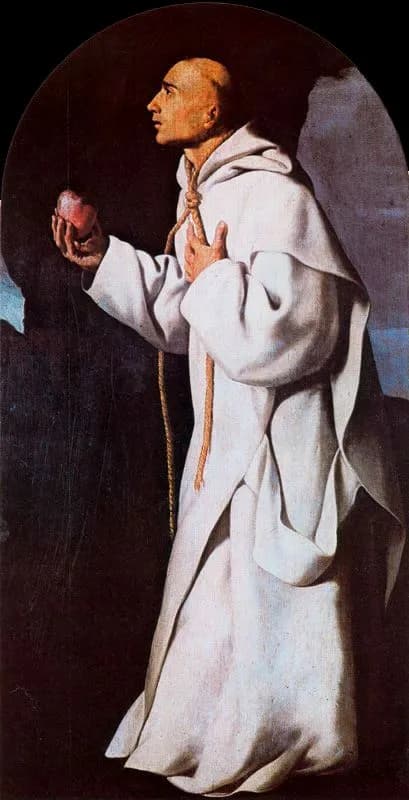
- Born
- In Essex, in 1487 by the encyclopedia's account 1
- Prior
- Of Beauvale, June to November 1531; of the London Charterhouse, 1531-1535 1
- Condemned
- For refusing the oath of supremacy; indicted April 28, 1535 1
- Known as
- Protomartyr of the persecution under Henry VIII 1
Saint John Houghton was the prior of the London Charterhouse, a monastery of hermit monks, and on May 4, 1535, he became the first person put to death for refusing to accept Henry VIII as head of the Church in England. 138 He was hanged, drawn and quartered at Tyburn with two other Carthusian priors, a Bridgettine monk and a parish priest. 14 Paul VI canonized him in 1970 among the Forty Martyrs of England and Wales, and England keeps the feast of all its martyrs on the day he died. 57
From Essex to the Charterhouse
The Catholic Encyclopedia says he was born in Essex in 1487 and educated at Cambridge, where he took degrees in law and later in divinity. 1 Its dates for his youth do not fit together. It has him a bachelor of laws "about 1497" and a priest in 1501, which would make him fourteen at his ordination, and it offers no explanation. 1
Its record of his religious life is fuller. He entered the novitiate at the London Charterhouse in 1505 and was professed in 1516. 1 The house had been founded in 1371 by Sir Walter Manny, one of Edward III's knights. 3 A Carthusian lived alone. Each monk had a small dwelling of his own off the great cloister, with a workroom, a garden and a room for prayer; he wore a white habit, never ate meat, and fasted at least once a week on bread, water and salt. 3 The order's boast, the encyclopedia notes, was that it had never been reformed because it had never grown lax. 3
Houghton held one office after another: sacristan from 1523 to 1528, procurator from 1528 to 1531, then prior of Beauvale in Nottinghamshire for a few months in 1531. 1 Later that year he came back to London as prior, and from 1532 he was provincial visitor as well. 1
The first oath
In 1534 the king required his prominent subjects to acknowledge his marriage to Anne Boleyn and the right of her children to succeed him, and royal commissioners came to the Charterhouse to take the monks' oath. 2 Houghton and his procurator, Humphrey Middlemore, refused and were sent to the Tower of London for about a month. 12
They were then persuaded that the oath could be taken with a condition attached. 2 The encyclopedia gives the condition in Latin, "quatenus licitum esset," as far as it was lawful, and says Houghton swore on those terms with some of his monks on May 29, 1534, the rest following on June 6. 1 Stephanie Mann, writing for Catholic Answers, says the first martyrs "all wanted to please King Henry VIII and his marital ambitions." 5 What they could not do came next.
The Mass of the Holy Spirit
The following year the king asked for an oath acknowledging him as supreme head of the English church. 16 Houghton gathered his monks and celebrated a votive Mass of the Holy Spirit to ask for light. 56 Bess Twiston-Davies quotes an eyewitness: "Suddenly there came from heaven—all of us heard and wondered—a pleasant sound like the voice of a gentle breeze, charming our outward ears as with a sweet breath, and then gently striking them with a softly whispered murmur." 6 The community took it as a sign, and the prior and his companions told the king they could not obey him. 6
On or about April 13, 1535, he was committed to the Tower again. 1 Two other priors were with him: Robert Lawrence of Beauvale, once a monk of the London house, and Augustine Webster of Axholme in Lincolnshire. They had been visiting the Charterhouse, and when the oath was put to them on April 20 they refused it too. 1 In the Tower they were joined by Richard Reynolds, a Bridgettine of Syon and one of the leading scholars of his day. 1
All four were indicted on April 28. The jury at first refused to find them guilty, the encyclopedia records, "but were intimidated by Cromwell into doing so the next day." 1
Tyburn, May 4, 1535
They were dragged across London on hurdles, together with John Hale, the vicar of Isleworth. 14 Thomas More, a prisoner himself, watched them leave the Tower. The Royston parish page has him see them from the Bell Tower "cheerfully going to their deaths as bridegrooms to their marriage"; Twiston-Davies gives the words as spoken to his daughter: "See how the blessed fathers go to their deaths as cheerfully as bridegrooms to a marriage." 46
The encyclopedia says they were hanged in their habits, without first being degraded; the Royston page says they were wearing their priestly vestments. 14 Houghton died first. 14 He was conscious while he was disemboweled, and Mann adds that the executioner had to cut through his hair shirt. 145
His last words come down in three forms, two of them hedged by the writers who report them. The Royston page gives "Good Jesu, what wilt Thou do with my heart?" and says "reportedly"; Twiston-Davies gives "Good Jesus, what will you do with my heart?" and calls it a story; Mann gives "Jesu, what will you do with my heart?" 456 Francisco de Zurbarán's painting of him holding his heart, now in Cádiz, takes its subject from them, and a copy hangs in the martyrs' crypt at Tyburn Convent. 46
Part of his body was nailed to the gate of the Charterhouse as a warning: one of his quarters, by the Royston account, or his arm, by Twiston-Davies's. 46 The warning did not end the resistance. Middlemore, who became vicar of the house, was executed that June with two more monks, and Independent Catholic News counts fifteen further Carthusians put to death in London and York over the next five years. 28
What is Saint John Houghton the patron saint of?
Saint John Houghton's feast day
Saint John Houghton is honored on May 4, the day of his death, which England keeps as the feast of the English Martyrs. 47 The National Calendar for England describes those it honors as the "English Men and Women martyred for the Catholic Faith 1535–1680 and beatified or canonised by the Holy See," and it was raised to the rank of Feast in 2010. 7 The date was chosen because of what happened at Tyburn in 1535. 45
Paul VI canonized him on October 25, 1970, as one of the Forty Martyrs of England and Wales. 59 Mann notes that Wales keeps the martyrs on October 25, and New Advent's note on the encyclopedia calls that date the Forty Martyrs' "joint feast day." 25 The old Charterhouse, long since an almshouse, has held its own commemoration of the Carthusian martyrs every May 4 since 2005. 8
Praying with Saint John Houghton
He was a man who had chosen silence. For thirty years his life was a cell, a garden, the church and the business of a house of hermits, and nothing in the sources suggests he wanted any part in the affairs of the kingdom. 13 The question came to him anyway, twice.
The first time he found a way to say yes. The conditional oath of 1534 is easy to pass over in a martyr's story, but it shows a prior trying to keep his community alive and loyal to the king as far as conscience allowed. 12 The second oath left no room for a condition, and he did not decide alone. He took the question to the altar with his monks and waited for an answer. 56
The sentence that survives from the scaffold is a question addressed to Christ about his own heart. 456 Whatever its exact wording, it is the prayer of someone still talking to God at the last moment.
At the canonization Paul VI prayed that the blood of these martyrs might "heal the great wound inflicted upon God's Church by reason of the separation of the Anglican Church from the Catholic Church." 9 The annual service in the old Charterhouse, where Anglicans, Catholics and Methodists gather while the names of the martyrs are called out, is in the spirit of that prayer. 8
Saint John Houghton, pray for us.
Sources
- 1.John Wainewright, "Blessed John Houghton," The Catholic Encyclopedia, vol. 8 (New York: Robert Appleton Company, 1910).
- 2.H. G. Wintersgill, "Bl. Humphrey Middlemore," The Catholic Encyclopedia, vol. 7 (New York: Robert Appleton Company, 1910), with New Advent's editorial note on the 1970 canonization.
- 3.Henry Birt, "Charterhouse," The Catholic Encyclopedia, vol. 3 (New York: Robert Appleton Company, 1908).
- 4."English Martyrs: Feast Day - 4 May," Roman Catholic Parish of Royston, Diocese of Westminster.
- 5.Stephanie A. Mann, "The Hero Martyrs of England," Catholic Answers Magazine, October 28, 2025.
- 6.Bess Twiston-Davies, "Divorce, Dissolution, and Death: The English Martyrs," Catholic Answers Magazine, July 1, 2006.
- 7."National Calendar for England," Liturgy Office of the Catholic Bishops' Conference of England and Wales.
- 8."Commemoration of Charterhouse Martyrs," Independent Catholic News, May 8, 2012.
- 9.Paul VI, Homily for the Canonization of Forty Martyrs of England and Wales, October 25, 1970 (English and Italian text), vatican.va.
Saints to turn to next
Others in this collection who are turned to for some of the same things.