Saint John Gabriel Perboyre
January 6, 1802 - September 11, 1840
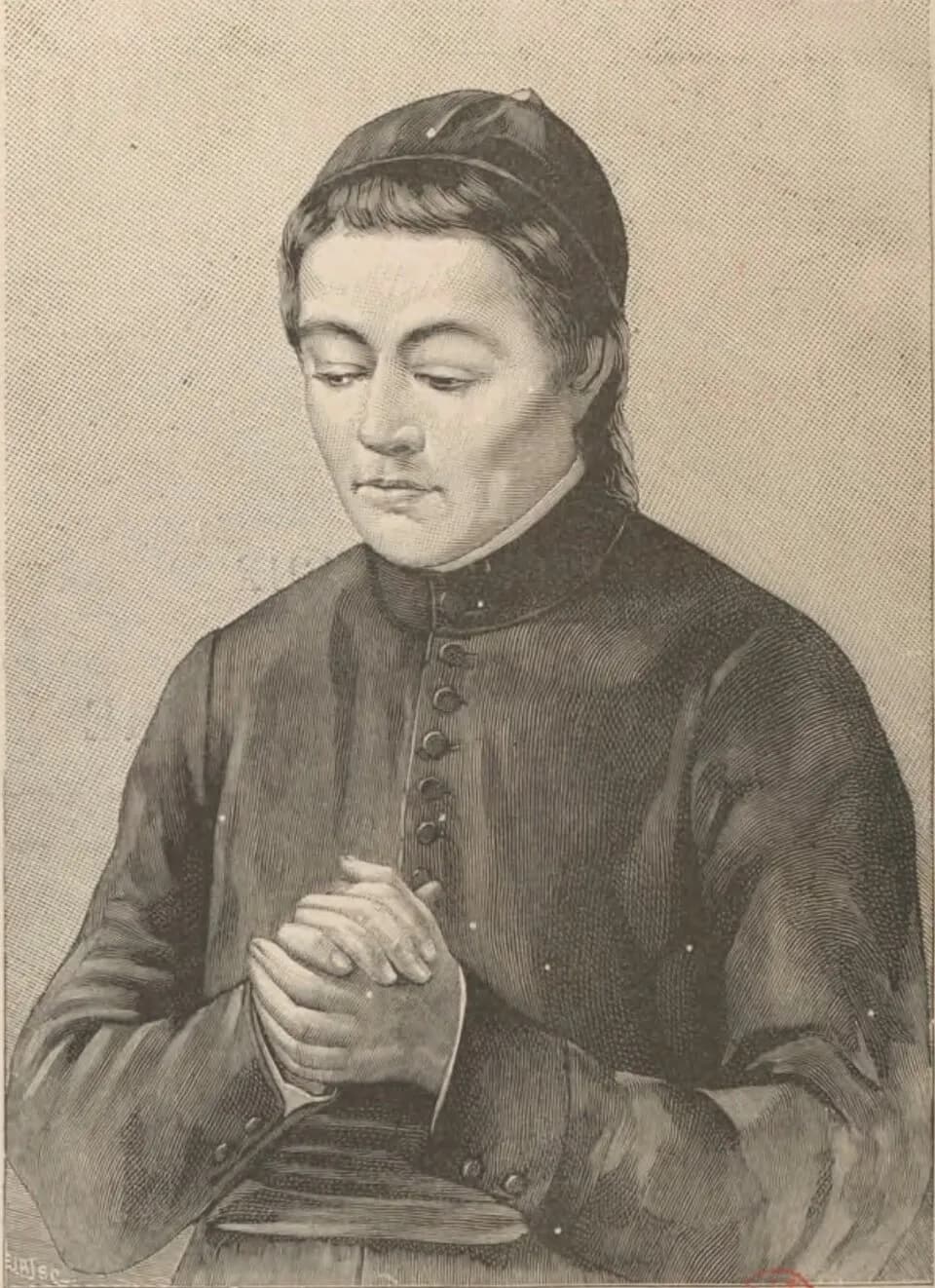
- Beatified
- 1889, by Pope Leo XIII 2
Saint John Gabriel Perboyre was a French Vincentian priest who spent nine years teaching and forming seminarians in France, went to China in 1835 in place of a brother who had died on the way there, and was strangled on a cross at Wuchang on September 11, 1840, after a year of interrogation and torture. 12 John Paul II canonized him on June 2, 1996. 24 His feast is September 11. 26
A family of missionaries
He was born on January 6, 1802, at Montgesty, near Cahors in the south of France, the second of eight children. 12 The family gave the Church an unusual number of its members: three sons became Vincentian priests and two daughters became Daughters of Charity. 12 Two of those sons and one of the daughters, the American Vincentians note, gave their lives to the missions in China. 2
His vocation came sideways. An uncle, Jacques Perboyre, was a Vincentian who ran a minor seminary, and it was the younger brother, Louis, who was sent there to study for the priesthood. 12 John Gabriel was asked to go along for a while until Louis settled in. He was supposed to come home. Instead, the Vatican biography says, he found at the seminary that this was his own path. 1
His parents were surprised and let him go. 1 In 1818 he chose the Congregation of the Mission, which Saint Vincent de Paul had founded in 1625, and he took his vows in 1820. 12 That was the year the Vincentian Francis Regis Clet was put to death in China, and the missions already drew him. 12
Teacher and spiritual director
For years he got no nearer China than a classroom. At the mother house in Paris he taught boys in the boarding school, and as a deacon he taught philosophy at Montdidier, where he organized his students into groups that visited prisoners and the poor with food and clothing. 2
He was ordained a priest in 1826 in the chapel of the Daughters of Charity in Paris, by Bishop William du Bourg, and sent to the seminary of Saint-Flour to teach theology. 2 His superiors then put him in charge of the boarding college there. The work succeeded and wore out his health, and he asked to be relieved. In 1832 he was made assistant spiritual director at the congregation's seminary, where he formed the new Vincentians. 2
In his brother's place
Louis had become a Vincentian too, and asked for China. He died on the voyage, at twenty-four. 1 John Gabriel asked to take his place. The Vatican biography puts it this way: everything Louis had hoped for "would have been useless if John Gabriel had not made the request to replace his brother in the breach." 1
He reached Macao in August 1835. 12 At the gates of China he wrote that he did not know what was ahead of him but expected crosses, the daily bread of a missionary, and asked what better a man could want who was going to preach a crucified God. John Paul II quoted the letter at his canonization. 4
Foreigners were forbidden to enter the empire on pain of death, so he traveled in disguise. 2 The journey inland took eight months by junk, on foot and on horseback. 1 The sources name his first post differently. The Vatican biography says Nanyang in Henan; the American Vincentians say Hunan, and add that he lived in the house from which Clet had been taken prisoner, with a district of nearly 50,000 square miles, six hundred Catholics and three Chinese Vincentian priests to help him. 12 After five months he could make himself understood in Chinese and began visiting the scattered Christian communities. 1
He was then moved to Chayuankou in Hubei, a parish of two thousand Catholics. 12 There he fell into a long desolation, sure that his work was fruitless and that God was displeased with him. 12 In a letter he wrote: "No, I am no more of a wonder man here in China than I was in France." 1 The American Vincentians say that in prayer he experienced Christ speaking to him from the cross, and that it restored him. 2
Arrest
Persecution flared again in 1839, under an old imperial decree against Christianity, at the same time as the Opium War with Britain began. 1 On September 15, 1839, Perboyre was at Chayuankou with another Vincentian, Baldus, a Franciscan named Rizzolati, and a Chinese priest, Father Wang, when word came that about a hundred soldiers were approaching. They did not take the warning seriously until it was too late. 1 The American Vincentians add that the soldiers burned the compound and carried off schoolboys and other Christians. 2
The other two Europeans fled, and Perboyre hid in the bamboo and caves of the hills nearby. 1 The American Vincentians say he and Father Wang, with a group of Christians, hid by day and moved by night. 2 How he was found is told three ways. The American Vincentians say simply that soldiers discovered his hiding place. 2 The Vatican biography, citing Father Baldus, says the soldiers used threats to make a catechumen reveal it, and adds that the man "was a weak person, but not a Judas." 1 The Vincentian curia, listing the likenesses between his death and Christ's, says he "was betrayed by a catechumen, as Jesus was by Judas." 3 He was chained, stripped of most of his clothes and led away. 2
A year of trials
He was tried three times, in three places. At the first hearing he said plainly that he was a priest and preached the Christian religion, and that he would never renounce it. Asked for the names of other Christians, he said nothing. 1 At Siang-Yang he was made to kneel for hours on rusty chains, hung from a rafter by his thumbs and hair, and beaten with bamboo. 1
At Wuchang, where Clet had died, he came before four tribunals and was interrogated twenty times. 12 Christians were forced to abjure in front of him, and one was made to spit on him and strike him. For refusing to trample a crucifix he was given 110 strokes. 1 He was accused of immorality with a Chinese woman, Anna Kao, who had vowed virginity; he denied it, and was distressed that the innocent suffered on his account. 1 Once his judges made him put on Mass vestments, meaning to charge him with abusing his priesthood. Two Christians in the room came forward and asked him for absolution. 1
The viceroy was the harshest of his judges. When Perboyre told him for the last time, "I would sooner die than deny my faith!", he was sentenced to be strangled, and his followers were sold as slaves. 12
The Red Mountain
The sentence needed the emperor's confirmation, and the war with the English removed any chance of clemency. On September 11, 1840, an imperial envoy arrived with the decree. 1 Perboyre was led with seven criminals to a height called the Red Mountain. They were killed first while he prayed. Then the executioners tied him to a post in the form of a cross, passed a rope around his neck and strangled him. 1 He was thirty-eight. 3
Christians buried him on the Red Mountain, and his body was later taken to Saint-Lazare in Paris. 12 The Catholic Encyclopedia, writing in 1911, noted that he and Clet had both been beatified. 5 Leo XIII had beatified him in 1889, and John Paul II canonized him on June 2, 1996. 2 In the homily the Pope joined to his memory all those who had borne witness to Christ in China over the centuries, and spoke of his hope that the blessed martyrs of China might one day be canonized together. 4
What is Saint John Gabriel Perboyre the patron saint of?
None of the sources consulted for this page names Saint John Gabriel Perboyre as patron of anything, and the page does not supply a patronage. 123 The Vincentian curia holds him up as an example for missionaries who meet "trials, difficulties, and misunderstandings," which is as close as the sources come. 3
Saint John Gabriel Perboyre's feast day
His feast is September 11, the day he died. The American Vincentians give it as his feast day, and the Roman Martyrology lists him on that date at Wuchang as a priest of the Congregation of the Mission who took on the dress and customs of the country to preach the Gospel, endured a long imprisonment and many tortures, and was finally hung on a cross and strangled. 26
Praying with Saint John Gabriel Perboyre
The likeness between his death and the Passion is the first thing the sources notice: given up by one of his own, arrested, taken from court to court, falsely accused, and killed on a cross. 13 The Vincentian curia and the Vatican biography both dwell on it. 13 John Paul II said it came from a habit, the daily imitation of Christ in humility and gentleness, carried through to the end. 4
He was not a confident man. The letter the Vatican biography quotes asks his correspondent to pray "first of all for my conversion and my sanctification and then the grace that I do not spoil his work too much." 1 That was written by a missionary whose parish was thriving and who thought he was failing. 2 The biography remarks that from outside it was inconceivable that such a man should be in a dark night. 1
The same biography is careful about the catechumen who gave him away. It calls him weak and refuses to call him a Judas. 1 Perboyre himself, the curia says, "did not respond with hatred, but with faith and forgiveness." 3
The Pope quoted a saying of his at the canonization, that only one thing is necessary, and that it is Jesus Christ. 4 It reads differently coming from a man who had taken 110 strokes sooner than step on a crucifix. 1
Saint John Gabriel Perboyre, pray for us.
Sources
- 1."John Gabriel Perboyre (1802-1840), priest, martyr of the Congregation of the Mission," biography published by the Holy See for his canonization, June 2, 1996.
- 2."Lives of the Vincentian Saints: St. John Gabriel Perboyre, C.M. (1802-1840)," Congregation of the Mission, Western Province (USA).
- 3."Saint John Gabriel Perboyre: Vincentian Martyr, Witness to Christ Crucified," Congregatio Missionis (Vincentian General Curia), September 11, 2025.
- 4.John Paul II, Homily for the Solemnity of the Most Holy Trinity and the Canonization of Jean-Gabriel Perboyre, Egidio Maria di San Giuseppe and Juan Grande Román, June 2, 1996 (in Italian and French).
- 5.Bartholomew Randolph, "Congregation of Priests of the Mission," The Catholic Encyclopedia, vol. 10 (New York: Robert Appleton Company, 1911).
- 6."San Giovanni Gabriele Perboyre, sacerdote," Santo del giorno, 11 settembre, from the Roman Martyrology, Conferenza Episcopale Italiana (in Italian).
Saints to turn to next
Others in this collection who are turned to for some of the same things.