Saint John Calybite
d. about 450
- Emblem
- A beggar holding the book of the Gospels 1
Saint John Calybite was a boy of a wealthy Constantinople family who ran away at about twelve to join the "sleepless" monks, and came home six years later so changed that his parents did not know him. 13 He lived for the rest of his life in a hut at their door on the alms they gave a stranger, and they learned who he was only at his death. 123 His surname comes from the Greek word for that hut. 1 The Norwegian bishops' saints database, which tells his story, adds that it may be less the life of one man than an example of a type. 1
The sleepless monks
According to katolsk.no, the Norwegian bishops' saints database, John was born in Constantinople to well-to-do parents. 1 Butler names his father as Eutropius, "a rich nobleman." 3 At about twelve he ran away from home and became a monk at Gomon on the Bosporus, among the monks called akoimetoi, the "sleepless," founded by Saint Alexander Akimetes. 1 They had the name because they sang the divine office in shifts, without a break, day and night. 1
Joseph Sollier's article on the Acoemetae in the 1907 Catholic Encyclopedia describes the community John would have found. Its founder, Alexander, was "a man of noble birth, who fled from the court of Byzantium to the desert," and came back to Constantinople with three hundred monks to establish the laus perennis, the unceasing praise of God. 5 Driven out of the city by the patriarch Nestorius and the emperor, he finally succeeded in building "at the mouth of the Black Sea the monastery of Gomon, where he died, about 440." 5 The monks kept seven hours of prayer a day, "the literal carrying out of Psalm 118: 'Seven times a day have I given praise to Thee.'" 5
The hut at the gate
Then he went home, dressed as a beggar. katolsk.no says his appearance had changed so much that his parents did not recognize him. 1 Butler says he "returned disguised in the rags of a beggar, and subsisted by the charity of his parents, as a stranger, in a little hut near their house; hence he was called the Calybite." 3 katolsk.no gives the Greek word, kalybe, a hut, and the forms of the name that grew from it: Kalabytes, Calabytes, Calybites, Calybita. 1
The Roman Martyrology tells it a little differently. In its entry, by tradition he lived for a time in a secluded corner of his father's house and then in a hovel called the kalybe, wholly given to contemplation and hidden from the sight of his own parents. 2 Butler adds only that "he sanctified his soul by wonderful patience meekness, humility, mortification, and prayer." 3
He lived there, on their charity and unknown to them, until he died, about the year 450. 13
Recognized at the end
The sources differ over how his parents learned the truth. katolsk.no says that at last he revealed his identity to his mother, who agreed that he could be buried under the hut. 1 Butler has the same: "He discovered himself to his mother, in his agony, in the year 450, and, according to his request, was buried under his hut." 3 The Martyrology says his parents recognized him only after his death, thanks to a golden book of the Gospels they had given him. 2
His parents built a church over the grave. 13 Butler calls it "a stately church," and adds that the Byzantine chronicler Cedrenus, who places it in the western quarter of the city, "calls it the church of poor John," while Zonaras calls it "the church of St. John Calybite." 3
Butler is unsure of the reign. A manuscript life commended by Cardinal Baronius puts him under Theodosius the Younger, who died in 450; Nicephorus puts him under Leo, proclaimed emperor in 457, "so that both accounts may be true." 3
From Constantinople to Rome and Besançon
His relics were later taken to Rome, katolsk.no says. 1 Butler describes an old church bearing his name "near the bridge of the isle of the Tiber," which an inscription said was built by Pope Formosus, who died in 896, together with a hospital. 3 From that, the scholar Du Cange inferred that the body had been carried from Constantinople to Rome before the iconoclast controversy. 3 In Butler's day the church and its hospital were in the hands of the Brothers of Saint John of God. 3
His head, Butler says, stayed at Constantinople until the Latins took the city in 1204, and soon afterward was brought to Besançon in Burgundy, where it was kept in the church of Saint Stephen "with a Greek inscription round the case." 3
A story told more than once
The same story is told of other saints. katolsk.no names Saint Alexius and Saint Onesimus among them and concludes that John's story is perhaps more an example of a type than the life of one person. 1
The best known of those other tellings is the legend of Alexius, a Roman who left home on his wedding night and came back years later to live as a beggar under the stairs of his father's palace, unknown to his family until a document found on his body after his death revealed who he was. 4 J.P. Kirsch, writing on Alexius in the Catholic Encyclopedia, traces that legend to Syriac and Greek sources and suggests that its Greek author "probably had in mind also the events related in the life of St. John Calybata, a young Roman patrician, concerning whom a similar story is told." 4 Kirsch makes him a Roman; every other source read here places him in Constantinople. 123
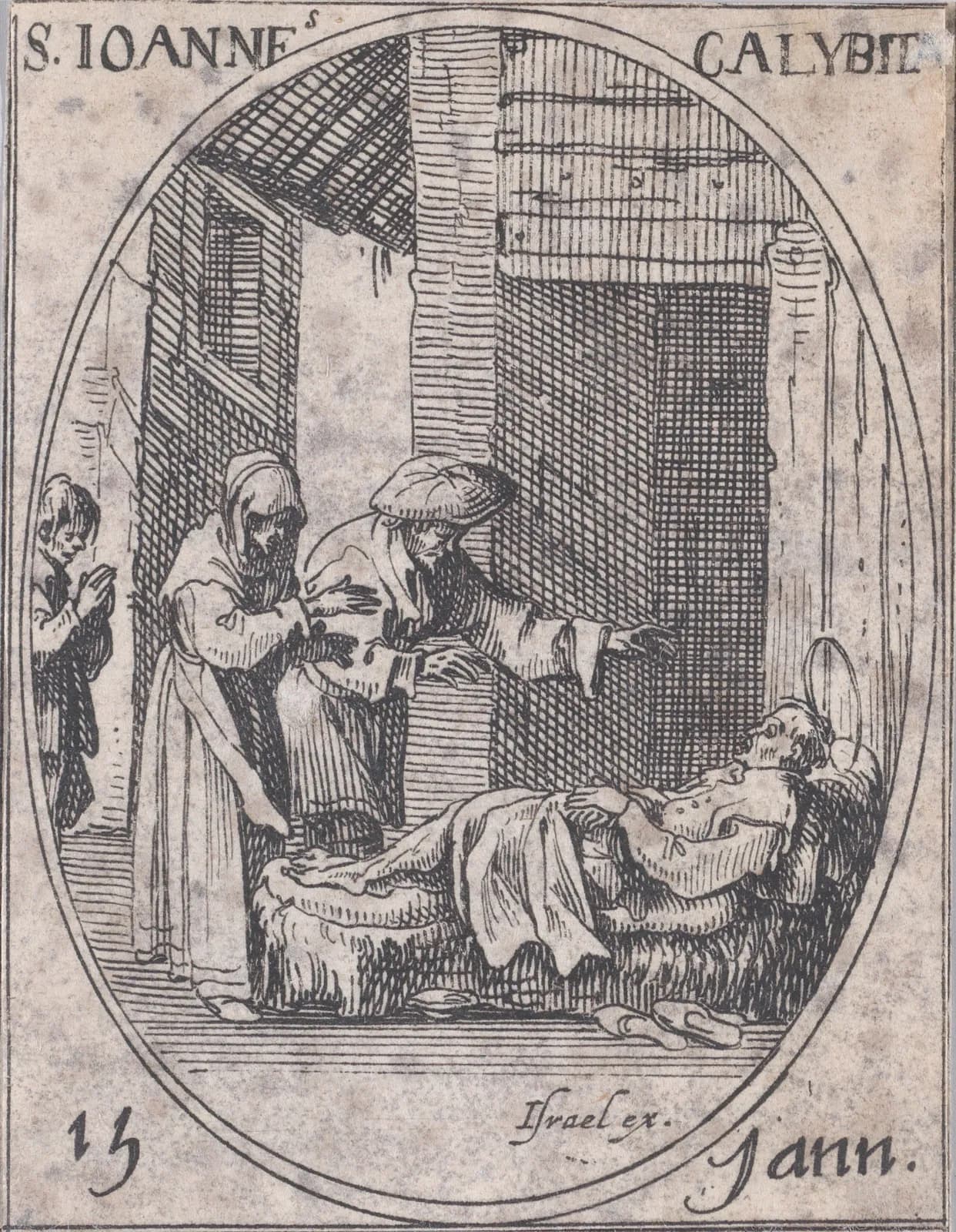
Painters show John as a beggar with the Gospel in his hand, katolsk.no says, and sometimes on his deathbed revealing himself to his parents. 1 Jacques Callot's 1636 etching above is the second kind: the dying man on his straw bed, with his mother and father reaching toward him.
What is Saint John Calybite the patron saint of?
None of the sources consulted names a patronage for Saint John Calybite. Butler records that the church built in his name at Rome stood beside a hospital, later run by the Brothers of Saint John of God. 3
Saint John Calybite's feast day
Praying with Saint John Calybite
Most stories of a runaway son end with the father running out to meet him. John's does not. He came back to his parents' door and let them treat him as a stranger, and they fed him as one for years. 13
The sources do not explain why, and it is hard to read. It may be that the story is less about a family than about hiddenness: a life of prayer lived a few steps from everything he had given up, with no one watching. 12 The Martyrology's version puts it that way, a man wholly given to contemplation and hidden from the eyes of his own parents. 2
At the end, by every account, the hiding stopped. Whether he told his mother himself or they knew him by the Gospel book they had given him as a boy, they buried him where he had lived and built a church over him. 123
Saint John Calybite, pray for us.
Sources
- 1."Den hellige Johannes Kalabytes (-~450)," Den katolske kirke (katolsk.no), Catholic Diocese of Oslo (in Norwegian).
- 2.Roman Martyrology, entry for January 15, "San Giovanni Calibíta," as printed in "Santo del giorno," Conferenza Episcopale Italiana (in Italian).
- 3.Alban Butler, "St. John Calybite, Recluse," January 15, The Lives of the Fathers, Martyrs, and Other Principal Saints, Vol. I.
- 4.J.P. Kirsch, "St. Alexius," The Catholic Encyclopedia, Vol. 1 (New York: Robert Appleton Company, 1907).
- 5.Joseph Sollier, "Acoemetae," The Catholic Encyclopedia, Vol. 1 (New York: Robert Appleton Company, 1907).
Saints to turn to next
Others in this collection who are turned to for some of the same things.
- Saint Alexius of RomeFifth century, by traditionPoverty and simplicityMarriage and familyPrayer
- Saint CunegundeDied March 3, 1040Marriage and familyPoverty and simplicityPrayer
- Saint Germaine Cousin1579 - 1601Marriage and familyPoverty and simplicityPrayer
- Saint Hedwig of Silesiac. 1174 - October 1243Marriage and familyPoverty and simplicityPrayer