Saint Joel the Prophet
Dates unknown
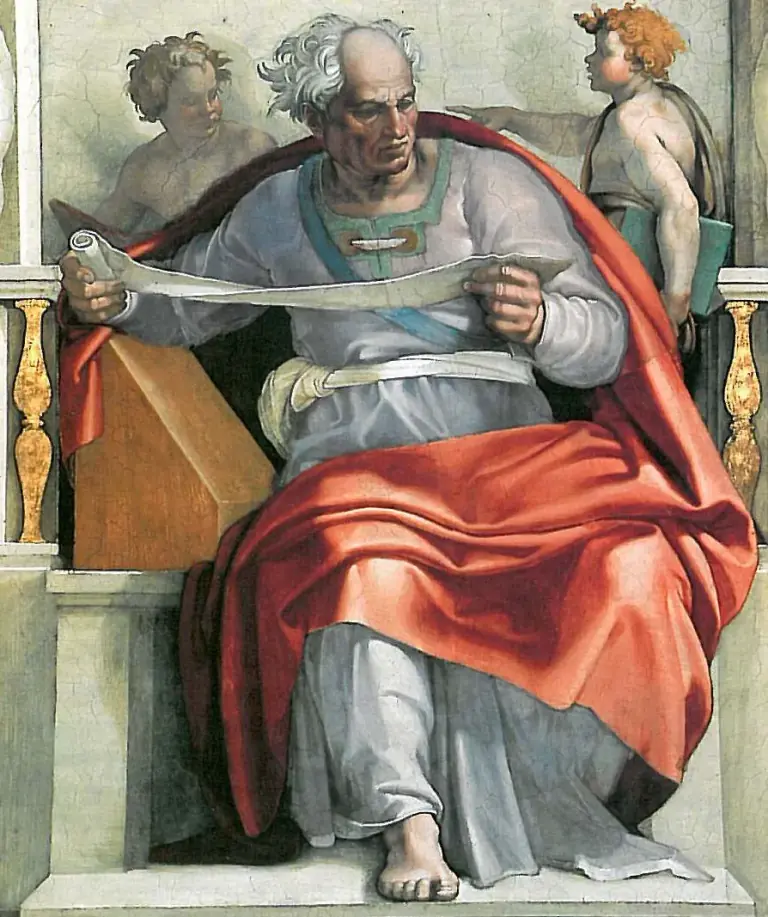
- Book
- The Prophecy of Joel, second of the twelve Minor Prophets; three chapters in the Vulgate and Septuagint, four in the Hebrew 1
Saint Joel was a prophet of Judah, the son of Phatuel, of whom nothing is known but a short book of three chapters. 13 Two passages from it are familiar to Catholics: the call to "rend your hearts, and not your garments," read at the start of Lent, and the promise "I will pour out my spirit upon all flesh," which Saint Peter quoted on the day of Pentecost. 1467 The Church keeps his memory on October 19. 2
Who was the prophet Joel?
His book opens with a single line about its author: "The word of the Lord that came to Joel the son of Phatuel." 3 That is all Scripture says of him. Michael Faulhaber, writing in the Catholic Encyclopedia in 1910, begins his article with the plain admission, "Nothing is known of his life." 1 ACI Prensa's introduction to the book says the same: outside the three chapters of prophecy that bear his name, we know nothing of him. 10
A little can be read from the book itself. Faulhaber thinks he worked in the southern kingdom of Judah and probably in Jerusalem, because he refers again and again to the temple and the altar. 1 He speaks directly to the priests more than once, telling them to put on sackcloth and to weep between the porch and the altar, and from this Faulhaber infers that Joel was "himself of priestly descent." 134
The locusts
The book begins with a disaster. "That which the palmerworm hath left, the locust hath eaten: and that which the locust hath left, the bruchus hath eaten: and that which the bruchus hath left, the mildew hath destroyed." 3 The vines are stripped, the fig trees barked, the grain and the oil gone, and even the offerings in the temple have stopped, because there is nothing left to offer. 13 "The beasts of the field have looked up to thee," the prophet says, "as a garden bed that thirsteth after rain." 3
In the second chapter the plague becomes an army: "They shall run like horsemen ... like men of war they shall scale the wall," and the sun and moon are darkened before it. 4 Readers have long asked what the locusts are. Faulhaber is firm that they were a real swarm, the scourge of the prophet's own day, and that the army is a figure for the insects rather than the other way round; from that present plague Joel passes to "the evils of the day of judgment." 1 ACI Prensa also takes the plague as real but reads it as a figure of Israel's humiliation by the nations. 10 The notes in the Douay-Rheims record both readings: some take the passage literally, and others understand it of the invasions of the Chaldeans. 34
"Rend your hearts, and not your garments"
The prophet's answer to the disaster is a fast. "Sanctify ye a fast, call an assembly; gather together the ancients, all the inhabitants of the land into the house of your God: and cry ye to the Lord." 3 The second chapter repeats it with more urgency, and it is the best-known passage in the book: "Be converted to me with all your heart, in fasting, and in weeping, and in mourning. And rend your hearts, and not your garments, and turn to the Lord your God: for he is gracious and merciful, patient and rich in mercy, and ready to repent of the evil." 4
Nobody is to be left out of the assembly. The old men are to come, and the little children, "and them that suck at the breasts," and even the bridegroom and the bride are to leave their chamber. 4 The priests are given their prayer: "Spare, O Lord, spare thy people: and give not thy inheritance to reproach, that the heathen should rule over them. Why should they say among the nations: Where is their God?" 4
Faulhaber notes that these passages "are still used in the Liturgy of the Church during Lent." 1 This passage of the second chapter is the first reading of Ash Wednesday. 7 On that day in 2013, the last of his pontificate, Benedict XVI told the congregation in Saint Peter's that "the Church repeats to us the powerful appeal which the prophet Joel addressed to the people of Israel," and he dwelt on the words "with all your heart." 7 People are ready enough to rend their clothing over scandals that are someone else's fault, he said, "but few seem prepared to do something about their own 'hearts'." 7 He pointed to the whole people summoned in the reading, old and young together, as a reminder that "we do not take up the path of repentance alone." 7
The Spirit poured out
After the fast, the book turns. "The Lord hath been zealous for his land, and hath spared his people." 4 Rain returns, the threshing floors fill with wheat, and God promises to restore "the ears which the locust, and the bruchus, and the mildew, and the palmerworm have eaten." 4 Faulhaber reads the turn as the heart of the book: the judgment is a purification that prepares the people for salvation, and the plenty that follows is a picture of "the fullness of grace in the kingdom of grace." 1
Then comes the promise for which Joel is chiefly remembered. "And it shall come to pass after this, that I will pour out my spirit upon all flesh: and your sons and your daughters shall prophesy: your old men shall dream dreams, and your young men shall see visions. Moreover upon my servants and handmaids in those days I will pour forth my spirit." 4 It ends, "every one that shall call upon the name of the Lord shall be saved." 4
Joel at Pentecost
On the morning of Pentecost the apostles were heard speaking in the languages of every nation in Jerusalem, and some in the crowd mocked them: "These men are full of new wine." 6 Peter stood up with the eleven and answered that it was only the third hour of the day. "But this is that which was spoken of by the prophet Joel," he said, and recited the prophecy of the Spirit to its last line, "whosoever shall call upon the name of the Lord, shall be saved." 6 About three thousand were baptized that day. 6
Faulhaber calls this passage "the first Biblical text of the first Apostolic sermon." 1 The Roman Martyrology remembers Joel for exactly this: it commemorates him as the prophet who announced the great day of the Lord and the outpouring of his Spirit on every person, which God fulfilled in Christ on the day of Pentecost. 2 The Byzantine Catholic Menaion uses the same words in English, and its hymn for his day sings, "Just as the prophet Joel announced the Spirit, receiving inspiration from him, so has the Spirit of God been poured forth over us the faithful." 8
The valley of Josaphat
The last chapter is a judgment on the nations that scattered God's people, sold their children and carried off the treasures of his house. 5 "Let the nations come up into the valley of Josaphat: for there I will sit to judge all nations round about. Put ye in the sickles, for the harvest is ripe." 5 Faulhaber thinks some of these "fiery pictures" were borrowed by the writer of the Apocalypse, and points to the harvest of Apocalypse 14:15. 1
The book ends in peace. "The mountains shall drop down sweetness, and the hills shall flow with milk," and "a fountain shall come forth of the house of the Lord." 5 Faulhaber considered Joel's pages on the day of judgment and the abundance of grace "one of the most beautiful pages in the eschatology of the Prophets," and his language "full of colour, rhetorically animated, and rhythmic." 1
When did Joel live?
His book gives no date, names no king and mentions no event that a historian can fix. 1 Faulhaber calls the date "the most difficult problem" the book poses. The early commentators, following Jerome, made Joel a contemporary of Hosea and Amos in the eighth century before Christ, partly because his book stands between theirs. 1 Others placed him under King Josiah, alongside Zephaniah, who also preaches the day of the Lord; later scholars put him after the Exile. 1 Faulhaber concludes that "none of the chronological hypotheses concerning Joel can claim to possess convincing proof." 1
ACI Prensa leans toward an early date. Because the book speaks of priests and never of a king, it suggests that Joel wrote under King Joash of Judah (836-797 B.C.), while the high priest Jehoiada governed in the name of the boy king; a minority of scholars, it adds, place him after the Exile, chiefly because the third chapter mentions the Greeks. 10
What is Saint Joel the patron saint of?
Saint Joel's feast day
Saint Joel's feast day is October 19. The Roman Martyrology, in the text published by the Italian bishops, commemorates him on that date. 2 The Byzantine Catholic Menaion of the Archeparchy of Pittsburgh keeps him on the same day, with its own troparion: "You knew beforehand the appearance of God in the flesh, and the descent of the Holy Spirit. You announced the impending judgment, O prophet Joel." 8
The older Roman Martyrology kept him on July 13. The 1897 English edition records on that day "the Saints Joel and Esdras, prophets," joining him to Ezra. 9
Praying with Saint Joel
Joel is a prophet without a biography. 110 What has come down is what he said, and the Church has kept saying it: every Ash Wednesday, the call to return "with all your heart" is read aloud again. 17
His call to repentance came in a ruined year, with the fields bare and the altar empty. 3 He did not tell the people to wait for better times before they prayed. He told them to gather everyone, old men and infants and newly married couples, and to weep together before the altar. 4 Benedict XVI drew from that crowd the reminder that no one repents alone. 7
The promise that follows is larger than the disaster. Joel asks for rain and a harvest, and the book goes on to speak of the Spirit poured out on sons and daughters, on old men and young, on servants and handmaids. 4 Centuries later Peter stood up in Jerusalem and said that this was happening in front of them. 6
Saint Joel the Prophet, pray for us.
Sources
- 1.Michael Faulhaber, "Joel," The Catholic Encyclopedia, vol. 8 (New York: Robert Appleton Company, 1910).
- 2.Roman Martyrology, entry for October 19, "San Gioele, profeta," Santo del giorno, Conferenza Episcopale Italiana (in Italian).
- 3.Joel 1, Douay-Rheims Bible, Challoner revision, as hosted by drbo.org.
- 4.Joel 2, Douay-Rheims Bible, Challoner revision, as hosted by drbo.org.
- 5.Joel 3, Douay-Rheims Bible, Challoner revision, as hosted by drbo.org.
- 6.Acts of the Apostles 2, Douay-Rheims Bible, Challoner revision, as hosted by drbo.org.
- 7.Benedict XVI, Homily for Ash Wednesday, Vatican Basilica, February 13, 2013, The Holy See.
- 8."Menaion - October 19," Metropolitan Cantor Institute, Byzantine Catholic Archeparchy of Pittsburgh.
- 9.The Roman Martyrology, July 13 (Baltimore: John Murphy & Co., 1897), Internet Archive.
- 10."Joel," introduction to the book, Biblia, ACI Prensa (in Spanish).
Saints to turn to next
Others in this collection who are turned to for some of the same things.