Saint Joan of Valois
April 23, 1464 - February 4, 1505
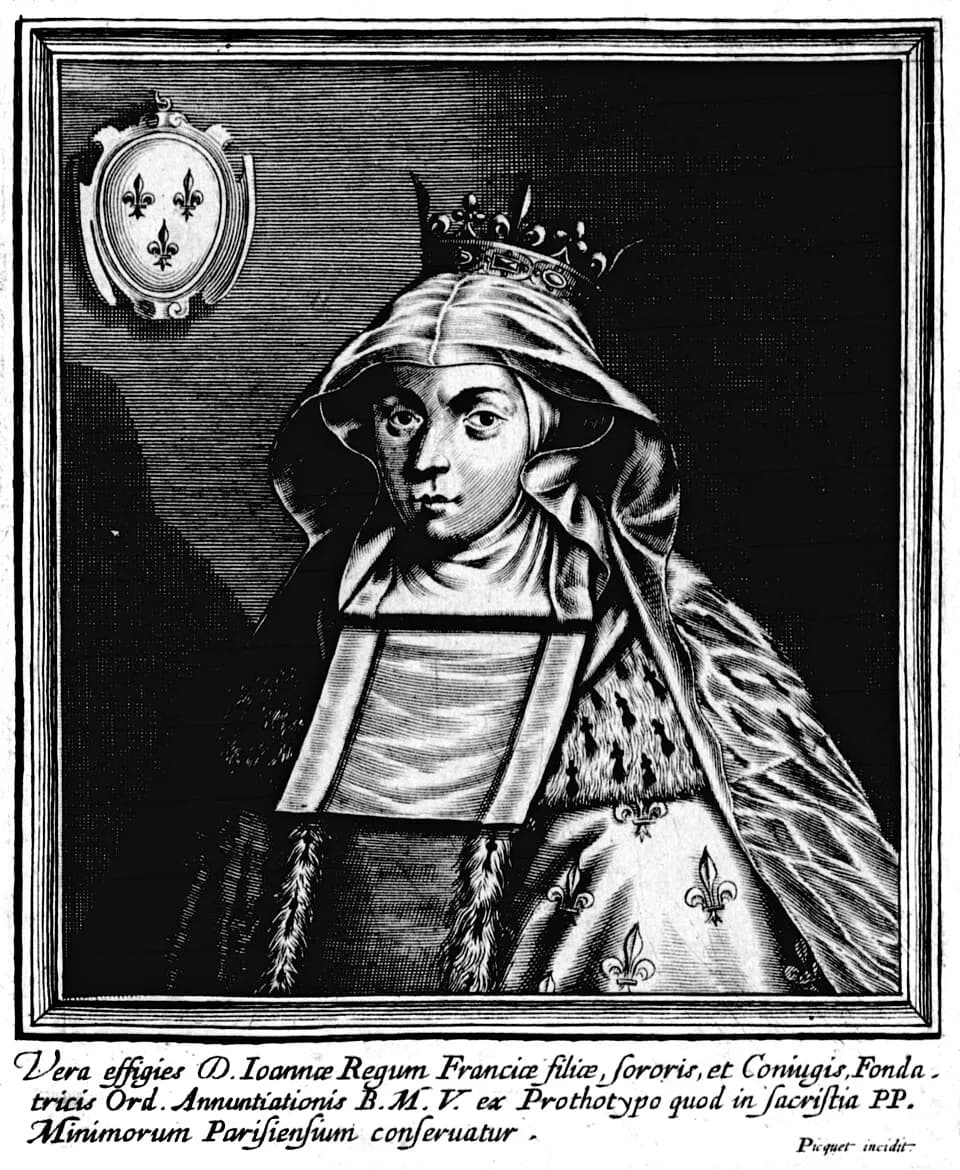
Saint Joan of Valois, Jeanne de France to the French, was the daughter of King Louis XI, married at twelve to a cousin who did not want her, and set aside as soon as he became King Louis XII in 1498. 125 She spent the years left to her governing the duchy of Berry and founding the Annonciade, an order of nuns whose rule is to imitate the Virgin Mary as the Gospels show her. 12 She died at Bourges on February 4, 1505, which is her feast, and was canonized in 1950. 26
The king's unwanted daughter
She was born on April 23, 1464, at Nogent-le-Roi, in the house of Pierre de Brézé, where her mother, Queen Charlotte of Savoy, was lodging. The order supposes she had come, as queens of France did, to pray at Chartres for a safe delivery. 4 Louis XI needed a son. The couple had already buried two, and the order's account says the king took the birth of another daughter badly. 4 The Catholic Encyclopedia is blunter: "she was hated from birth by her father, partly because of her sex and partly on account of her being sickly and deformed." 1
Within weeks the king betrothed her to his cousin Louis of Orléans, then two years old and heir presumptive to the throne, to tighten his hold on that branch of the family. 14 At four or five she was sent away from court, unlike her sister and brother, and brought up by guardians in the country. 13 The order's Chronicle, written by Sister Françoise Guyard, says she was kept in great poverty, on an allowance that had to cover a household whose servants went unpaid. 3
It was in that solitude, the encyclopedia says, that she turned to God and to a practical devotion to the Blessed Virgin. 1 The order prints her own account from one of her few writings. She was seven and hearing Mass when she understood that before she died she would found a religious order in honor of the Mother of God, and that it was to be guided by the friars of Saint Francis. 9 Butler, as Catholic Culture excerpts him, puts her first offering of herself at five. 6
Twenty-two years a wife
She was married to Louis in 1476, at twelve. 25 The encyclopedia says her father forced the match for political ends, and that the duke hated the wife imposed on him and insulted her in public. 1 The order quotes a witness at the later trial who said he never once saw Louis speak to her on his visits. 3
When Louis rebelled against her brother, King Charles VIII, and was imprisoned, Joan pleaded for him. The Diocese of Paris says she saved his head. 45 The order preserves, from the trial record, a conversation with his physician, who urged her to beg the king on her knees and promised that her husband would love her for it. She answered that she had done her duty already, and that she did not expect to be loved, since she was not the wife such a prince wanted. 3
Charles VIII died in 1498 and Louis became king. He had the marriage annulled at Rome, on the grounds, as the encyclopedia gives them, of lack of consent and non-consummation. 12 The order calls it a repudiation for reasons of state, and the Diocese of Paris names the reason: he wanted to marry Anne of Brittany. 25 Joan contested the case while there was any use in it. 1 When the sentence came she accepted it, and Butler gives her words: "God be praised Who has allowed this, that I may serve Him better than I have heretofore done." 6 The encyclopedia, which is entirely on her side, calls her "an unjustly repudiated wife and queen." 1
The Good Duchess
Louis gave her the duchy of Berry, several towns and a pension, and she went to live at Bourges, its capital, and to govern. 15 The people there called her the Good Duchess. 45
The order has her account book for 1499 and 1500, and what it shows is small and specific. She paid for a servant's wedding outfit, settled a widow's debts, covered the school fees of three poor children, and gave alms to a peasant who brought her apples. 3 The Chronicle says she sent people through Bourges to find those too ashamed to ask for help and had sheets, linen and money carried to them so quietly that one household did not know about another. 3 Poor students, the sick, women who had fallen into prostitution and wives put away by their husbands, as she had been, are all named among those she looked after. 4
The Annonciade
The order she had waited for since childhood was founded at Bourges with the help of her Franciscan confessor. The encyclopedia names him as Gilbert Nicolas and dates the foundation 1500; the order calls its co-founder Gabriel-Maria and gives 1502. 12 Butler says the rule was approved by Pope Alexander VI in 1501 and that she built and endowed the first convent in 1502. 6
It did not come easily. The Chronicle says that when she first told her confessor what she wanted, he advised her instead to found a convent of Poor Clares, as her mother had done. She did not argue, said that God and his Mother would help if they willed it, and waited two years. 3
The order's chief aim, as Butler describes it, was to imitate ten virtues that Our Lady practiced, and its superior is called the Ancelle, the handmaid, in honor of Mary's humility. 6 The Diocese of Paris says Joan took the habit herself at Pentecost 1504. 5 The encyclopedia says that toward the end she made her vows, "gave up her wedding ring, which she had hitherto worn, and wore the habit under her clothes." 1 She prayed for Louis to the last and left her nuns the duty of praying for him, for her father and for her brother. 1
At the Epiphany before she died she visited the sisters a last time and gave them the gifts of the Magi as a program: gold for love of God and neighbor, incense for prayer, myrrh for the memory of the Passion. 3 She died at Bourges on February 4, 1505. 12 Butler adds that she "was buried in the royal crown and purple, beneath which lay the habit of her Order." 6
A long road to canonization
Pope Leo X allowed the Annonciades a special office in her honor in 1514. 1 Her body, which lay in the convent at Bourges and was honored there, was burned by the Huguenots in 1562. 5 A cause for canonization was opened in 1614. 1 Benedict XIV declared her Blessed in 1742. 12 There the matter rested for two centuries, and the encyclopedia, writing in 1910, could say only that she "has never been actually canonized, though universally known as a saint." 1
Pope Pius XII canonized her on May 28, 1950. 56 Speaking to the French pilgrims who had come for it, he called her one of the silent heroines whose stature grows clearer with time, a light that had stayed under the bushel during her life, and he marked three things in her: the gifts of the Spirit from her earliest years, an unusually deep understanding of the Virgin Mary, and a union with Christ that carried her above every humiliation. 7
What is Saint Joan of Valois the patron saint of?
No source consulted for this page names Saint Joan of Valois as the patron of a cause, a trade or a country. 125 Catholic Culture's patronage list for her has a single entry, the Order of the Annunciation of the Blessed Virgin Mary, which is the order she founded. 6 That order still exists, and its family now includes apostolic sisters, a lay fraternity and oblates as well as the enclosed nuns. 9
Saint Joan of Valois's feast day
Saint Joan of Valois's feast is February 4, the day she died in 1505. The Roman Martyrology lists her under that date, Catholic Culture gives it as her commemoration, and the Annonciade keeps it as the feast of its foundress. 689 Catholic Culture lists her as a commemoration from the Martyrology on what is otherwise an ordinary weekday of the general calendar. 6
Praying with Saint Joan of Valois
Her life does not resolve into a happy ending, and the sources do not try to make it one. She loved a husband who would not speak to her, pleaded for his life, and was discarded anyway. 135 The encyclopedia says she "found happiness at last" in her order, and she had only a few years of it. 1
What she did with the injury is the part worth looking at. She fought the annulment while it could be fought, then stopped, and went on praying for the man until she died. 1 The Martyrology says she took refuge in God and had a particular devotion to the Cross. 8
Her charity was the kind that keeps accounts: shoes, school fees, a wedding outfit, linen sent in secret. 3 The two virtues she had resolved to copy from Mary were silence and humility, and the secrecy of her almsgiving fits them. 1
She also waited. The promise came to her at seven by her own telling, and the first convent was built when she was thirty-eight, after two more years in which her confessor advised something else. 369
Saint Joan of Valois, pray for us.
Sources
- 1.Florence Capes, "St. Jeanne de Valois," The Catholic Encyclopedia, vol. 8 (New York: Robert Appleton Company, 1910).
- 2."L'histoire de l'Annonciade," L'Annonciade, Ordre de la Vierge Marie (in French).
- 3."Jeanne et le don des trois rois," L'Annonciade, Ordre de la Vierge Marie, January 18, 2026 (in French).
- 4."En avril, un anniversaire," L'Annonciade, Ordre de la Vierge Marie, April 18, 2025 (in French).
- 5."Sainte Jeanne de Valois (Jeanne de France)," Commission diocésaine d'Art Sacré, Diocèse de Paris (in French).
- 6.Catholic Culture, Liturgical Year, February 4, 2026 (St. Jane de Valois, Foundress, Roman Martyrology), with an excerpt from Alban Butler, Lives of the Saints (Benziger Bros., 1894).
- 7.Pope Pius XII, address to the French pilgrims come for the canonization of Jeanne de France, May 29, 1950 (in French).
- 8.Roman Martyrology entry for February 4, "Santo del giorno," Chiesa Cattolica Italiana (in Italian).
- 9."La famille de l'Annonciade," L'Annonciade, Ordre de la Vierge Marie (in French).
Saints to turn to next
Others in this collection who are turned to for some of the same things.
- Saint Bridget of Swedenc. 1303 - July 23, 1373PrayerMarriage and familySuffering and illness
- Saint Elizabeth of Portugal1271 - July 4, 1336Marriage and familySuffering and illnessPrayer
- Saint Frances of Rome1384 - March 9, 1440Marriage and familyPrayerSuffering and illness
- Saint Germaine Cousin1579 - 1601Suffering and illnessMarriage and familyPrayer