Saint Jeremiah
Seventh to sixth century BC
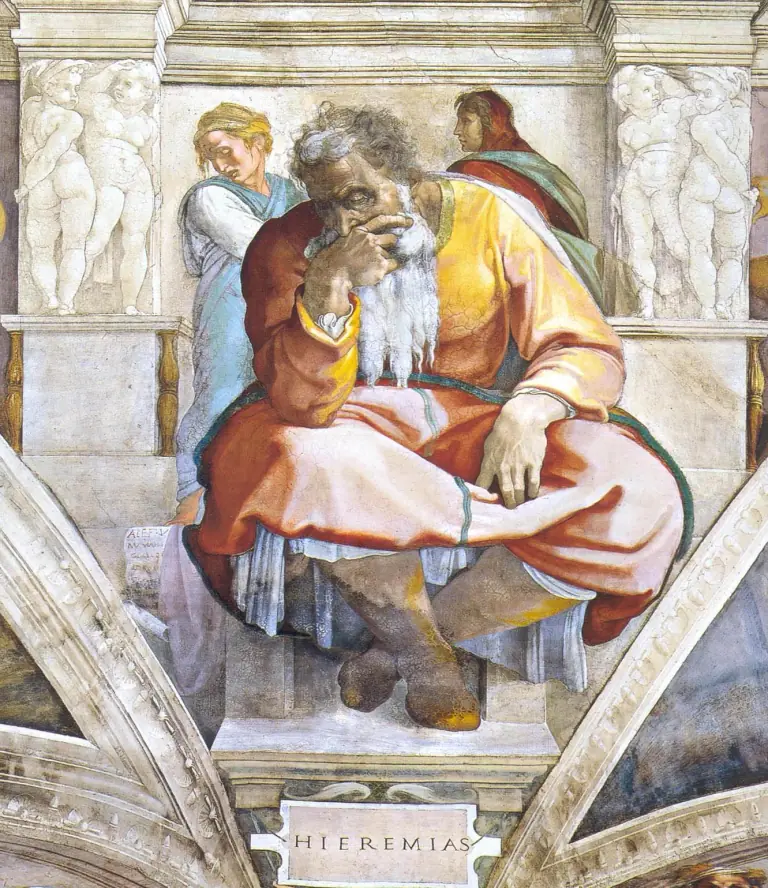
Saint Jeremiah was the prophet who told Jerusalem, for some forty years, that it would be destroyed, and lived to see it happen. 12 He was beaten, put in the stocks, thrown into a muddy cistern and finally taken to Egypt against his will, and the Church has seen in his sufferings a figure of Christ. 14611 He also foretold the new covenant that God would write on the hearts of his people. 511 The Roman Martyrology remembers him on May 1. 11
A priest's son from Anathoth
The book that bears his name begins: "The words of Jeremiah, son of Hilkiah, of a priestly family in Anathoth, in the land of Benjamin." 3 Anathoth was a village about three miles northeast of Jerusalem. 3 Michael Faulhaber, writing in the Catholic Encyclopedia in 1910, notes that the family was priestly but not high-priestly, and that Jeremiah seems never to have served as a priest in the Temple. 1
The introduction to the book in the New American Bible puts his birth about 650 BC. 2 The word of the Lord first came to him in the thirteenth year of King Josiah, which the New American Bible dates to 628 and Faulhaber to 627. 123 He kept prophesying through the reigns of Josiah's sons until Jerusalem fell, and on into the years after. 13
The call of a young prophet
The call is told in the first person. "Before I formed you in the womb I knew you, before you were born I dedicated you, a prophet to the nations I appointed you." 3 Jeremiah objected: "Ah, Lord GOD! I know not how to speak; I am too young." 3 The New American Bible's note says he was less than thirty. 3
The answer left him no way out. "To whomever I send you, you shall go; whatever I command you, you shall speak. Have no fear before them, because I am with you to deliver you." 3 Then the Lord touched his mouth and set him "over nations and over kingdoms, to root up and to tear down, to destroy and to demolish, to build and to plant." 3 The chapter ends with a promise that would be tested: God had made him "a fortified city," "a pillar of iron, a wall of brass," and his enemies would not prevail. 3
The prophet nobody wanted to hear
The times were catastrophic. Josiah's religious reform ended with his death in battle at Megiddo, in 608 by Faulhaber's reckoning and 609 by the New American Bible's. 12 Against all of them Jeremiah said the same thing: the city and the Temple would be destroyed, because the people had abandoned their God. 1
Faulhaber calls it "the constant assertion, the ceterum censeo of the Cato of Anathoth." 1 Jeremiah appeared before the people with chains about his neck to show the captivity coming, contradicted the prophets who promised victory, and gave up marriage so as not to father children who would die by the sword or be carried off. 1 His own townspeople plotted against him. 1
In Jerusalem it grew worse. The priest Pashhur, chief officer of the Temple, had him beaten and put in the stocks at the Gate of Benjamin. 4 When his prophecies, written down by his scribe Baruch, were read to King Jehoiakim in his winter house, the king cut off each few columns as they were read and threw them into the fire in the brazier, until the whole scroll was gone, and ordered Baruch and Jeremiah arrested. 7 "But the LORD kept them concealed," and Jeremiah had the words written out again. 17
During the last siege, the princes told King Zedekiah that Jeremiah was weakening the soldiers and should die. 6 They lowered him on ropes into a cistern: "There was no water in the cistern, only mud, and Jeremiah sank into the mud." 6 A foreigner saved him, Ebed-melech the Cushite, a courtier in the palace, who went to the king and then drew the prophet up with ropes, with old rags to pad them under his arms. 16
"You duped me, O Lord"
Jeremiah left something rare among the prophets: a record of what his mission cost him inside. 1 Right after the night in the stocks the book gives his complaint to God. "You duped me, O LORD, and I let myself be duped; you were too strong for me, and you triumphed. All the day I am an object of laughter; everyone mocks me." 4
He tried to stop. "I say to myself, I will not mention him, I will speak in his name no more. But then it becomes like fire burning in my heart, imprisoned in my bones; I grow weary holding it in, I cannot endure it." 4 A few verses later he curses the day he was born. 4 The New American Bible's note says that deception, sorrow and terror had brought him close to despair, and that he had nonetheless just expressed his complete confidence in God. 4
Faulhaber calls him "a Job among the prophets," and points out that the same man who announced the city's punishment kept praying for it to be spared, often immediately afterward. 1 John Paul II, speaking of another lament from the book, describes him entering "with his face bathed in tears," weeping without stopping for his people. 10
The fall of Jerusalem, and Egypt
Jerusalem fell to Nebuchadnezzar after a siege of eighteen months, in 586 according to Faulhaber and in 587 according to the New American Bible and John Paul II. 129 Jeremiah was not carried off to Babylon. He stayed among the ruins with the people left in the land. 12
Then the leaders of those who remained, Johanan son of Kareah among them, refused his warning not to go down to Egypt. They took the whole remnant of Judah there, Jeremiah and Baruch included, as far as Tahpanhes. 128 Scripture follows him as far as Egypt and says nothing of how he died. 2 Tradition supplies an ending. Faulhaber says that according to a tradition first mentioned by Tertullian he was stoned to death in Egypt by his own countrymen. 1 Tertullian lists him simply among the persecuted prophets: "Jeremias stoned." 13 The 1897 Martyrology says he was stoned by the people and died at Taphnas, where he was buried. 12 The New American Bible's introduction is more guarded: "according to an old tradition, he was murdered by his own countrymen." 2
The new covenant
In the middle of the book stand chapters of hope which, John Paul II notes, are called the "Book of Consolation." 9 The Lord promises to gather the scattered people and to "turn their mourning into joy." 5 Then comes the passage the New American Bible's introduction calls his "most sublime teaching": 2
"The days are coming, says the LORD, when I will make a new covenant with the house of Israel and the house of Judah. ... I will place my law within them, and write it upon their hearts; I will be their God, and they shall be my people." 5 The Roman Martyrology reads it as a prophecy of the new and eternal covenant in Jesus Christ. 11
John Paul II admitted that "this dream has not yet come true," and placed the fault with the people, not with God. 9 The promise stood anyway: "God's love does not fail." 9 For him the new covenant came "with the death and resurrection of Christ and the gift of the Spirit," and will be fulfilled completely only when the Lord returns. 9
A figure of Christ
The Martyrology says that because he was persecuted for foretelling the destruction of the holy city, the Church has seen in him a figure of the suffering Christ. 11 Faulhaber puts it more boldly: "The other seers were Messianic prophets; Jeremias was a Messianic prophecy embodied in flesh and blood." 1 He quotes the prophet's own words, "I was as a meek lamb, that is carried to be a victim," and notes that both Jeremiah and Christ wept over the city that would not listen. 1
The Church still prays with his words. The Lamentations, which tradition attributes to him, have a place in the Office of Passion Week. 1 Two of his canticles belong to Morning Prayer in the Liturgy of the Hours, one on Thursdays of the first week and the lament of chapter 14 on Fridays, the day the Church commemorates the Lord's death. 910
Faulhaber also singles out Michelangelo's Jeremiah on the ceiling of the Sistine Chapel, the figure shown on this page: bent forward, "the head supported by the right hand, the disordered beard expressive of a time of intense sorrow." 1
What is Saint Jeremiah the patron saint of?
Saint Jeremiah's feast day
Saint Jeremiah's feast day is May 1. The Roman Martyrology, as the Italian bishops print it, keeps a commemoration of Saint Jeremiah, prophet, on that day. 11 The 1897 English edition of the Martyrology had him on May 1 as well, and Faulhaber wrote in 1910 that "the Roman Martyrology assigns his name to 1 May." 112
Praying with Saint Jeremiah
Jeremiah said he was too young and did not know how to speak, and he was sent anyway. 3 Nothing in his story suggests the mission grew easier. He was mocked, beaten, imprisoned and left in the mud, and the city he warned fell exactly as he had said it would. 146
What he left behind is an unusually honest record of prayer. He accused God of deceiving him, tried to stop speaking, cursed his birth, and found that he could not keep the word in: it burned. 4 The book does not tidy this up.
He also prayed for the people who hated him, and wept for the city that would not listen. 110 In the ruins he kept a promise of a covenant written on the heart, and John Paul II called that love of God "the golden thread" running through Israel's joys and sorrows. 59
He died, as far as anyone knows, in exile, among people who had refused his advice. 12 The Church remembers him on May 1 as a prophet in whom it sees the suffering Christ. 11
Saint Jeremiah, pray for us.
Sources
- 1.Michael Faulhaber, "Jeremias," The Catholic Encyclopedia, vol. 8 (New York: Robert Appleton Company, 1910).
- 2.Introduction to the Book of Jeremiah, The New American Bible, as hosted by the Holy See.
- 3.Jeremiah 1, with notes, The New American Bible, as hosted by the Holy See.
- 4.Jeremiah 20, with notes, The New American Bible, as hosted by the Holy See.
- 5.Jeremiah 31, The New American Bible, as hosted by the Holy See.
- 6.Jeremiah 38, The New American Bible, as hosted by the Holy See.
- 7.Jeremiah 36, The New American Bible, as hosted by the Holy See.
- 8.Jeremiah 43, The New American Bible, as hosted by the Holy See.
- 9.John Paul II, General Audience on the Canticle of Jeremiah (Jer 31:10-14), October 10, 2001, Libreria Editrice Vaticana.
- 10.John Paul II, General Audience on the Canticle from the Book of Jeremiah (Jer 14:17-21), December 11, 2002, Libreria Editrice Vaticana.
- 11.Roman Martyrology, entry for May 1, "San Geremia, profeta," Santo del giorno, Conferenza Episcopale Italiana (in Italian).
- 12.The Roman Martyrology, May 1 (Baltimore: John Murphy Company, 1897).
- 13.Tertullian, Scorpiace, chapter 8, translated by S. Thelwall, Ante-Nicene Fathers, vol. 3 (Buffalo: Christian Literature Publishing Co., 1885), as hosted by New Advent.
Saints to turn to next
Others in this collection who are turned to for some of the same things.
- Saint Bernardo TolomeiMay 10, 1272 - August 20, 1348DiscernmentCourageSuffering and illness
- Saint Claude de la Colombiere1641 - February 15, 1682DiscernmentSuffering and illnessCourage
- Saint John Ic. 470 - May 18, 526CourageSuffering and illnessDiscernment
- Saint John Paul IIMay 18, 1920 - April 2, 2005CourageSuffering and illnessDiscernment