Saint John I
c. 470 - May 18, 526
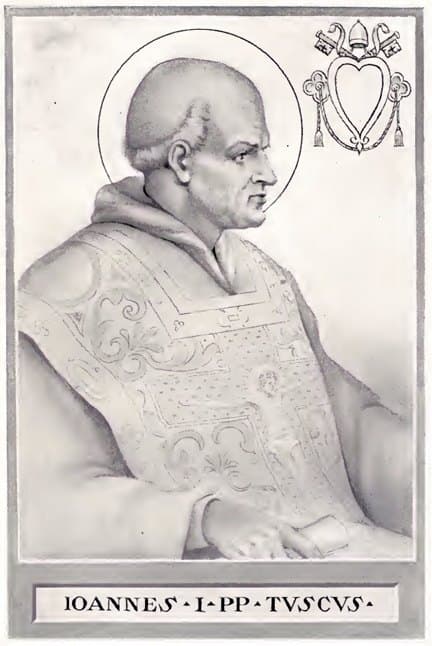
- Born
- A Tuscan, son of Constantius 1
- Pope for
- Two years, nine months and seven days, from August 13, 523 1
- Sent to Constantinople
- By Theodoric, the Arian king of Italy, to get an anti-Arian edict withdrawn 12
- At Constantinople
- The emperor Justin prostrated himself before him and was afterward crowned by him 1
- Died
- In prison at Ravenna, "apparently from the treatment he received" 2
Saint John I was sent east by an Arian king to ask a Catholic emperor to go easier on Arians - a mission the pope could not honestly perform and could not refuse. 12 He was received in Constantinople as no pope had been, crowned the emperor, and sang Easter Mass in Hagia Sophia. 1 Theodoric had him imprisoned on his return, and he died there. 2
An errand that could not be run
He was a Tuscan, the son of Constantius, elected on August 13, 523 after a seven-day interregnum, and he held the see for "two years, nine months, and seven days." 1 Of his actual governing, the encyclopedia is blunt: "We know nothing of the matter of his administration", and the only two letters under his name "are apocryphal." 1
What is recoverable is one journey. The emperor Justin, "in his zeal for orthodoxy", had issued a severe decree against the Arians in 523, requiring them to hand their churches to the Catholics. 1 Theodoric, king of the Ostrogoths and of Italy, "the ardent defender of Arianism", resented it - and was also alarmed at the warming between the Latin and Greek Churches, which might encourage Roman senators to look to Byzantium. 1
So Theodoric assembled an embassy of Roman senators "of which he obliged the pope to assume the direction", with instructions to get the edict of 523 withdrawn - and, if "Anonymous Valesianus" is to be believed, to urge the emperor to help converted Arians return to Arianism. 1
Franciscan Media puts the bind more plainly: the western ruler "forced John to head a delegation to the East to soften the measures against the heretics", and the negotiations were "designed to secure continued toleration of Catholics in the West." 2 He was being made to lobby for heresy in order to protect his own people from a king who could destroy them.
The encyclopedia states what he could and could not have done: "the pope could only counsel Justin to use gentleness and discretion towards the Arians; his position as head of the Church prevented his inviting the emperor to favour heresy." 1
Constantinople
How he was received is the evidence that he did not betray his office. "The inhabitants of Constantinople went out in throngs to meet John. The Emperor Justin on meeting him prostrated himself, and, some time afterwards, he had himself crowned by the pope." 1
"All the patriarchs of the East made haste to manifest their communion in the Faith with the supreme pontiff; only Timothy of Alexandria, who had shown himself hostile to the Council of Chalcedon, held aloof." 1
And on Easter Day, April 19, 526, "the pope, exercising his right of precedence over Epiphanius, Patriarch of Constantinople, solemnly officiated at St. Sophia in the Latin Rite." 1 A bishop of Rome sang Easter in Hagia Sophia, ahead of its own patriarch.
The encyclopedia draws the inference carefully: a reception like that "certainly would not have been kindly, had the Roman ambassadors opposed the emperor and his Catholic subjects in their struggle waged against the Arian sect." 1 He had not done what Theodoric sent him to do.
Ravenna
"Immediately afterwards he made his way back to the West." 1
Theodoric had spent the interval getting worse. "Enraged at seeing the national party reviving in Italy, [he] had just stained his hands with the murder of Boethius, the great philosopher, and of Symmachus his father-in-law." 1
Franciscan Media gives the ending: "On his way home, John was imprisoned at Ravenna because the emperor had begun to suspect that John's friendship with his eastern rival might lead to a conspiracy against his throne. Shortly after his imprisonment, John died, apparently from the treatment he received in prison." 2
The encyclopedia dates it to "18 or 19 May (according to the most popular calculation), 526" - it will not commit to the day. 1 His body was taken to Rome and buried in St. Peter's. 2 Vatican News lists him as "St. John I, Pope and Martyr". 3
What is Saint John I the patron saint of
Neither source gives him a patronage. 12 He belongs, by the shape of his life, to anyone sent by a superior to argue a case they do not believe and cannot decline.
The title Vatican News gives him is the one that matters: Pope and Martyr. 3 He was not executed for professing the faith; he was imprisoned on suspicion and died of it, and the Church counts that.
Saint John I's feast day
The feast of Saint John I is May 18. 23 Vatican News keeps his day page there and Franciscan Media gives his dates as "c. 470 - May 18, 526". 23
The encyclopedia is less certain about the day itself, giving his death as "18 or 19 May (according to the most popular calculation), 526." 1 The calendar settled on the eighteenth.
Praying with Saint John I
He was handed an errand with no honest version. Go east, get the protection of Catholics repealed, and possibly ask an emperor to help people return to a heresy - and if you fail, the king who controls Italy will take it out on the Church you lead. 12 There was no answer that was both safe and true.
What he did was the narrow thing available: counsel gentleness, and go no further. 1 Not defiance, which would have been simpler and would have cost other people. Not compliance either. He asked for mercy toward the Arians and did not ask for heresy to be favored, and the encyclopedia is clear that this was the only road open to him.
Then Constantinople, where he was met by crowds and an emperor on the ground and sang Easter in the greatest church in the world. 1 It is the high point of his life and it was, from Theodoric's side of the map, the evidence against him. The better he was received, the more obviously he had failed his instructions.
And so a prison at Ravenna, and death from how he was treated there. 2 Franciscan Media's reflection is the right last word: "We cannot choose the issues for which we have to suffer and perhaps die. John I suffered because of a power-conscious emperor." 2 He is a saint because of an errand somebody else sent him on.
Saint John I, pray for us.
Sources
Saints to turn to next
Others in this collection who are turned to for some of the same things.