Saint Isaiah the Prophet
Eighth century B.C.; date of death unknown
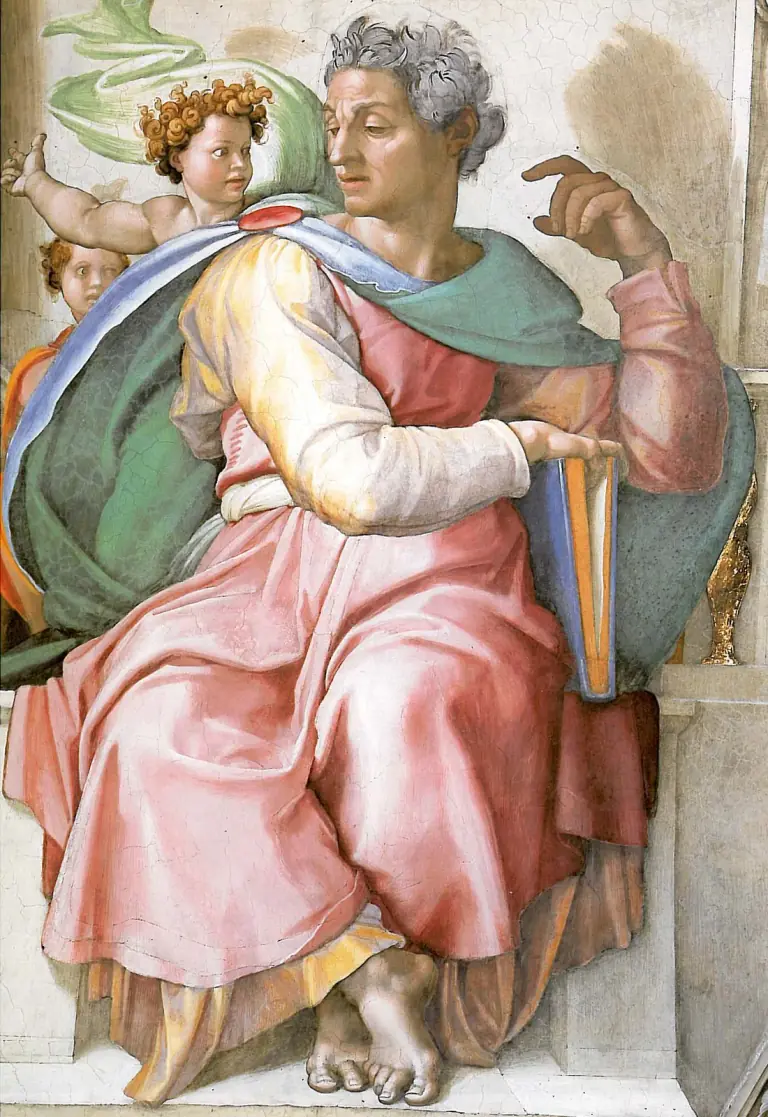
- Also called
- Isaias, Esaias 1
- Name
- "Yahweh is salvation" 1
- Father
- Amos, not the prophet of that name 1
- Prophesied
- In Jerusalem under the kings Uzziah, Jotham, Ahaz and Hezekiah of Judah, for nearly half a century from about 740 B.C. 123
- Family
- A wife he calls "the prophetess" and two sons, Shear-jashub and Maher-shalal-hash-baz 1
Saint Isaiah was a prophet of Jerusalem in the eighth century before Christ, who spoke to four kings of Judah while Assyria swallowed the kingdoms around them. 12 He is the prophet of "Behold a virgin shall conceive," and the book in which Christ, at Nazareth, found the words "The Spirit of the Lord is upon me." 56 The Church keeps his feast on May 9. 2
Who was the prophet Isaiah?
His name means "Yahweh is salvation." 1 He calls himself the son of Amos; some of the Fathers took this to be the prophet Amos, and Saint Jerome pointed out the mistake. 1 Charles Souvay, writing in the Catholic Encyclopedia, says that "of Isaias's ancestry we know nothing," though passages in his book suggest that he belonged to one of the best families of Jerusalem, and a Jewish tradition in the Talmud made him a nephew of King Amaziah. 1 Vatican News, in its calendar of saints, calls him a descendant of the royal house of David. 3
He married a woman whom he calls "the prophetess," and they had two sons with names that were themselves prophecies: Shear-jashub and Maher-shalal-hash-baz. 1 He was about twenty, Souvay thinks, when his ministry began, and it lasted "wellnigh half a century." 1 The current Roman Martyrology names the four kings of Judah in whose days he was sent: Uzziah, Jotham, Ahaz and Hezekiah. 2
"Here am I, send me"
The call is told in chapter 6 of his book. "In the year that king Ozias died, I saw the Lord sitting upon a throne high and elevated: and his train filled the temple." 4 Seraphim stood above the throne and cried to one another, "Holy, holy, holy, the Lord God of hosts, all the earth is full of his glory." 4
Isaiah's first words are a confession. "Woe is me, because I have held my peace; because I am a man of unclean lips, and I dwell in the midst of a people that hath unclean lips, and I have seen with my eyes the King the Lord of hosts." 4 One of the seraphim took a live coal from the altar with tongs and touched his mouth: "Behold this hath touched thy lips, and thy iniquities shall be taken away, and thy sin shall be cleansed." 4 Then the Lord asked, "Whom shall I send? and who shall go for us?" and Isaiah answered, "Lo, here am I, send me." 4
Souvay notes that commentators are not agreed whether this was his first call; Jerome, in his commentary, put the first five chapters earlier, but "it is more commonly held" that chapter 6 is the beginning. 1 Vatican News tells the scene as God coming to him in a dream. 3 The text itself says only, "I saw." 4
Ahaz and the sign of Emmanuel
Judah in those years was small and frightened. 1 When the kings of Syria and Israel marched on Jerusalem, the Lord sent Isaiah to meet King Ahaz "at the conduit of the upper pool," taking his son with him, to tell the king that the attack would fail. 5 "If you will not believe, you shall not continue." 5 Ahaz meant to buy protection from Assyria instead, and Isaiah opposed it "with all his might," Souvay says, because he saw that the Assyrian help would cost Judah its independence. 1
Isaiah offered the king a sign, and Ahaz refused to ask for one: "I will not ask, and I will not tempt the Lord." 5 The answer came anyway. "Therefore the Lord himself shall give you a sign. Behold a virgin shall conceive, and bear a son, and his name shall be called Emmanuel." 5 The Eastern Catholic Church sings this in its hymn for his day: through his gift of prophecy he made clear the incarnation of God and proclaimed, "Behold, a virgin shall conceive in her womb!" 8 Souvay dismisses the old suggestion that the virgin of the prophecy was Isaiah's own wife as "gratuitous and indefensible." 1
Hezekiah and the Assyrians
Under Hezekiah, Ahaz's son, the politicians of Judah planned an alliance with Egypt against Assyria and hid it from the prophet. 1 Isaiah condemned it, and in 701 B.C. the Assyrian king Sennacherib invaded. 13 Jerusalem paid an enormous ransom, and then Sennacherib demanded its surrender. 1
Hezekiah asked Isaiah to pray for the city. Souvay calls him the man "of whom Sennacherib had taken no account," and quotes the answer he sent: "The virgin, the daughter of Sion hath despised thee and laughed thee to scorn; . . . He shall not come into this city, nor shoot an arrow into it. . . . By the way that he came, he shall return, and into this city he shall not come, saith the Lord." 1 A sudden catastrophe fell on the Assyrian army, and Jerusalem was spared. 1
The prophet of justice
Isaiah did not hold office, but Souvay says that for nearly forty years he took "an active part" in steering his country's policy, and that experience taught Judah's rulers that ignoring him "meant always a set-back." 1 His principle was simple: God governs the nations, and Judah could not save itself by alliances while it oppressed the poor. 1
He describes a city full of corrupt officials, luxury, partial judges and great estates swallowing small ones, with sacrifices offered out of routine. 1 God, in the passage Souvay quotes, loathes offerings made by "hands full of blood. Wash yourselves, be clean, . . . relieve the oppressed, judge for the fatherless, defend the widow." 1 The Fathers, Souvay adds, agree that Isaiah was the greatest of the prophets who wrote, and he himself says that "never perhaps did any man utter lofty thoughts in more beautiful language." 1
His book falls into two collections, chapters 1 to 35 and 40 to 66, with history between them. Modern critics called the second part "Deutero-Isaias." Souvay, writing in 1910, reports the Pontifical Biblical Commission's decision of 1908 that the arguments for several authors were not strong enough to compel that conclusion. 1
How did Isaiah die?
Nobody knows. Souvay notes that none of his prophecies seems later than 701 B.C., so "it is doubtful if Isaias saw the reign of Manasses at all." 1 An old Jewish tradition says that he outlived Hezekiah and was put to death by Manasseh, and the apocryphal "Ascension of Isaias" says that he was sawn in two. 1 Many of the Fathers accepted this and saw it in the Letter to the Hebrews, which speaks of the saints of old who "were cut asunder." 1
The 1897 English edition of the Roman Martyrology states it plainly: he died "under king Manasses" by "being sawed in two," and was "buried beneath the oak Rogel." 7 The current Martyrology is more careful and says only that among the Jews it is handed down that he died a martyr under Manasseh. 2 Vatican News dates his death to 681 B.C. 3 His tomb was believed to be at Paneas in northern Palestine, and Souvay says his relics were taken to Constantinople in 442. 1
Isaiah in the Gospel
When Christ began to preach in the synagogue at Nazareth, "the book of Isaias the prophet was delivered unto him." 6 He found the place where it was written, "The Spirit of the Lord is upon me. Wherefore he hath anointed me to preach the gospel to the poor," read it, and sat down. Then he said, "This day is fulfilled this scripture in your ears." 6
What is Saint Isaiah the patron saint of?
Saint Isaiah's feast day
Saint Isaiah's feast day is May 9. The Roman Martyrology, in the text published by the Italian bishops, commemorates him on that date as the prophet sent in the days of Uzziah, Jotham, Ahaz and Hezekiah to reveal to an unfaithful and sinful people the faithfulness and salvation of the Lord, fulfilling God's promise to David. 2 Vatican News lists him on May 9, and the Byzantine Catholic Menaion of the Archeparchy of Pittsburgh keeps him on the same day. 38
The older Roman Martyrology kept him on July 6. Souvay, in 1910, writes that "the Roman Martyrology commemorates Isaias on 6 July," and the 1897 English edition has him on that day. 17
Praying with Saint Isaiah
Isaiah's vocation begins with a man who knows he is not fit to speak. He has seen the King, and his first thought is of his own unclean lips and those of his people. 4 He is made ready by something done to him, the coal from the altar, and only then is he asked who will go. 4
What he was sent to say was not welcome. The same chapter tells him that the people will hear and not understand, and when he asks how long, the answer is, until the cities are wasted. 4 He spent the rest of his life advising kings who sometimes did not listen. 1
His counsel to Ahaz was to trust God rather than buy safety from Assyria, and he put it in one line: "If you will not believe, you shall not continue." 5 The king answered with pious words and refused the sign. 5 The sign was given all the same, and the Church has read it ever since as the promise of Emmanuel. 58
The tradition of his death, true or not, has the prophet killed by a king of his own people. 12 Seven centuries later Christ opened his book at Nazareth and said that it was fulfilled. 6
Saint Isaiah the Prophet, pray for us.
Sources
- 1.Charles Souvay, "Isaias," The Catholic Encyclopedia, vol. 8 (New York: Robert Appleton Company, 1910).
- 2.Roman Martyrology, entry for May 9, "Sant'Isaia, profeta," Santo del giorno, Conferenza Episcopale Italiana (in Italian).
- 3."Sant'Isaia, profeta," Santo del giorno, 9 maggio, Vatican News (in Italian).
- 4.Isaiah (Isaias) 6, Douay-Rheims Bible, Challoner revision, as hosted by drbo.org.
- 5.Isaiah (Isaias) 7, Douay-Rheims Bible, Challoner revision, as hosted by drbo.org.
- 6.Luke 4, Douay-Rheims Bible, Challoner revision, as hosted by drbo.org.
- 7.The Roman Martyrology, July 6 (Baltimore: John Murphy & Co., 1897).
- 8."Menaion - May 9," Metropolitan Cantor Institute, Byzantine Catholic Archeparchy of Pittsburgh.
Saints to turn to next
Others in this collection who are turned to for some of the same things.