Saint Innocent I
Died March 12, 417
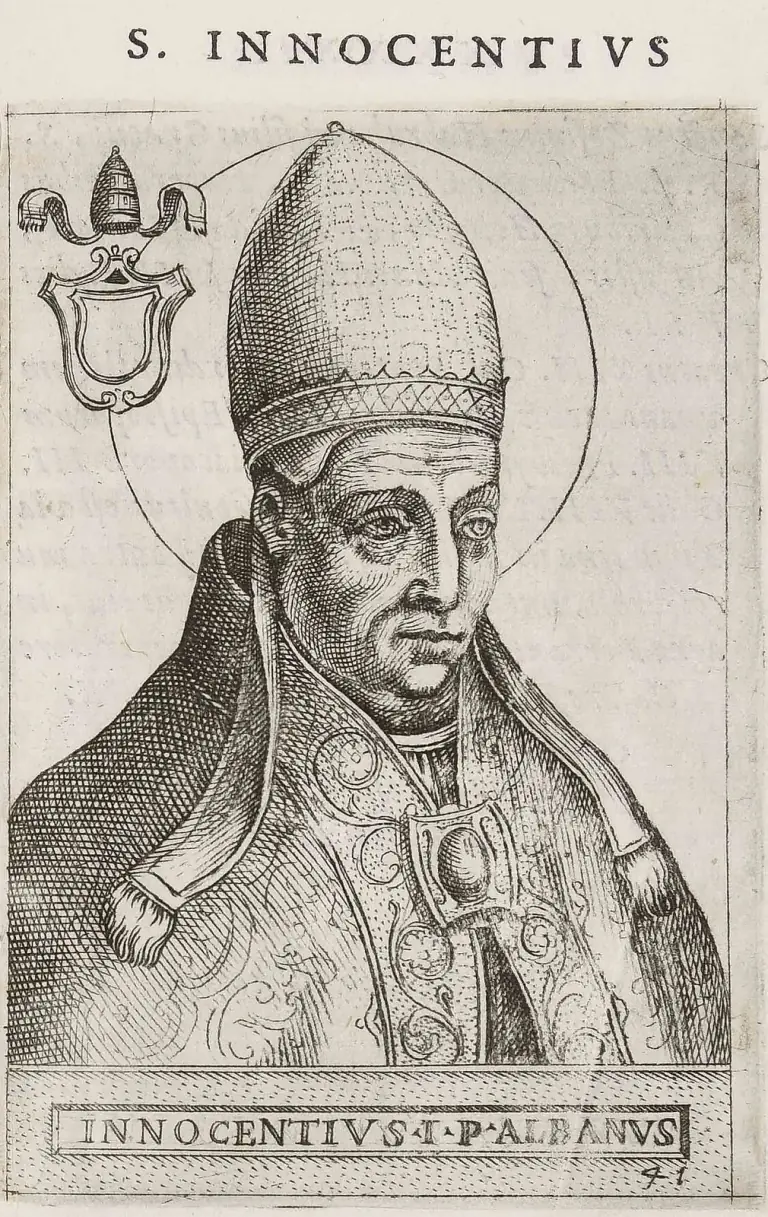
- Known for
- Leading the Roman Church through Alaric's sieges and sack of Rome; defending Saint John Chrysostom; confirming the African condemnation of Pelagius 1245
Saint Innocent I was bishop of Rome from 401 to 417, the years in which the Visigoths under Alaric besieged the city three times and sacked it in 410. 12 He took the side of Saint John Chrysostom when the bishop of Constantinople was deposed and exiled, and in 417 he confirmed the African bishops' condemnation of Pelagius, which drew from Saint Augustine the words "causa finita est," the case is closed. 145 His feast is March 12. 6
From Albano to the Chair of Peter
Johann Peter Kirsch, writing in the Catholic Encyclopedia, begins with a confession: "very little is known concerning the life of this energetic pope" before his election. 1 The Liber Pontificalis, the old Roman book of the popes, calls him "by nationality an Alban, son of Innocent." 3 The Norwegian bishops' database reports another account: Saint Jerome says that Innocent was the son of his own predecessor, Pope Anastasius I, and the Norwegian writer thinks this is probably right. 2 Either way he grew up among the clergy of Rome, and when Anastasius died in December 401 he was chosen bishop "unanimously" by clergy and people. 1
In the city itself, Kirsch says, "not much has come down to us." 1 He took several churches from the Novatians and had a heretic named Marcus banished. 1 A wealthy Roman woman named Vestina left her estate to build a church to the martyrs Gervasius and Protasius; the Liber Pontificalis says her jewels and pearls were to be sold "at a fair price" until the building was done, and that Innocent made it a parish church of Rome. 3 It stands today as San Vitale. 1
Alaric and the sack of Rome
The Western emperor Honorius had shut himself up at Ravenna. In 408 he had his own best general, Stilicho, killed, and nothing then stood between Alaric's Visigoths and Rome. 2 Alaric besieged the city; the Norwegian account says Innocent saw the famine and despair inside the walls, and that the Romans in the end bought the Goths off with a huge ransom. 2
Alaric then pressed the emperor for land and money. Kirsch says that when the Romans sent an embassy to Honorius at Ravenna to try to make peace, "Pope Innocent also joined this embassy. But all his endeavours to bring about peace failed." 1 The siege began again, and the pope and the envoys could not get back into the city, "which was taken and sacked in 410." 1 The Norwegian account dates the sack from August 24, 410, for five days, after traitors opened the Salarian Gate, and says Innocent did not return to Rome until 412, to a city in ruins. 2
Letters to the whole Church
"From the beginning of his pontificate," Kirsch writes, "Innocent often acted as head of the whole Church, both East and West." 1 The Norwegian account counts thirty-six of his letters surviving. 2 He confirmed the archbishop of Thessalonica as the pope's representative over the churches of Eastern Illyria, which had passed to the Eastern Empire; Kirsch dates the decisive letter to June 17, 412, the Norwegian account to June 17, 415. 12
Bishops wrote to him with questions and he answered them. To Victricius of Rouen in 404 he sent a decretal on ordinations, clerical celibacy, the reception of converts and the rule that "important matters" go to the Apostolic See. 1 He wrote to the bishops of Spain, to Exuperius of Toulouse, and to Decentius of Gubbio. 1 The Norwegian account notes that the Toulouse letter deals with the canonical books of the Bible and the Gubbio letter with the Mass, penance, the anointing of the sick and confirmation, which it reserves to bishops. 2 The same letter defends the Roman fast on Saturday, "because both days brought grief to the apostles and those who had been with Christ." 3 Throughout, Kirsch says, "the pope indicated the discipline of the Roman Church as being the norm for the other bishops to follow." 1
The defense of John Chrysostom
In 404 Saint John Chrysostom, bishop of Constantinople, was deposed by what Kirsch calls an illegal synod and sent into exile, with the empress Eudoxia and Theophilus of Alexandria against him. He appealed to Rome. 1 Innocent refused to recognize the sentence, summoned Theophilus to a synod, and called for a general council. 1 The historian Sozomen copied out his letter to the clergy of Constantinople. "John, our brother and fellow-minister and your bishop, has been the first to suffer this unjust treatment without being allowed a hearing. No accusation was brought, none was heard." 4 To John himself he wrote counseling "long-suffering." 4
Words were what he had. Sozomen says he sent five bishops and two Roman priests east to ask the emperors for a council, and that they were "ignominiously dismissed" at Constantinople. 4 The council never met. 1 Innocent kept writing to the exile, whose last letter from him arrived shortly before his death in 407. 1 He refused communion to the bishops who had condemned John, and to the two men put in his place, and he insisted that John's name be restored to the list of bishops read at the altar. Constantinople gave way only after Theophilus died in 412. 12
He stood by Jerome too. In 416 a mob attacked the monasteries at Bethlehem, killed a deacon and set buildings on fire. Kirsch blames "brutal followers of Pelagius." 1 Innocent wrote to Jerome offering the full weight of the Holy See against the guilty, and rebuked Bishop John of Jerusalem for having done nothing to prevent it. 12
Pelagius and "causa finita est"
Pelagius taught that a person could live without sin by the strength of free will, so that grace became, at most, a help. 25 A synod in Palestine had acquitted him in 415. In 416 two African councils, at Carthage and at Mileve, condemned his teaching again and wrote to Innocent asking that the authority of the Apostolic See be added to theirs; Augustine and four other bishops wrote to him as well. 15
Innocent answered in three letters dated January 27, 417. 5 He praised the Africans for referring the question to the Chair of Peter, rejected Pelagius's teaching, and excluded Pelagius and his follower Caelestius from communion "until they should come to their senses." 15 The Liber Pontificalis records the point in the plainest terms: he "ordained that the child of a Christian woman must be born a second time through baptism." 3
Augustine announced the answer from the pulpit. Joseph Pohle, in the Catholic Encyclopedia, gives his words: "Jam de hac causa duo concilia missa sunt ad Sedem apostolicam, inde etiam rescripta venerunt; causa finita est," translated as "Two synods having written to the Apostolic See about this matter; the replies have come back; the question is settled." 5 The saying is usually remembered as "Roma locuta, causa finita est," and the Norwegian account gives it that way, with a warning that Augustine did not mean it as generally as later readers took it. 2 Pohle adds that Augustine "was mistaken; the matter was not yet settled." 5
Death and burial
Innocent died on March 12, 417. 12 Pelagius had sent him a confession of faith, but it arrived too late and was delivered to his successor. 1 He was buried in a basilica above the catacomb of Pontianus, on the Via Portuensis, in the same church as Anastasius I. 126 Kirsch's judgment is brief: "He was a very energetic and active man, and a highly gifted ruler, who fulfilled admirably the duties of his office." 1
What is Saint Innocent I the patron saint of?
Saint Innocent I's feast day
Saint Innocent I's feast day is March 12, the day he died. The Roman Martyrology, in the text published by the Italian bishops, enters him on that date: at Rome, in the cemetery of Pontianus, the burial of Saint Innocent I, pope, who defended Saint John Chrysostom, consoled Jerome and approved Augustine. 6
Older calendars kept him on July 28. The Norwegian bishops' database says his memorial stood on that day, with Pope Victor I, in the Roman calendar until 1969, and it still heads its page with July 28. 2 The 1897 English edition of the Roman Martyrology has "at Rome, of St. Innocent, pope and confessor" on July 28. 8 The date has an old root: one recension of the Liber Pontificalis gives July 28 as the day of his burial, the other June 27. 3
Praying with Saint Innocent I
Innocent lived through the worst thing that had happened to Rome in eight hundred years and was not there when it happened. 2 He had gone to Ravenna to ask for peace and could not get home. 1 Nothing in the sources suggests he could have stopped it.
His letter to the clergy of Constantinople is a letter about patience written by a man who could not fix what he was describing. He told them that "only the consolation of patience heals such a state of affairs," and that he himself took comfort from their letters, "for we are not strangers to your sufferings." 4 He asked for a council, his envoys were thrown out, and John died in exile. 14
What he could do was refuse to pretend. He would not accept the men who replaced John, and he kept saying so until John's name was read again at Constantinople. 1 When Jerome's monasteries were burned, he wrote to the victim first and to the negligent bishop second. 1
His answer on Pelagius ended one round of a long argument and not the argument itself. 5 The Martyrology sums up his life in three verbs: he defended Chrysostom, consoled Jerome and approved Augustine. 6
Saint Innocent I, pray for us.
Sources
- 1.Johann Peter Kirsch, "Pope Innocent I," The Catholic Encyclopedia, vol. 8 (New York: Robert Appleton Company, 1910).
- 2."Den hellige pave Innocent I," compiled and translated by Per Einar Odden, Den katolske kirke (katolsk.no), the Catholic Church in Norway (in Norwegian).
- 3.The Book of the Popes (Liber Pontificalis), vol. 1, To the Pontificate of Gregory I, translated by Louise Ropes Loomis (New York: Columbia University Press, 1916), "Innocent I."
- 4.Sozomen, Ecclesiastical History, Book VIII, chapters 26 and 28, translated by Chester D. Hartranft, Nicene and Post-Nicene Fathers, Second Series, vol. 2 (Buffalo: Christian Literature Publishing Co., 1890), as hosted by New Advent.
- 5.Joseph Pohle, "Pelagius and Pelagianism," The Catholic Encyclopedia, vol. 11 (New York: Robert Appleton Company, 1911).
- 6.Roman Martyrology, entry for March 12, "Sant'Innocenzo I, papa," Santo del giorno, Conferenza Episcopale Italiana (in Italian).
- 7."Innocent I," The Supreme Pontiffs, The Holy See.
- 8.The Roman Martyrology, July 28 (Baltimore: John Murphy & Co., 1897).
Saints to turn to next
Others in this collection who are turned to for some of the same things.