Saint Hyginus
Died about 140 or 142
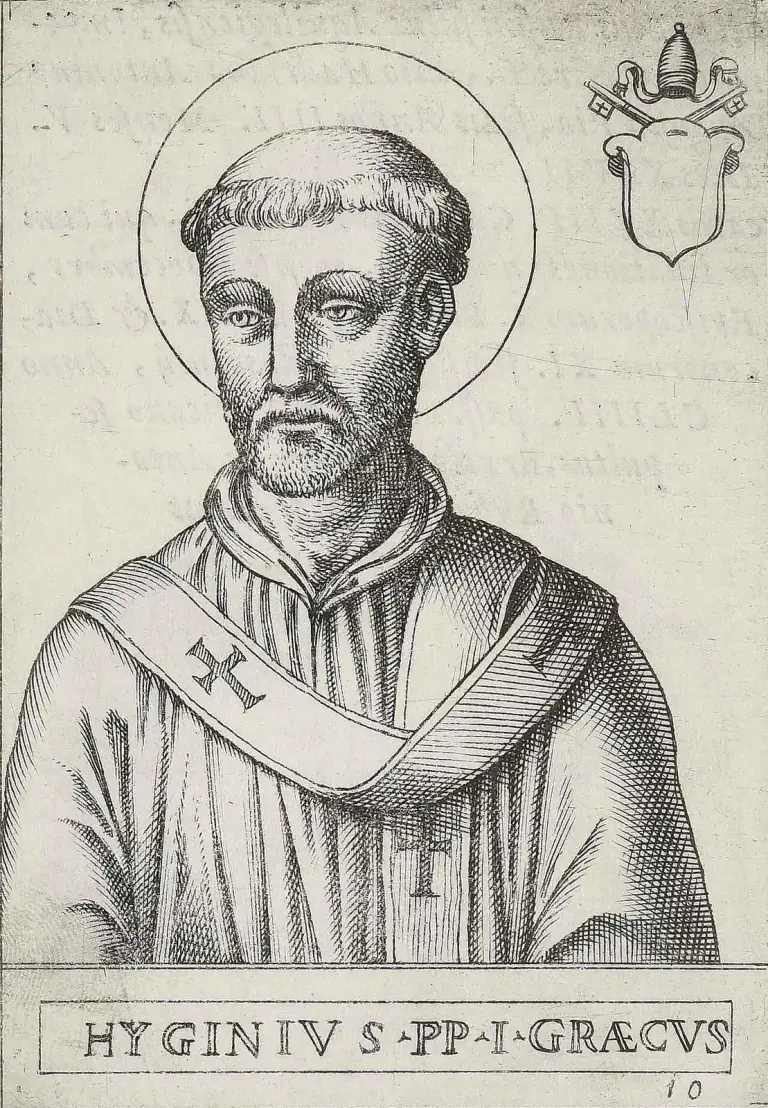
- Pope
- About 138 to 142, by Kirsch's reckoning 1; four years, says Eusebius 7; four or ten years in the two versions of the Liber Pontificalis 9
Saint Hyginus was bishop of Rome for about four years around 140, between Telesphorus and Pius I. 17 Almost nothing is known of his own deeds, but Saint Irenaeus fixed two arrivals by his name: the Gnostic teacher Valentinus and the Syrian Cerdo, forerunner of Marcion, both came to Rome "in the time of Hyginus." 56 The Church keeps his memory on January 11. 3
A name in the oldest list
Saint Irenaeus of Lyons, writing before the end of the second century, set down the bishops of Rome in order to show that the teaching of the apostles had come down by an unbroken succession. After Sixtus, "sixth from the apostles," came Telesphorus, "who was gloriously martyred; then Hyginus; after him, Pius; then after him, Anicetus." 4 Louise Ropes Loomis, introducing her translation of the Liber Pontificalis, notes that Irenaeus added to his list a few facts he had learned at Rome, among them the rise of heresies there "under Hyginus and Pius." 9
Counting places on that list gives two answers. Reckoned from the apostles, as in the list itself, Hyginus stands eighth, and the current Roman Martyrology calls him the eighth to occupy the chair of the apostle Peter. 34 Elsewhere Irenaeus calls him "the ninth bishop" and says he "held the ninth place in the episcopal succession from the apostles downwards." 56
Four years, and their dates
Eusebius of Caesarea writes that Telesphorus died in the first year of the Emperor Antoninus Pius, in the eleventh year of his own episcopate, "and Hyginus became bishop of Rome." 7 Four years later, "Hyginus having died at the close of the fourth year of his episcopate, Pius succeeded him in the government of the church of Rome." 7
Johann Peter Kirsch, in the Catholic Encyclopedia, puts the death of Telesphorus in 138 or 139 on that evidence, and the reign of Hyginus at about 138 to 142. 1 He adds a warning that applies to every bishop of this period: "the chronology of these bishops of Rome cannot be determined with any degree of exactitude by the help of the authorities at our disposal today." 1 The Norwegian bishops' saints database (katolsk.no) dates his death to about 140. 2
The Liber Pontificalis, a collection of papal lives compiled in Rome centuries later, survives in two forms that disagree. One gives Hyginus four years, three months and four days; the other gives ten years, three months and seven days. 9 It places him "in the time of Verus and Marcus" and dates him by consuls from the year 138, one version running to 149. 9
A Greek, and perhaps not a philosopher
The same book says that Hyginus was "by nationality a Greek, previously a philosopher of Athens, whose ancestry I have not been able to ascertain." 9 Kirsch repeats the Greek birth on the Liber Pontificalis's authority, but thinks the philosopher was probably borrowed: two Latin authors bore the same name, and the compiler seems to have mixed them up with the pope. 1 katolsk.no gives the same explanation, attributing it to modern scholars. 2
Valentinus and Cerdo
Not every teacher who came to Rome in these years taught what the Church taught. Irenaeus writes that "Valentinus came to Rome in the time of Hyginus, flourished under Pius, and remained until Anicetus." 5 Patrick Healy, in the Catholic Encyclopedia, calls Valentinus "the best known and most influential of the Gnostic heretics," born on the coast of Egypt and trained in Alexandria. 11 At first, Healy says, he "allied himself with the orthodox community in Rome," and stayed perhaps fifteen years, until his errors led to his excommunication and he left for Cyprus. 11
Cerdo came at the same time. Irenaeus says he took his system from the followers of Simon and taught that the God proclaimed by the law and the prophets was not the Father of Jesus Christ. 6 His behavior in Rome was double: "Coming frequently into the Church, and making public confession, he thus remained, one time teaching in secret, and then again making public confession; but at last, having been denounced for corrupt teaching, he was excommunicated from the assembly of the brethren." 5 Eusebius quotes the same passage, and in its English translation Cerdo ends not excommunicated but "withdrawing from the assembly of the brethren." 7 Marcion of Pontus, says Irenaeus, succeeded him and developed his doctrine. 6 John Arendzen, in the encyclopedia's article on the Marcionites, calls Cerdo "the Syrian Gnostic" and agrees that Marcion made common cause with him in Rome, but thinks it unlikely that Marcion's doctrine was actually derived from him. 12 katolsk.no says Cerdo came to Rome from Syria and Valentinus from Egypt. 2
How much of this belongs to Hyginus himself is uncertain. Kirsch says plainly: "How many of these events took place during the time of Hyginus is not known." 1 None of the sources says that he was the one who put Cerdo out, and the page does not say it either. 157
Ordering the clergy
The Liber Pontificalis credits him with one act of government: "He set in order the clergy and distributed ranks." 9 It adds that he ordained fifteen priests, five deacons and six bishops at three ordinations in December. 9 Loomis calls the first sentence "a vague phrase," which may mean only that Hyginus carried further the arrangement of the clergy into ranks with distinct duties. 9 Kirsch is harder on it. The same remark turns up in the life of Pope Hormisdas, and he says "it has no historical value"; following the scholar Louis Duchesne, he thinks the writer probably had the lower orders of the clergy in mind. 1
katolsk.no reports two further traditions: that Hyginus introduced godparents at baptism, to help newborn children through their Christian life, and that he ordered all churches to be consecrated. 2 Neither Kirsch nor the Liber Pontificalis as Loomis translates it says anything of either. 19
Easter and the peace of the churches
One more glimpse comes from a letter. Decades later, when Pope Victor tried to cut off the churches of Asia over the date of Easter, Irenaeus wrote to remind him of the bishops who had gone before. "Anicetus, and Pius, and Hyginus, and Telesphorus, and Xystus" had not kept the Asian custom of the fourteenth day of the month, and had not let their own people keep it. 8 "And yet though not observing it, they were none the less at peace with those who came to them from the parishes in which it was observed." 8 Those bishops, he adds, "sent the eucharist to those of other parishes who observed it." 8
Martyr or not
The older calendars counted Hyginus among the martyrs. The 1897 English edition of the Roman Martyrology entered him on January 11 as a pope "who suffered a glorious martyrdom in the persecution of Antoninus." 10 Kirsch is direct: "The ancient authorities contain no information as to his having died a martyr." 1 Irenaeus calls Telesphorus "gloriously martyred" and says nothing of the kind about Hyginus, and the Liber Pontificalis, which says of Telesphorus that "he was crowned with martyrdom," makes no such claim for his successor. 49 katolsk.no says he is honored as a martyr but that there is no evidence for it, and the current Martyrology names him only as pope. 23
He was buried, says the Liber Pontificalis, "near the body of the blessed Peter" at the Vatican, and the see stood empty for three days after him. 9 Kirsch agrees on the place, the Vatican Hill near the tomb of Saint Peter. 1
What is Saint Hyginus the patron saint of?
Saint Hyginus's feast day
Saint Hyginus's feast day is January 11. Kirsch writes: "His feast is celebrated on 11 January." 1 The Roman Martyrology, in the text the Italian bishops publish, keeps on that day the memory of Saint Hyginus, pope, at Rome. 3
The date is the one the Liber Pontificalis gives for his burial, and the 1897 Martyrology has him on the same day. 910 katolsk.no adds that January 11 stood in the Roman calendar until 1969. 2
Praying with Saint Hyginus
Hyginus left no writing, and the few lines the sources give him are mostly about other people: the bishop before him who was martyred, the teachers who arrived in his time, the bishops who came after. 145 Kirsch will not even say how much of Cerdo's story happened on his watch. 1 It is an honest picture of how little is known, and the sources do not fill it in. 12
What does come through is a Church being tested from inside. Valentinus at first stood among the faithful, and Cerdo kept returning to make public confession while teaching something else in private. 511 Irenaeus describes the pattern repeating, confession and then secret teaching again, before Cerdo was finally denounced. 57
Irenaeus remembered him, too, among the Roman bishops who held to their own way of keeping Easter and still sent the Eucharist to churches that kept another. 8 The same writer who named him beside the arrival of Valentinus and Cerdo named him again among the bishops who would not break communion over a calendar. 58
Saint Hyginus, pray for us.
Sources
- 1.Johann Peter Kirsch, "Pope St. Hyginus," The Catholic Encyclopedia, vol. 7 (New York: Robert Appleton Company, 1910).
- 2."Den hellige pave Hyginus ( - ~140)," Den katolske kirke (katolsk.no), Catholic Diocese of Oslo (in Norwegian).
- 3.Roman Martyrology, entry for January 11, "Sant'Igino, papa," Santo del giorno, Conferenza Episcopale Italiana (in Italian).
- 4.Saint Irenaeus, Against Heresies, Book III, chapter 3, translated by Alexander Roberts and William Rambaut, Ante-Nicene Fathers, vol. 1 (Buffalo: Christian Literature Publishing Co., 1885), as hosted by New Advent.
- 5.Saint Irenaeus, Against Heresies, Book III, chapter 4, translated by Alexander Roberts and William Rambaut, Ante-Nicene Fathers, vol. 1 (Buffalo: Christian Literature Publishing Co., 1885), as hosted by New Advent.
- 6.Saint Irenaeus, Against Heresies, Book I, chapter 27, translated by Alexander Roberts and William Rambaut, Ante-Nicene Fathers, vol. 1 (Buffalo: Christian Literature Publishing Co., 1885), as hosted by New Advent.
- 7.Eusebius, Church History, Book IV, chapters 10 and 11, translated by Arthur Cushman McGiffert, Nicene and Post-Nicene Fathers, Second Series, vol. 1 (Buffalo: Christian Literature Publishing Co., 1890), as hosted by New Advent.
- 8.Eusebius, Church History, Book V, chapter 24, quoting Irenaeus's letter to Pope Victor, translated by Arthur Cushman McGiffert, Nicene and Post-Nicene Fathers, Second Series, vol. 1 (Buffalo: Christian Literature Publishing Co., 1890), as hosted by New Advent.
- 9.The Book of the Popes (Liber Pontificalis), I: To the Pontificate of Gregory I, translated by Louise Ropes Loomis (New York: Columbia University Press, 1916), introduction and lives of Telesphorus and Hyginus, with the translator's notes.
- 10.The Roman Martyrology, January 11 (Baltimore: John Murphy Company, 1897).
- 11.Patrick Healy, "Valentinus and Valentinians," The Catholic Encyclopedia, vol. 15 (New York: Robert Appleton Company, 1912).
- 12.John Arendzen, "Marcionites," The Catholic Encyclopedia, vol. 9 (New York: Robert Appleton Company, 1910).
Saints to turn to next
Others in this collection who are turned to for some of the same things.
- Saint Agnes of Montepulcianoc. 1268 - April 1317Work and vocationDiscernment
- Saint Albert ChmielowskiAugust 20, 1845 - December 25, 1916DiscernmentWork and vocation
- Saint Andrew Avellino1521 - November 10, 1608DiscernmentWork and vocation
- Saint Angela MericiMarch 21, 1474 - January 27, 1540Work and vocationDiscernment