Saint Hosea the Prophet
Eighth century BC; date of death unknown
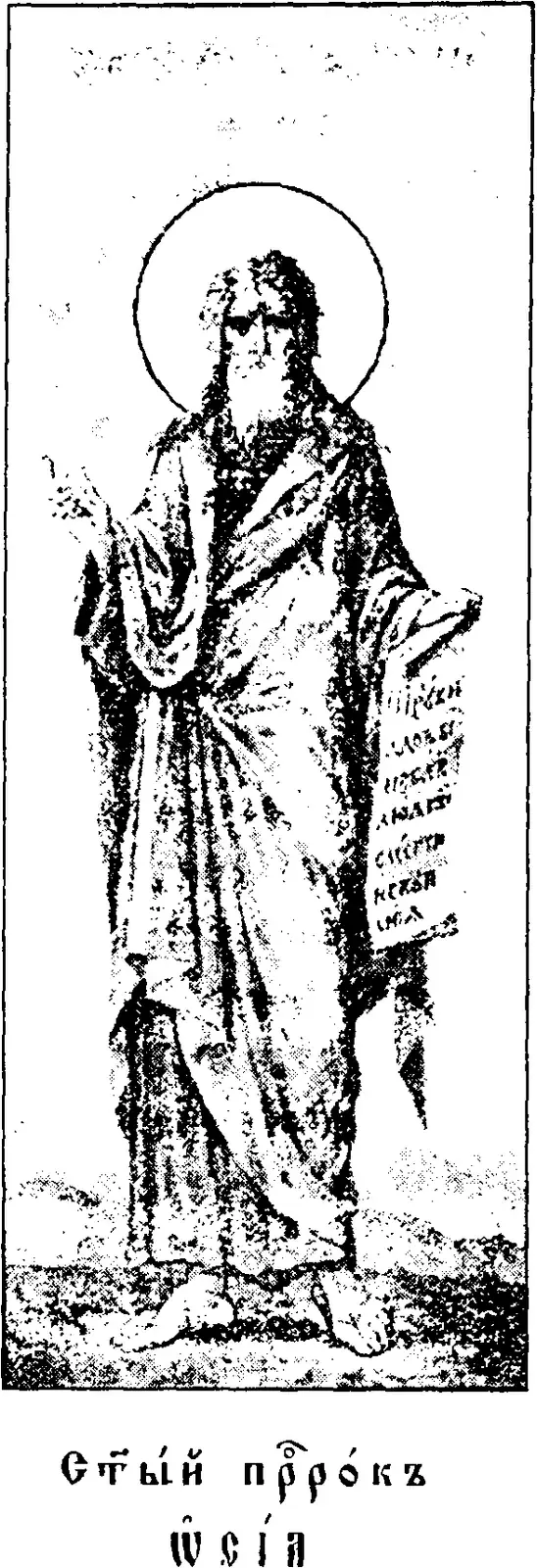
Saint Hosea was a prophet of the northern kingdom of Israel in the eighth century before Christ, in the prosperous and collapsing years after Jeroboam II. 12 He was the first to describe God's bond with Israel as a marriage and her idolatry as adultery, and his book turns on his own marriage to an unfaithful wife, Gomer, whom he was told to take back. 125 The Church remembers him on October 17. 13
A prophet of the north
Hosea was the son of Beeri and a subject of the northern kingdom, which he calls "the land"; its king is "our king," its places are familiar to him, and he seldom mentions Judah and never Jerusalem. 1 The New American Bible notes that some think he was a priest and others a prophet attached to a shrine, and that his book, the only source for his life, gives no certain answer. 2
The book's title places him under Jeroboam II of Israel and four kings of Judah, from Uzziah to Hezekiah, which J. M. Calès, writing in the Catholic Encyclopedia, reckons as about 750 to 725 BC. 13 Calès doubts the title. Nothing in the prophecies themselves seems later than the reign of Menahem, and nothing mentions the Assyrian invasion of 734-733, so he puts Hosea's preaching at about 750-735, at the end of Amos's career and the beginning of Isaiah's. 1 The New American Bible says he began in the last years of Jeroboam II, whom it dates 786-746. 2
They were years of outward success and inward collapse. Calès describes a kingdom made richer by Jeroboam and rotting faster for it: his son Zechariah was murdered after six months, the murderer reigned one month before he too was killed, and within a generation Samaria fell to the Assyrians in 722. 1
Gomer
The book opens with a command. "Go, take thee a wife of fornications, and have of her children of fornications: for the land by fornication shall depart from the Lord." 3 Hosea married Gomer, the daughter of Debelaim, and she bore three children, each named as a sentence on Israel. 3 The first was Jezrahel, for the blood that the house of Jehu had shed at Jezrahel. The second, a daughter, was called "Without mercy," and the third, "Not my people: for you are not my people, and I will not be yours." 13
Then, in the third chapter, comes the second command. "Go yet again, and love a woman beloved of her friend, and an adulteress: as the Lord loveth the children of Israel, and they look to strange gods." 5 Hosea bought her back for fifteen pieces of silver and a core and a half of barley, and told her to wait many days, as Israel would sit many days "without king, and without prince, and without sacrifice," until they returned to seek the Lord. 5
Whether this was a real marriage is disputed. The New American Bible reads it as one, "a personal tragedy which profoundly influenced his teaching": as Hosea could not give up his wife forever even when she played the harlot, so the Lord could not renounce Israel. 2 Calès, writing in 1911, reports that most scholars of his day thought the marriage historical, gives their reasons, and is not persuaded. 1 The action moves too fast, he argues, the children seem to be named just when their names are explained, and it is hard to believe God ordered a prophet to marry a woman so that she would be unfaithful. 1 He prefers the allegorical reading of Saint Jerome, and adds that the doctrine is the same either way, "and that is the only consideration of real importance." 1
The faithless bride
The rest of the book applies the marriage to the nation. Calès, following Van Hoonacker, divides it into three sections, each ending in a promise of salvation. 1 Israel has said, "I will go after my lovers, that give me my bread, and my water, my wool, and my flax," not knowing that it was the Lord who gave her the corn and wine and oil that she spent on Baal. 4 She has made alliances with Egypt and Assyria instead of trusting her husband, and she has kept up a worship of the Lord that is only outward. 1
Against that outward worship Hosea set the line that Christ would later quote: "For I desired mercy, and not sacrifice: and the knowledge of God more than holocausts." 610 For Calès, the root of every evil in the book is the lack of this knowledge of God, which is less a matter of theory than of the practical knowledge whose object is love. 1 The New American Bible names Israel's sins as idolatry and the ruthless oppression of the poor, which no amount of sacrifice could atone for. 2
Hosea, Calès writes, was the first to use the image of God as the husband of Israel and Israel as his bride, "a profoundly philosophical and mystical image" that runs on through Jeremiah, Ezekiel, the Song of Songs and the Apocalypse. 1 The New American Bible says the same, and adds that Saint John and Saint Paul use it of Christ and the Church. 2
"My heart is turned within me"
The eleventh chapter, which the New American Bible calls one of the summits of Old Testament theology, changes the image from a husband to a father. 2 "Because Israel was a child, and I loved him: and I called my son out of Egypt." 7 God taught Ephraim to walk and carried him in his arms, drew him "with the cords of Adam, with the bands of love," and Ephraim turned to idols. 17 And then, at the point of judgment, the Lord refuses to destroy: "my heart is turned within me, my repentance is stirred up. I will not execute the fierceness of my wrath: I will not return to destroy Ephraim: because I am God, and not man." 7
Pope Benedict XVI built a passage of his first encyclical on these verses. The prophets, "particularly Hosea and Ezekiel," described God's passion for his people in the language of betrothal and marriage, he wrote, and Hosea above all shows that God's love is a love which forgives. 12 Israel had broken the covenant and God should have repudiated her, but "it is precisely at this point that God is revealed to be God and not man." 12 Benedict saw there a dim prefiguring of the Cross. 12
The book ends with an invitation. "Return, O Israel, to the Lord thy God," and the Lord answers: "I will heal their breaches, I will love them freely." 8 Calès calls the closing chapter "a touching exhortation" and the new covenant it promises "an admirable sketch of the Church which Christ is to found." 1
Hosea in the New Testament
Saint Matthew puts Hosea's words in the mouth of Christ, who tells the Pharisees who objected to his eating with sinners, "Go then and learn what this meaneth, I will have mercy and not sacrifice." 10 He also reads the flight of the Holy Family into Egypt as the fulfillment of "Out of Egypt have I called my son." 9 Saint Paul, writing to the Romans about the call of the Gentiles, quotes Hosea's reversal of the children's names: "I will call that which was not my people, my people; and her that was not beloved, beloved." 11 The promise is already in the first chapter: "in the place where it shall be said to them: You are not my people: it shall be said to them: Ye are the sons of the living God." 3
What is Saint Hosea the patron saint of?
Saint Hosea's feast day
Saint Hosea's feast day is October 17. The current Roman Martyrology, as the Italian bishops print it, commemorates him on that day as the prophet who, not only by his words but by his life, showed the unfaithful people of Israel that the Lord is a Spouse always faithful and moved by infinite mercy. 13 The Byzantine Catholic Menaion keeps him on the same day in nearly the same words. 15
The 1897 English Martyrology kept him on July 4, with the prophet Haggai: "Of the prophets Osee and Aggeus." 14
Praying with Saint Hosea
The Martyrology remembers Hosea for what he showed by his life as well as his words. 13 Whether his marriage happened as the book tells it or was a parable he acted out in speech, the book asks the reader to imagine a man told to love a woman who would betray him, and then told to love her again. 125
His God is not calm. He is a husband who strips and threatens, and a father whose heart turns over within him at the thought of destroying his son. 47 Benedict XVI did not soften this; he called it God's love turned against his own justice. 12
Hosea gave Christ a sentence to answer his critics with, and gave the image of the bride that the New Testament would apply to the Church. 1210 He also left the words a sinner can carry back: "Take away all iniquity, and receive the good." 8
Saint Hosea the Prophet, pray for us.
Sources
- 1.J. M. Calès, "Osee," The Catholic Encyclopedia, vol. 11 (New York: Robert Appleton Company, 1911).
- 2."Hosea: Introduction," The New American Bible (Libreria Editrice Vaticana), at vatican.va.
- 3.Osee 1, Douay-Rheims Bible (Challoner revision), at drbo.org.
- 4.Osee 2, Douay-Rheims Bible (Challoner revision), at drbo.org.
- 5.Osee 3, Douay-Rheims Bible (Challoner revision), at drbo.org.
- 6.Osee 6, Douay-Rheims Bible (Challoner revision), at drbo.org.
- 7.Osee 11, Douay-Rheims Bible (Challoner revision), at drbo.org.
- 8.Osee 14, Douay-Rheims Bible (Challoner revision), at drbo.org.
- 9.Matthew 2, Douay-Rheims Bible (Challoner revision), at drbo.org.
- 10.Matthew 9, Douay-Rheims Bible (Challoner revision), at drbo.org.
- 11.Romans 9, Douay-Rheims Bible (Challoner revision), at drbo.org.
- 12.Benedict XVI, Deus Caritas Est, encyclical letter, December 25, 2005, sections 9 and 10, at vatican.va.
- 13.Roman Martyrology, entry for October 17, "Sant'Osea, profeta," Santo del giorno, Conferenza Episcopale Italiana (in Italian).
- 14.The Roman Martyrology, July 4 (Baltimore: John Murphy Company, 1897), Internet Archive.
- 15.Menaion, October 17, Metropolitan Cantor Institute, Byzantine Catholic Archeparchy of Pittsburgh.
Saints to turn to next
Others in this collection who are turned to for some of the same things.
- Saint Clotildec. 474 - June 3, 545ConversionMarriage and familySuffering and illness
- Saint EustaceMartyred at Rome, in 118 by tradition; other accounts give 140 or 188ConversionMarriage and familySuffering and illness
- Saint Margaret of Cortona1247 - February 22, 1297ConversionMarriage and familySuffering and illness
- Saint Aloysius GonzagaMarch 9, 1568 - June 21, 1591Suffering and illnessConversion