Saint Hormisdas
Died August 6, 523
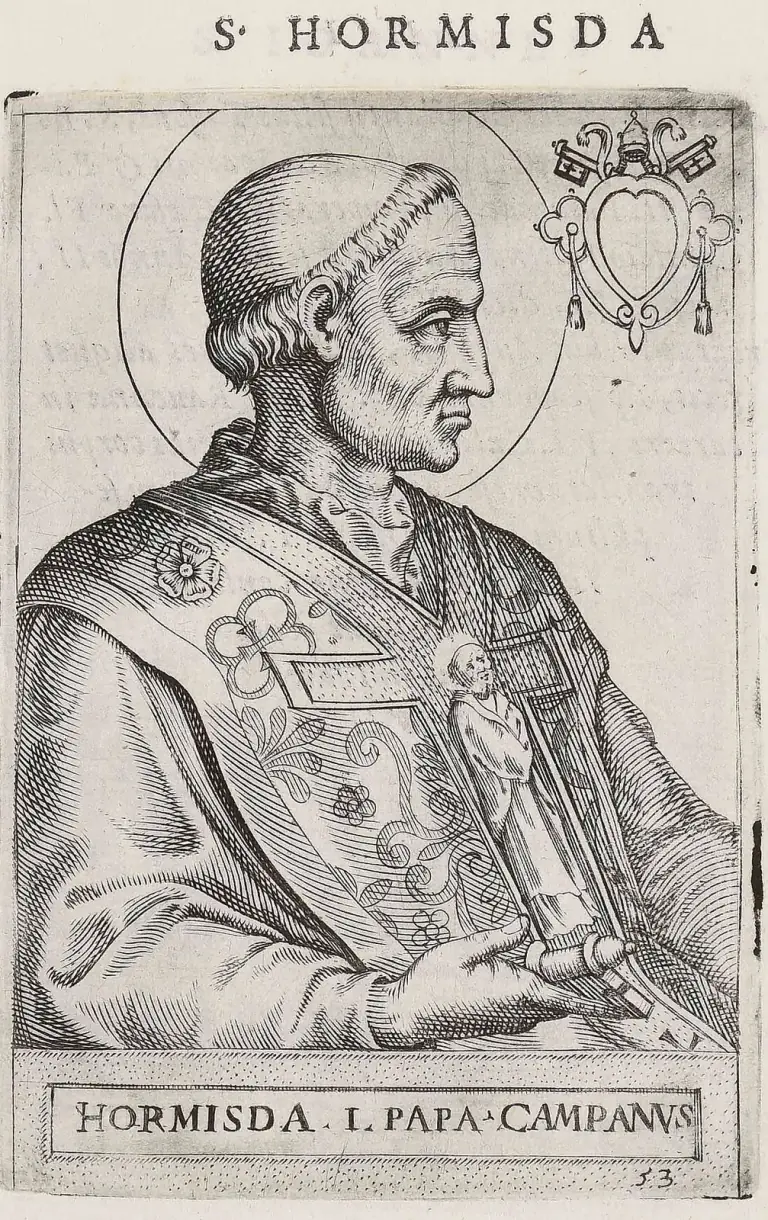
Saint Hormisdas was pope from 514 to 523 and ended a schism of thirty-five years between Rome and Constantinople. 12 The confession of faith he sent east, which declares that in the Apostolic See the Catholic religion has always been kept unblemished, was signed in Constantinople on Holy Thursday, March 28, 519, and was quoted again at the First Vatican Council in 1870. 16 He had been married before he was ordained, and his son became pope after him. 1 His feast is August 6. 4
A deacon from Frosinone
Hormisdas came, in J.P. Kirsch's words in the Catholic Encyclopedia, from "a wealthy and honourable family of Frosinone," in the Campagna di Roma. 1 The Liber Pontificalis names his father as Justus. 3 He had been married before he took higher orders, and his son became pope as Silverius in 536. 12 Vatican News calls him a widowed deacon. 5
Under Pope Symmachus he served as a deacon of the Roman Church, and in the schism of the antipope Laurentius he stood close to Symmachus throughout. 12 He was notary at the synod held at Saint Peter's in 502, and his friend Ennodius of Pavia already expected him to be pope. 1 He was chosen the day after Symmachus's funeral in July 514, and Kirsch records no division over the election. 1 One of his first acts was to receive back the last followers of Laurentius. 12
The schism he inherited
The quarrel with the East was thirty years old. In the 480s the patriarch Acacius of Constantinople had drawn up the Henoticon, a formula of union which passed over the Council of Chalcedon "in silence," and Pope Felix III had excommunicated him. 7 The emperor Anastasius kept the Henoticon in force, leaned toward Monophysitism, and persecuted the bishops who would not repudiate Chalcedon; three patriarchs had been driven from their sees. 1
A revolt made the first opening. Vitalian, a general, marched on Constantinople demanding that Chalcedon be recognized and unity with Rome restored, and among the terms of peace the emperor swore to hold a synod at Heraclea and invite the pope. 1 Anastasius wrote on December 28, 514. 1 Kirsch thought the emperor "evidently wished to prolong the negotiations." 1 Hormisdas consulted King Theodoric at Ravenna and sent legates in 515, led by Ennodius of Pavia, carrying a confession of faith for the Eastern bishops to sign. 13 They came back with an evasive letter. 1
"We cannot endure to be commanded"
A second embassy, of Ennodius and the bishop Peregrinus, went in 517. 13 The Liber Pontificalis says the emperor tried to bribe them and they refused, and that he had them put out of the city by a back way onto a dangerous ship, forbidden to enter any town. 3 They passed the pope's letters secretly to the cities through monks, and bishops loyal to the emperor sent the letters on to Constantinople. 3
Anastasius then broke off. In the Liber Pontificalis he writes to Hormisdas, "We wish to command you not to lay commands upon us." 3 Loomis gives the end of the actual letter, dated July 11, 517: "We can endure to be insulted and to be made of no effect; we cannot endure to be commanded." 3 Kirsch calls it "an insolent letter." 1
A year later he was dead. Anastasius died suddenly on July 9, 518, Kirsch says "in the midst of a terrible storm," and the new emperor, Justin I, was a Chalcedonian. 12 The people of Constantinople demanded that their new patriarch, John, accept Chalcedon and reunite with Rome, and an envoy went to ask the pope to send legates. 13
Holy Thursday, 519
Hormisdas sent Germanus, bishop of Capua, the bishop John, the priest Blandus, the deacons Felix and Dioscorus, and the notary Peter, with the same instructions as before. 13 They were met outside the city and brought in with honor. 3 The Liber Pontificalis says the emperor himself came out to meet them; Loomis, from the legates' own report, says it was his nephew Justinian. 3
The clergy of Constantinople held back. According to the Liber Pontificalis they shut themselves in Hagia Sophia and sent word that they would make no agreement unless someone explained why their bishop Acacius had been condemned. 3 The legates chose Dioscorus, an Alexandrian deacon who knew Greek, to answer, and he did it so well that the whole assembly cried out against Acacius. 23 Loomis adds that Dioscorus's own report makes nothing of his part. 3
On Holy Thursday, March 28, 519, in the cathedral of Constantinople, the reunion was ratified "in the most solemn manner." 1 The names of Acacius and of the emperors Zeno and Anastasius were struck from the diptychs, and the patriarch John signed the pope's formula. 1 katolsk.no says some 250 Eastern bishops signed it. 2
The Formula of Hormisdas
Kirsch gives its opening in English: "The first means of safety is to guard the rule of strict faith and to deviate in no way from those things that have been laid down by the Fathers." 1 It then cites the words of Christ, "Thou art Peter; and upon this rock I will build my church," and goes on: "these things which were spoken are demonstrated by the results, for the Catholic religion has been preserved ever immaculate in the Apostolic See." 1 There follows the condemnation of Nestorius, the other heresiarchs, and Acacius. 1
The text outlived its occasion. The First Vatican Council quoted it in Pastor aeternus in 1870, in the chapter on the teaching authority of the pope, as the profession the fathers of the Fourth Council of Constantinople had signed. 6 katolsk.no adds that it rests the primacy expressly on Matthew 16. 2
katolsk.no is also the most cautious about what Hormisdas won. It says he could have achieved nothing if Justin and his nephew Justinian had not been convinced Chalcedonians who also needed Rome for their plans in Italy; that the patriarch John, signing, added a note rejoicing that Old Rome and New Rome were now one, meaning equal; and that in the months that followed Hormisdas went on demanding strict observance while the emperor and patriarch quietly did only what was possible. 2
The rest of a peacemaker's reign
A new controversy began almost at once. Scythian monks in Constantinople, backed by Justinian, urged the formula "One of the Trinity was crucified." 1 In 521 Hormisdas judged it not false but dangerous, because it could be read wrongly, and held that the Council of Chalcedon needed no addition. 12 Asked about the writings of Faustus of Riez, he rebuked the quarrelsome monks who had raised the question and ruled that what was good in Faustus should be kept and the rest rejected. 12
He had the canons of the Greek Church translated into Latin by Dionysius Exiguus. 12 Kirsch calls his relations with Theodoric "amicable." 1 Shortly before he died he heard that the Vandal king Thrasamund was dead and that the persecution of Catholics in North Africa had ended. 12 Hormisdas died on August 6, 523, and was buried in Saint Peter's. 13 His epitaph, Loomis notes, was written by his son Silverius, and credits him with healing the schisms at home and abroad. 3
What is Saint Hormisdas the patron saint of?
Saint Hormisdas's feast day
Saint Hormisdas's feast day is August 6, the day he died and was buried. 13 The current Roman Martyrology, as the Italian bishops print it, records on that day his burial at Rome beside Saint Peter's, and calls him a standard-bearer of peace who mended the Acacian schism in the East and won respect for the rights of the Church from the new peoples of the West. 4 Vatican News lists him on August 6, and katolsk.no gives the same day. 52 The 1897 English Martyrology entered him there as "pope and confessor." 8
The Martyrology lists him among the other saints of the day, after the feast of the Transfiguration, which August 6 also keeps. 4
Praying with Saint Hormisdas
Hormisdas spent four years asking for something he did not get. 1 He sent two embassies, saw the second sent home on a dangerous ship, and received in return a letter telling him the emperor would not be commanded. 3 Then the emperor died and the door he had been pushing opened in a few months. 1
The Martyrology remembers him as a bearer of peace. 4 One of his first acts as pope was to take back the last of the men who had followed an antipope against his own patron. 1 When the East came back, the explanation that won over the clergy of Constantinople came from his deacon Dioscorus, who left himself out of his own report. 3
katolsk.no argues that the unity he signed was thinner than it looked, and that he was slow to see it. 2 The schism was over all the same, and the words he sent east were still being quoted by a council thirteen and a half centuries later. 26
Saint Hormisdas, pray for us.
Sources
- 1.Johann Peter Kirsch, "Pope St. Hormisdas," The Catholic Encyclopedia, vol. 7 (New York: Robert Appleton Company, 1910).
- 2."Den hellige pave Hormisdas," Den katolske kirke, the saints database of the Catholic Church in Norway, katolsk.no (in Norwegian).
- 3.The Book of the Popes (Liber Pontificalis), vol. 1, "LIV. Hormisdas (514-523)," translated with notes by Louise Ropes Loomis (New York: Columbia University Press, 1916), Internet Archive.
- 4.Roman Martyrology, entry for August 6, "Sant'Ormisda, papa," Santo del giorno, Conferenza Episcopale Italiana (in Italian).
- 5."Sant'Ormisda, papa," Santo del giorno, 6 agosto, Vatican News (in Italian).
- 6.First Vatican Council, Dogmatic Constitution Pastor aeternus (July 18, 1870), chapter 4, The Holy See (in Latin).
- 7.Cornelius Clifford, "Acacius," The Catholic Encyclopedia, vol. 1 (New York: Robert Appleton Company, 1907).
- 8.The Roman Martyrology, August 6 (Baltimore: John Murphy Company, 1897), Internet Archive.
Saints to turn to next
Others in this collection who are turned to for some of the same things.
- Saint AbrahamPatriarch of Genesis; dates unknownDiscernmentMarriage and family
- Saint Catherine of Sweden1331 or 1332 - March 24, 1381Marriage and familyDiscernment
- Saint Ethelburga of Faremoutiersd. 664 or 695DiscernmentMarriage and family
- Saint Euphrosyne of Alexandriac. 415 - c. 470DiscernmentMarriage and family