Saint Euphrosyne of Alexandria
c. 415 - c. 470
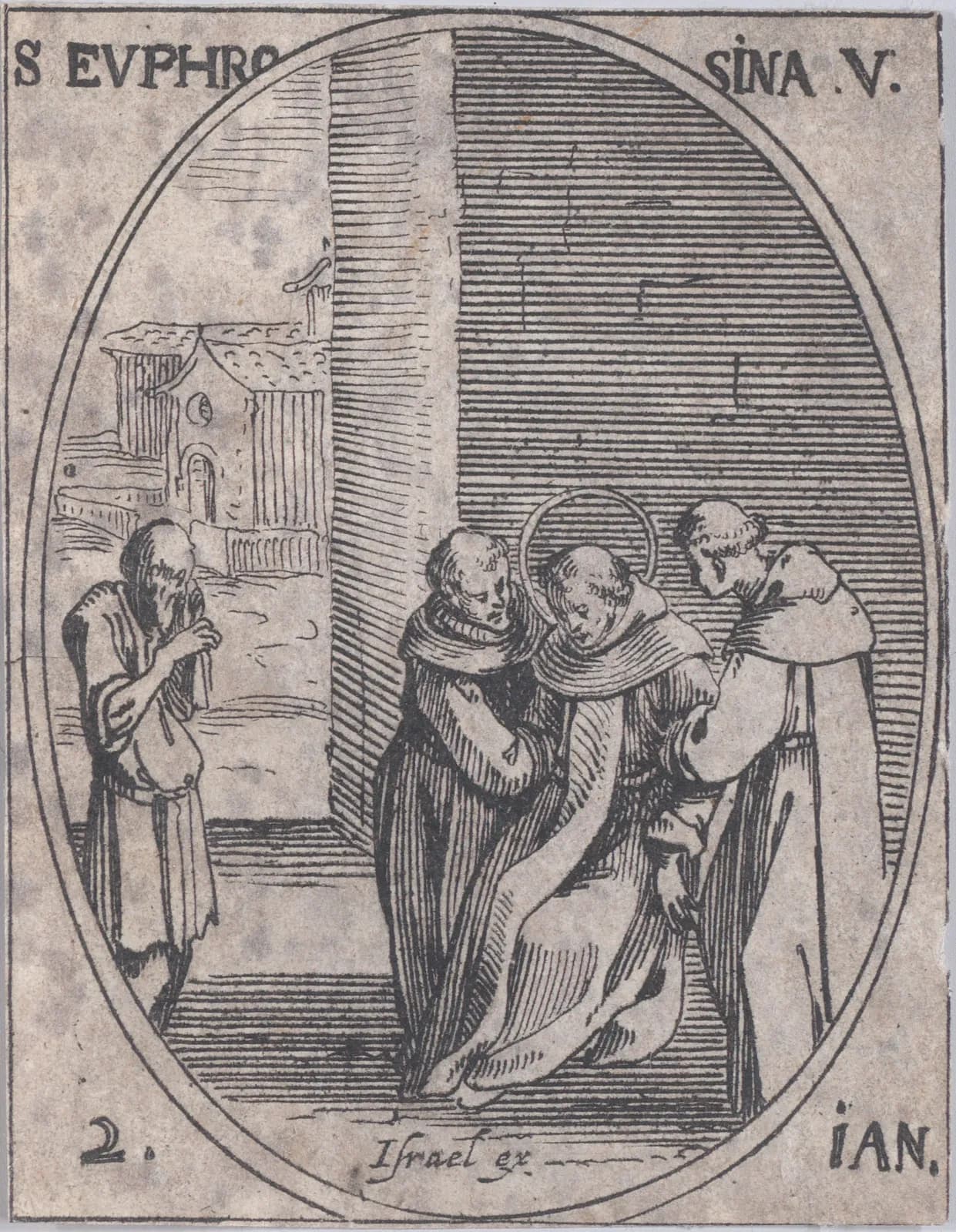
- Historical record
- Known only from her legend, which the encyclopedia groups with other legends of women disguised as monks 12
- Relics
- At Boulogne and at the monastery of Saint John at Beaulieu in Picardy, says katolsk.no 2
Saint Euphrosyne of Alexandria is remembered by a story: the only daughter of a rich and devout man, promised in marriage, she cut her hair, put on men's clothes and entered a monastery near the city as a monk named Smaragdus. 13 There, by her legend, she lived thirty-eight years, and her own father, grieving for his lost daughter, came to her for comfort without knowing her. 12 She told him who she was only as she was dying, about 470. 12
A legend, and an old one
J.P. Kirsch, writing in the 1909 Catholic Encyclopedia, is clear about what kind of text this is. Her story "belongs to that group of legends" in which Christian virgins, the better to keep the celibate and ascetic life they had chosen, "put on male attire and passed for men." 1 He follows "the narrative of her life in the 'Vitæ Patrum'" and dates her death to about 470. 1 The Norwegian bishops' saints database (katolsk.no) opens its account with the words "according to the legend." 2
katolsk.no notes that such stories were popular in the early and medieval Church, and that biographers have often passed over them as unsupported or as faintly scandalous. 2 It argues that for a woman of that time men's dress could be a matter of plain prudence, giving her freedom to travel or live alone without fear of violence, and that monastic life for men developed long before communities for women existed to receive her. 2 Among the other women told of in the same way it names Marina, Pelagia, Theodora of Alexandria and Eugenia of Rome. 2
The life was widely read. It was turned into Old English and copied among the lives of saints gathered by Aelfric of Eynsham, and Walter W. Skeat, who edited it, notes that Latin collections attribute it to an unknown author or to Symeon Metaphrastes. 3 The account below follows that Old English life, in Skeat's translation, alongside Kirsch and katolsk.no. 123
A daughter promised in marriage
Her father, Paphnutius, was a wealthy man of Alexandria, and he and his wife were childless for years. 23 He made friends with the abbot of a monastery near the city, who prayed with him for a child, and a daughter was born; they had her baptized at seven and named her Euphrosyne. 3 Her mother died when she was twelve, and her father taught her the Scriptures himself. 23 Many sought her in marriage, and Paphnutius answered each, "God's will be done," until he promised her to a young man richer than the rest. 3
At eighteen she went with her father to the monastery to receive the abbot's blessing before her wedding, and stayed seven days listening to the monks sing. 3 "Blessed are these men who in this world are like unto the angels," she said. 3 katolsk.no says she began quietly selling her jewelry and giving to the poor. 2 In the Old English life she sent for a monk while her father was away, asked his counsel, and begged him to bless her and cut her hair; he clothed her in the monastic habit. 3 katolsk.no says she received the veil secretly from a wandering monk. 2
She knew her father would search the convents of women. 23 "I will go to a man's minster where no man will suspect me," the Old English life has her say, and she left home at evening in men's clothing, with fifty gold pieces. 3 She went to the same monastery her father visited and introduced herself as Smaragdus, a eunuch from the household of the emperor Theodosius who wished to become a monk. 23
Smaragdus
The abbot received her and gave her to a monk named Agapitus as his disciple. 3 Her beauty troubled the brethren, and the abbot sent for her and said, "thy countenance is beautiful, and to the brothers cometh great ruin on account of their frailty." 3 He gave her a cell of her own, where she was to sing the hours and eat alone. 23 katolsk.no says she spent the next thirty-eight years there in work, fasting and prayer, and became known for holiness and spiritual wisdom. 2
Paphnutius, meanwhile, searched for her. The Old English life has him send riders through Alexandria and Egypt, to the ships, the convents, the deserts and the caves, and then mourn her as if she were dead: "What wolf hath seized my lamb?" 3 The monks fasted and prayed a week for a sign and none came, because, the life says, she herself prayed day and night never to be discovered. 3
At last the abbot sent the grieving father to talk with the young monk Smaragdus. 123 She knew him at once and wept; he took the tears for devotion and did not recognize her, worn thin as she was by fasting, and she drew her cowl over her face. 23 She spoke to him of the kingdom of heaven, told him that "tribulation worketh patience," and promised to pray for him. 3 He went away saying he felt as glad as if he had found his daughter. 3 katolsk.no says he went on coming to her for counsel for thirty-eight years. 2 Kirsch sums it up: "The father received from his own daughter, whom he failed to recognize, helpful advice and comforting exhortation." 1
The revelation
After thirty-eight years Smaragdus fell ill, and Paphnutius came and sat by the bed, lamenting that the monk who had comforted him was leaving him too. 3 Smaragdus asked him to stay three days. 3 On the third day she told him: "Verily I, miserable one, am she herself; and thou art Paphnutius my father." 3 katolsk.no says she asked that no one but he should prepare her body for burial. 2 Then she died. 3
In the Old English life her father collapsed beside her, and when Agapitus raised him he said, "Let me here die; verily I have seen God's miracle to-day." 3 The abbot came and fell on the body, and the brethren, burying her, found that she was a woman and "gloried in God, Who in the womanly and tender nature worketh such wonders." 3 A brother blind in one eye kissed the body and received his sight. 3
Kirsch and katolsk.no agree that Paphnutius then entered the monastery himself. 12 He gave much of his fortune to the poor and to the monks, and lived ten years in his daughter's cell; when he died he was buried beside her. 23
What is Saint Euphrosyne the patron saint of?
None of the sources consulted names a patronage for Saint Euphrosyne. 12 katolsk.no says that much of her relics came to Boulogne and to the monastery of Saint John at Beaulieu in Picardy, and that her day has since been kept with a great feast at Beaulieu-les-Fontaines, near Compiègne. 2 In art she is shown in a monk's habit, and the scene of her identity revealed is the favorite subject. 2
Saint Euphrosyne's feast day
Saint Euphrosyne's feast day is January 1, the day katolsk.no gives for her death and her place in the Roman Martyrology. 2 The 1897 English edition of that Martyrology recorded on January 1, "At Alexandria, the departure from this world of St. Euphrosyna, virgin, who, in her monastery, was renowned for the virtue of abstinence, and the gift of miracles." 4 The santoral of the Archdiocese of Madrid still lists her among the saints of January 1. 6
Other calendars keep other days. Kirsch gives January 16 for the Roman Church, February 11 for the Carmelites and September 25 for the Greek Church. 1 katolsk.no adds February 11 in the Nordic calendars, and further Eastern dates. 2 Skeat notes that Aelfric's own calendar placed her on February 11. 3 The current Roman Martyrology, as the Italian bishops print it, does not list her on January 1 among the saints of the day. 5
Praying with Saint Euphrosyne
The legend is built around a hard choice. Euphrosyne loved her father, and the Old English life gives her the words: "I dare not be disobedient to my father, and I know not what to do as to this." 3 She chose the monastery over the marriage, and the cost fell on him as much as on her. 23
Then the story does something unexpected. It sends the father to the daughter he lost, and lets her comfort him for years without either of them closing the distance. 12 katolsk.no notes that the moment of recognition became the favorite subject for artists. 2 The legend never says which of the two had the better claim.
She did not explain herself until she was dying, and even then she asked him to keep it quiet. 23 The life does not tell the reader whether she was right to wait so long. It ends with the father in her cell, living the life she chose, and the two of them buried side by side. 23
Saint Euphrosyne of Alexandria, pray for us.
Sources
- 1.J.P. Kirsch, "St. Euphrosyne," The Catholic Encyclopedia, Vol. 5 (New York: Robert Appleton Company, 1909).
- 2."Den hellige Eufrosyne av Alexandria (~415-~470)," Den katolske kirke (katolsk.no), Catholic Diocese of Oslo (in Norwegian).
- 3."St. Eufrasia (or Euphrosyne), Virgin," Old English text with translation, and editor's note, in Aelfric's Lives of Saints, Vol. 2, ed. Walter W. Skeat (London: Early English Text Society, 1900), Internet Archive.
- 4.The Roman Martyrology, January 1 (Baltimore: John Murphy Company, 1897).
- 5."Santo del giorno," January 1, Conferenza Episcopale Italiana, following the Roman Martyrology (in Italian).
- 6.Santoral for January 1, 2026, Oración y Liturgia, Archdiocese of Madrid (in Spanish).
Saints to turn to next
Others in this collection who are turned to for some of the same things.
- Saint Catherine of Sweden1331 or 1332 - March 24, 1381Marriage and familyDiscernment
- Saint Ethelburga of Faremoutiersd. 664 or 695DiscernmentMarriage and family
- Saint Melania the Youngerc. 383 - December 31, 439 (or 440)Marriage and familyDiscernment
- Saint Nicholas of FlüeMarch 21, 1417 - March 21, 1487DiscernmentMarriage and family