Saint Melania the Younger
c. 383 - December 31, 439 (or 440)
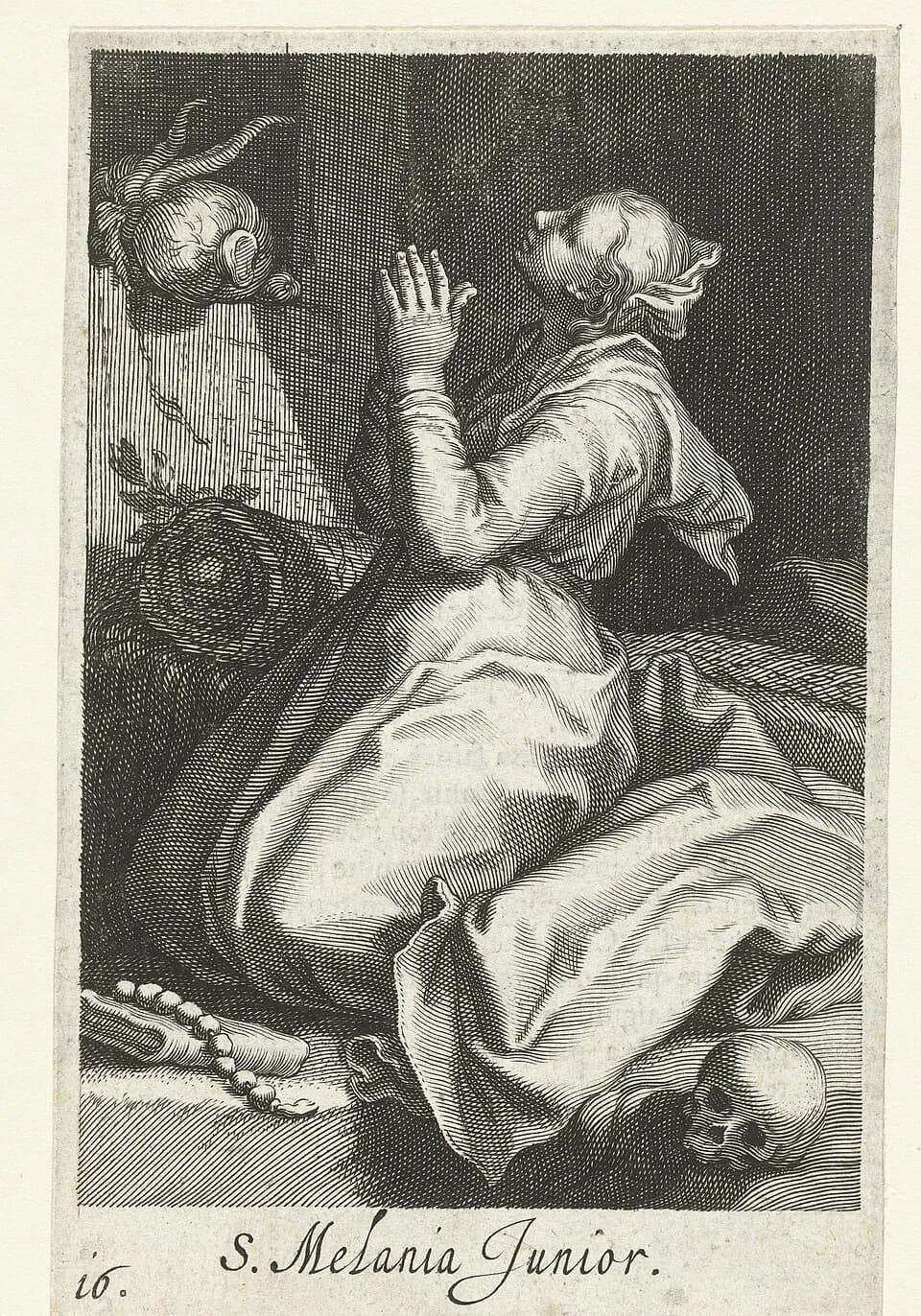
- Born
- About 383, in Rome, to Publicola and Albina of the Valerii 1
- Known for
- Giving away one of the great fortunes of Rome and founding monasteries in Africa and Jerusalem 123
- Left Rome
- 408, for Sicily; Africa from 410; Palestine from 417 1
Saint Melania the Younger was the heiress of one of the richest families in Rome, married at thirteen or fourteen, who persuaded her husband to live as her brother and then, little by little, gave the fortune away. 12 The road took them from Rome to Sicily, to Saint Augustine's Africa, and at last to the Mount of Olives in Jerusalem, where she founded monasteries and died on the last day of the year. 1 The Church remembers her on December 31. 5
An heiress of the Valerii
She was born in Rome about 383, "a member of the famous family of Valerii," the daughter of Publicola and Albina. 1 Her father's mother, also named Melania, is the one history calls Melania the Elder, and the granddaughter is "the Younger" to tell them apart. 13 The Catholic Encyclopedia admits that many writers have "wholly or partially confounded" the two. 1
The French edition of Aleteia credits the grandmother with planting the idea of the monastic life in her. The elder Melania had sold her property and gone to found a monastery in Jerusalem. 2 The same article sets the scene with a detail a modern reader may not expect in a saint's life: the family held slaves by the thousand to work its estates. 2
Little is known of her childhood. 1 Her parents married her young to a relative, the patrician Pinianus. The encyclopedia says it happened "in her thirteenth year" and "through obedience to her parents"; Aleteia says she was fourteen, and that it went against what she wanted. 12
The bargain with Pinianus
The marriage lasted seven years in the ordinary way, and in that time she had two children, who both died young. 1 After their deaths, the encyclopedia says, her "inclination toward a celibate life" reasserted itself, and "she secured her husband's consent." 1
Aleteia gives the terms of her appeal as the bishop and writer Palladius recorded them. She told her husband that if he would live with her in chastity she would acknowledge him as lord of her life, and that if he found that too heavy, being young, he could keep all her property and let her go free. 2 He chose to stay. In the encyclopedia's words Pinianus "now assumed a brotherly position toward her" and "was her companion in all her efforts toward sanctity." 1
Then the two of them began to part with what they owned, "little by little," as the encyclopedia puts it. 1 According to Aleteia this included freeing eight thousand slaves, each of whom was given a small sum of money. 2 The same article says that the dismantling of so large a senatorial fortune met resistance, and that the couple succeeded only because the Christian empress Serena took their side against the senators. 2
Sicily and Africa
In 408, with the Visigoths invading Italy, they left Rome. For two years they lived near Messina in Sicily, in a household "of a monastic character" that some of their former slaves shared. 1 In 410 they crossed to Africa, where Melania and Pinianus lived with her mother Albina for seven years. 1
They were at Thagaste, the birthplace of Saint Augustine, and the encyclopedia says Melania came to know both him and his friend Alypius well. 16 A letter of Augustine to the three of them, dated 411, survives. He apologizes at length for not having come to greet them, calls them "lights kindled into vehement flame by the Supreme Light," and promises to visit "in whatsoever part of Africa you may be." 6
In Africa, the encyclopedia says, Melania gave herself to works of charity and founded a convent of nuns, of which she became superior, and a cloister of men that Pinianus took in charge. 1 Augustine remarks that the church of Thagaste gained nothing from their gifts "but the joy of seeing your good work." 8
The uproar at Hippo
One episode from these years is known in detail because Augustine had to explain it afterward. When the family came to his own church at Hippo, the congregation began shouting that Pinianus should be ordained a priest for them. 78 Augustine told the crowd that he had promised not to ordain the man against his will, and that if they got their priest by making their bishop break his word, "they could not retain me as their bishop." 8
The noise went on. Pinianus finally offered to swear that he would settle in Hippo, provided no one forced the clerical office on him. 8 While the wording was being worked out, Augustine records, "the holy Melania wished to add also, as a possible reason for departure, the unhealthiness of the climate," and her husband talked her out of it. 8
Albina was not appeased. She accused the people of Hippo of wanting a rich man for his money, and Augustine understood that she, her daughter and her son-in-law suspected him of the same thing. 7 He did not take offense. "I am not angry with the pious Albina," he wrote to Alypius; the suspicion needed curing, not rebuking. 7 His long letter to Albina herself argues that the people had admired Pinianus for his "contempt of money." 8
The friendship survived. Later the three wrote to Augustine about a meeting with Pelagius, whom they had pressed to condemn in writing the errors charged against him, and Augustine answered with a treatise, On the Grace of Christ, addressed to "Albina, Pinianus, and Melania." 9
Jerusalem and the Mount of Olives
In 417 the three of them went to Palestine by way of Alexandria. 1 They spent a year in a hospice for pilgrims in Jerusalem, where Melania met Saint Jerome, and when money arrived from the sale of her estates in Spain she gave that away as well. 1 She traveled in Egypt to see the places where the monks and hermits lived, and on her return shut herself for twelve years in a hermitage near the Mount of Olives. 1
Her mother died in 431. 1 By then Melania had begun to build: first a convent for women on the Mount of Olives, which she supported while refusing to be its superior, and, after Pinianus had died, a cloister for men, a chapel and a larger church. 1 The Italian edition of Vatican News describes what the couple made in Jerusalem as a kind of monastic community on the model of those of the East. 3
She made one more long journey. In November 436 she went to Constantinople, where she helped bring her pagan uncle Volusian to the faith. He was there as an ambassador at the court of Theodosius II. 1 In 438 the emperor's wife, Eudocia, traveled to Jerusalem, and soon after the empress went home Melania died. 1 The encyclopedia dates her death December 31, 439; Vatican News says 440. 13
What is Saint Melania the Younger the patron saint of?
Saint Melania the Younger's feast day
Saint Melania the Younger's feast day is December 31, the day she died. The Roman Martyrology has her entry on that date: at Jerusalem, Saint Melania the Younger, who left Rome with her husband, Saint Pinian, and went to the Holy City, where she lived among the women consecrated to God and he among the monks, and where both died a holy death. 5 Aleteia gives the same day, and Vatican News lists her on 31 December beside Pope Saint Sylvester. 24
Her cult in the West is recent. The Greek Church venerated her soon after her death, the encyclopedia says, but Western interest dates from 1905, when Cardinal Rampolla published her life from two manuscripts, one Latin and one Greek. 1 In 1908 Pius X granted her office to the congregation of clergy at Somascha, which the encyclopedia calls "the beginning of a zealous ecclesiastical cult." 1
Praying with Saint Melania the Younger
Melania did nothing quickly. The encyclopedia's phrase for how she gave up her wealth is "little by little," and the dates bear it out: the proceeds of her Spanish estates were still arriving in Jerusalem more than a decade after she began. 1 Giving away a fortune of that size turned out to be long, practical work.
She also did very little alone. Her husband went with her at every step, and her mother traveled with them from Africa to Jerusalem. 1 The Martyrology remembers the couple in a single sentence and calls both of them saints. 5 What began as a marriage arranged by her parents became, on the evidence of every source, a partnership that lasted until his death. 12
Augustine's letters show the family as people. They could be suspicious and aggrieved, and Melania at one tense moment wanted to write an escape clause about the climate into a solemn oath. 78 Augustine loved them anyway and said so. 6
Her children died, and the sources say nothing more about them than that. 12 The encyclopedia connects their deaths with the change in her life without explaining it, and this page does not try to. She built her first convent in Jerusalem and declined to govern it. 1
Saint Melania the Younger, pray for us.
Sources
- 1.Carl Schlitz, "St. Melania (the Younger)," The Catholic Encyclopedia, vol. 10 (New York: Robert Appleton Company, 1911).
- 2.Margot Giraud, "Mélanie la Jeune, cette Romaine qui a affranchi 8.000 esclaves," Aleteia (French edition), November 30, 2018 (in French).
- 3."Santa Melania, matrona romana," Santo del giorno, 31 dicembre, Vatican News (in Italian).
- 4."St. Melany, Roman Matron," Saint of the Day, 31 December, Vatican News.
- 5.Roman Martyrology, entry for December 31, "Santa Melania la Giovane," Santo del giorno, Conferenza Episcopale Italiana (in Italian).
- 6.Augustine of Hippo, Letter 124, to Albina, Pinianus and Melania (A.D. 411), trans. J. G. Cunningham, Nicene and Post-Nicene Fathers, First Series, vol. 1 (1887), at New Advent.
- 7.Augustine of Hippo, Letter 125, to Alypius (A.D. 411), trans. J. G. Cunningham, Nicene and Post-Nicene Fathers, First Series, vol. 1 (1887), at New Advent.
- 8.Augustine of Hippo, Letter 126, to Albina (A.D. 411), trans. J. G. Cunningham, Nicene and Post-Nicene Fathers, First Series, vol. 1 (1887), at New Advent.
- 9.Augustine of Hippo, On the Grace of Christ, and on Original Sin, book I, trans. Peter Holmes and Robert Ernest Wallis, rev. Benjamin B. Warfield, Nicene and Post-Nicene Fathers, First Series, vol. 5 (1887), at New Advent.
Saints to turn to next
Others in this collection who are turned to for some of the same things.
- Saint Agnes of Bohemiac. 1200-1205 - March 1281 or 1282Poverty and simplicityDiscernment
- Saint Albert ChmielowskiAugust 20, 1845 - December 25, 1916Poverty and simplicityDiscernment
- Saint Alexius of RomeFifth century, by traditionPoverty and simplicityMarriage and family
- Saint Benedict Joseph Labre1748 - April 16, 1783Poverty and simplicityDiscernment