Saint Hilary of Arles
c. 400 - May 5, 449
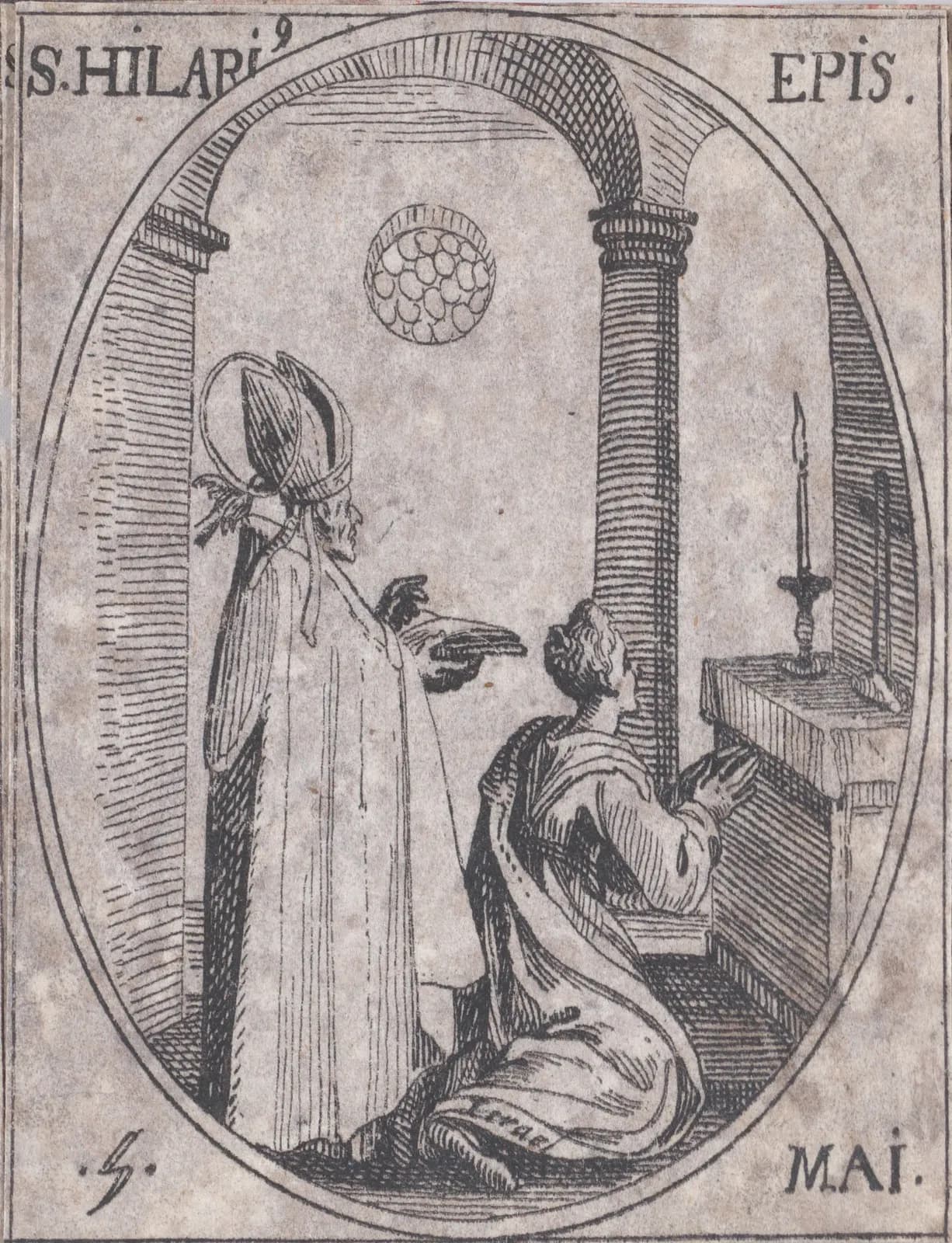
Saint Hilary of Arles was a rich young Gaul who gave up a promising career to become a monk at Lérins, and was made archbishop of Arles at twenty-nine against his will. 12 The Roman Martyrology remembers a bishop who worked with his hands, wore one tunic summer and winter, went everywhere on foot, and gave the city's church money to ransom captives. 3 He is remembered too for a sharp quarrel with Pope Leo the Great, who curtailed his authority in 445 and four years later called him "Hilary of holy memory." 57
From a career to Lérins
Léon Clugnet, writing in the 1910 Catholic Encyclopedia, says that Hilary was born about 401, that the exact place is not known, and that he came of a notable family of northern Gaul, the family to which Saint Honoratus, his predecessor at Arles, in all probability also belonged. 1 The Norwegian bishops' saints database (katolsk.no) puts his birth about 400 and calls the family aristocratic and pagan. 2 He was gifted and well educated, probably at a school of rhetoric, and as Clugnet puts it he "had everything calculated to ensure success in the world." 12
Honoratus, who had founded a monastery on the island of Lérins off the coast near Cannes, was convinced the young man was meant for something else, and katolsk.no says he left the island for a time to go and persuade him. 2 At first Hilary seemed deaf to it. He later wrote that he was pulled two ways, by the call of God and by the attractions of the world, and that his will swung back and forth until Christ won; katolsk.no notes that his account of it is modeled on Augustine's Confessions. 2 Once decided, he did not look back. He sold his inheritance to his brother, gave the money to the poor, and went to Lérins, where katolsk.no says Honoratus baptized him and received him as a monk. 2 There, in Clugnet's words, he gave himself "up under the saint's direction to the practice of austerities and the study of Holy Scripture." 1
Bishop of Arles
In 426 Honoratus was chosen archbishop of Arles. He was old, and he wanted Hilary with him; Hilary was unwilling to leave the island until Honoratus came in person to fetch him. 2 At Arles, katolsk.no says, he went on living as though he were still in the monastery, keeping its hours of prayer, working with his hands and giving alms. 2
Honoratus died in 429 with Hilary at his side. 12 Hilary set off at once for Lérins and was overtaken on the road. Clugnet says he "was retained by force and proclaimed archbishop"; katolsk.no says messengers caught up with him to say that the people of Arles wanted him, as Honoratus had, and that he let himself be persuaded. 12 He was consecrated at twenty-nine. 2 The Martyrology calls him promoted to the episcopate from the hermitage of Lérins in spite of himself. 3
He kept the monk's life in the bishop's house. The Martyrology says he worked with his own hands, wore a single tunic in summer and in winter, always went on foot, and gave himself to prayer, fasting and vigils; that he preached tirelessly, showed sinners the mercy of God, took in orphans, and put all the money collected by the city's basilicas straight to the ransom of captives. 3 katolsk.no adds that once he sold the sacred vessels to buy prisoners free. 2 Gennadius of Marseilles, writing later in the same century, says that this man "of noble race and very differently brought up, engaged in farming, though it was beyond his strength," so as to live in poverty "not only in religiousness of mind, but also in labour of body." 6 He calls him "an acceptable teacher" who "without regard to persons administered correction to all." 6
Clugnet says he took part in the councils held at Riez, Orange, Vaison and Arles; katolsk.no says he presided over them, and dates the first three to 439, 441 and 442. 12 It also says he built monasteries and visited them, and that Prosper of Aquitaine accused him of semi-Pelagianism because he did not share Augustine's view of grace. 2
The quarrel with Pope Leo
Clugnet calls what followed "one of the most curious phases of the history of the Gallican Church." 1 The boundaries of Hilary's authority in southern Gaul had never been clearly drawn, katolsk.no says, and J. P. Kirsch, in the encyclopedia's article on Leo, says that Hilary "made excessive use of his authority over other ecclesiastical provinces." 27 About 444 he presided over a meeting of bishops, Saint Eucherius of Lyons and Saint Germanus of Auxerre among them, that deposed Bishop Celidonius of Besançon. 127 The charges were that Celidonius had married a widow before his ordination and, as a magistrate, had consented to a death sentence; either would have barred him from the episcopate. 27 Hilary consecrated a successor named Importunus. 7
Celidonius went to Rome to appeal, and Hilary followed him there. 27 About the same time a second complaint arrived: Hilary had consecrated a new bishop for the see of Projectus, who was gravely ill, and then Projectus recovered. 27 Pope Leo held a synod about 445. The charges against Celidonius could not be proved, and he and Projectus were both restored to their sees. 7 katolsk.no says that Hilary came to argue that the case should have been heard by papal commissioners in Gaul, and that, feeling himself watched and fearing he would be made to receive communion with Celidonius, he left Rome secretly before judgment was given. 2
Leo's account of all this survives in his letter to the bishops of the province of Vienne, and it is not gentle. He accuses Hilary of "novel arrogance," of coveting "a reputation for the swiftness of a courier rather than for the sobriety of a priest," of moving through the provinces with "a band of soldiers," and of "his usual untruthfulness." 4 He says that Hilary, called to answer, "trusted to make good his escape by disgraceful flight, and has put himself out of Apostolic communion." 4 Clugnet says simply that the pope excommunicated him. 1 Leo restricted him to the single see of Arles, forbade him to take part in any ordination, and asked that Leontius, a senior bishop, be given the precedence. 4 Clugnet and katolsk.no say the prerogatives of Arles were transferred to the see of Fréjus. 12 An edict of the emperor Valentinian III, dated July 8, 445, backed the pope's measures. 7
Clugnet and katolsk.no weigh the quarrel differently. katolsk.no suggests that his youth let his zeal outrun his discretion, and says Leo decided rightly that his action over Projectus was unlawful. 2 Clugnet declines to judge at all: the documents, he says, are "too few to allow us to form a definitive judgment," and the dispute "evidently arose from the fact that the respective rights of the Court of Rome and of the metropolitan were not sufficiently clearly established at that time." 1
Reconciliation and death
Kirsch says that once back in his diocese Hilary sought a reconciliation with the pope, and that "after this there arose no further difficulties between these two saintly men." 7 katolsk.no says that he defended himself to Leo but on both occasions submitted to the pope's authority, and that little is known of his last years beyond his work in his own diocese. 2
He died at Arles on May 5, 449, according to Clugnet; katolsk.no gives 449, in his forty-ninth year. 12 On August 22 of that year Leo wrote to the bishops of the province of Arles to approve their choice of Ravennius as bishop, "on the death of Hilary of holy memory." 5 Gennadius, writing later, says only that he died "during the reign of Valentinianus and Martianus." 6 In 450, Kirsch says, Leo gave back to Ravennius the rights his predecessor had lost. 7
Gennadius praises his few writings for their "immortal genius," and singles out "his Life of Saint Honoratus, his predecessor" as a work "of so great practical value to many." 6 katolsk.no says he is remembered chiefly for that discourse on the life of Honoratus, which survives. 2 Clugnet notes that a number of other writings carry his name but are "far from being all authentic." 1
What is Saint Hilary of Arles the patron saint of?
Saint Hilary of Arles's feast day
Praying with Saint Hilary of Arles
Hilary's own description of his conversion is of a will that swung back and forth for a long time before it settled. 2 Once it settled, he gave away his inheritance and never took the career back up, even when he had a great see to run. 23 He farmed, by Gennadius's account, beyond what his body could manage, and sold the church's vessels for prisoners. 26
He was also, by the testimony of a pope the Church also keeps as a saint, high-handed, hasty and hard to deal with. 4 Leo's letter is the angry document of one side, and Clugnet warns against reading too much into it. 1 Still, it is there, and the Church kept both men on the calendar.
What ended the quarrel is told in a single sentence of Kirsch's: the bishop went home and sought a reconciliation. 7 Four years later the man Leo had called untruthful was, in Leo's own letter, "Hilary of holy memory." 45
Saint Hilary of Arles, pray for us.
Sources
- 1.Léon Clugnet, "St. Hilary of Arles," The Catholic Encyclopedia, Vol. 7 (New York: Robert Appleton Company, 1910).
- 2."Den hellige Hilarius av Arles (~400-449)," Den katolske kirke (katolsk.no), Catholic Diocese of Oslo (in Norwegian).
- 3.Roman Martyrology, entry for May 5, "Sant'Ilario di Arles, vescovo," as printed in "Santo del giorno," Conferenza Episcopale Italiana (in Italian).
- 4.Leo the Great, Letter 10, to the Bishops of the Province of Vienne, trans. Charles Lett Feltoe, Nicene and Post-Nicene Fathers, Second Series, Vol. 12 (Buffalo, NY: Christian Literature Publishing Co., 1895), via New Advent.
- 5.Leo the Great, Letter 40, to the Bishops of the Province of Arles, August 22, 449, trans. Charles Lett Feltoe, Nicene and Post-Nicene Fathers, Second Series, Vol. 12 (Buffalo, NY: Christian Literature Publishing Co., 1895), via New Advent.
- 6.Gennadius of Marseilles, Lives of Illustrious Men, ch. 70, trans. Ernest Cushing Richardson, Nicene and Post-Nicene Fathers, Second Series, Vol. 3 (Buffalo, NY: Christian Literature Publishing Co., 1892), via New Advent.
- 7.J. P. Kirsch, "Pope St. Leo I (the Great)," The Catholic Encyclopedia, Vol. 9 (New York: Robert Appleton Company, 1910).
Saints to turn to next
Others in this collection who are turned to for some of the same things.
- Saint Andrew Corsinic. 1302 - January 6, 1374ConversionPoverty and simplicityWork and vocation
- Saint CajetanOctober 1480 - August 7, 1547Work and vocationPoverty and simplicityConversion
- Saint Guntramd. March 28, 592 or 593ConversionWork and vocationPoverty and simplicity
- Saint John Francis RegisJanuary 31, 1597 - December 1640Work and vocationPoverty and simplicityConversion