Saint Guntram
d. March 28, 592 or 593
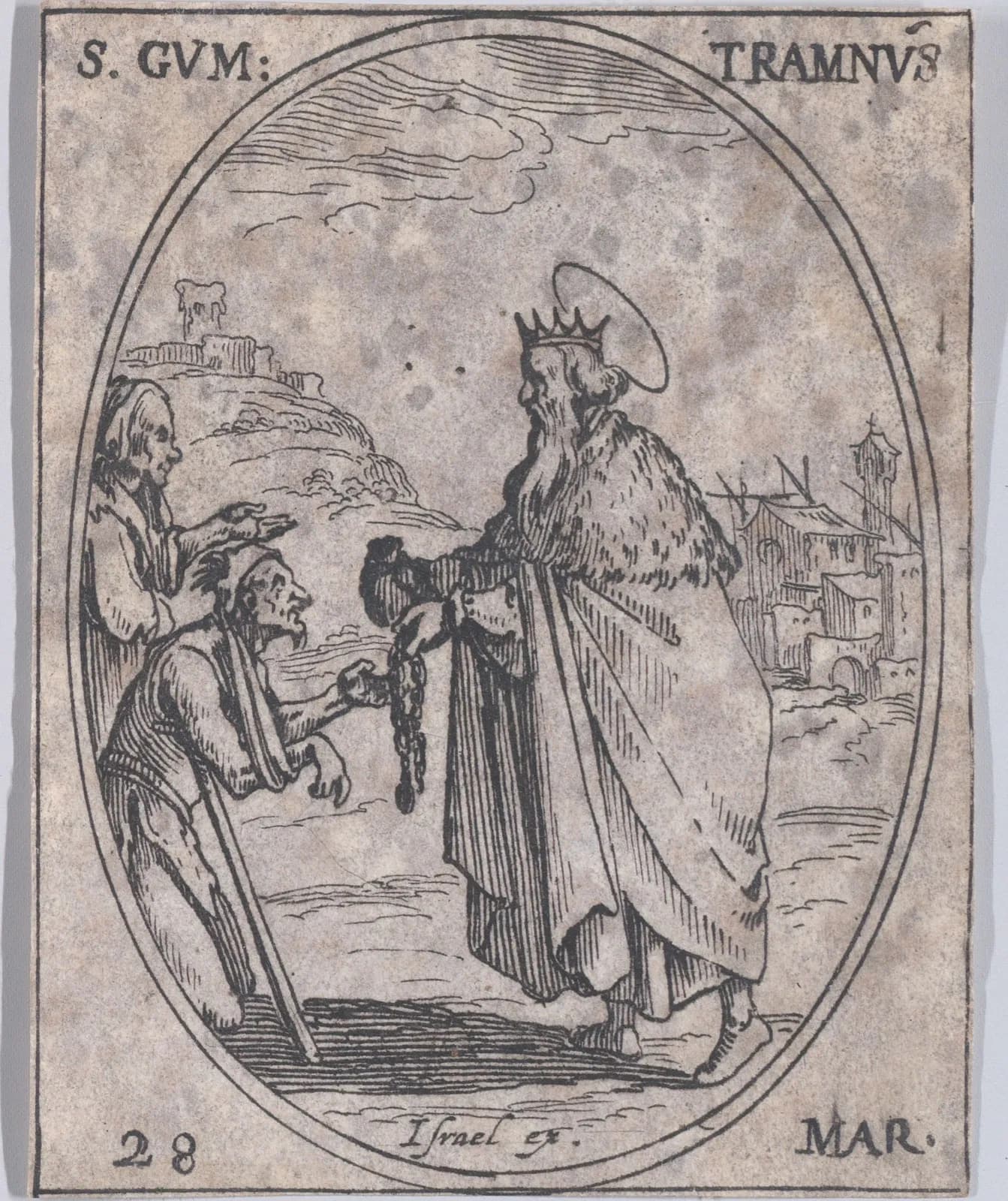
Saint Guntram was a Frankish king, a grandson of Clovis, who ruled Burgundy from 561 until his death in the 590s. 25 Gregory of Tours, who knew him, calls him "the good king Gunthram" and describes a man of great almsgiving, fasting and prayer who once ordered public penance against a plague "like a good bishop." 1 The same Gregory records that he took a concubine, had two physicians put to death at his dying wife's demand, and had his chamberlain stoned over a dead buffalo, which he afterward regretted. 1
A king among brothers
Guntram was a son of King Clotaire I and a grandson of Clovis I and Saint Clotilde. 24 When Clotaire died in 561 his realm was divided among four sons, much as Clovis's had been in 511. 5 Godefroid Kurth, in the Catholic Encyclopedia, lists the shares: Guntram reigned at Orleans, Charibert at Paris, Sigebert at Reims and Chilperic at Soissons. 5 Alban Butler puts Sigebert at Metz and says Guntram was crowned king of Orleans and Burgundy, with Chalon-sur-Saône as his capital. 2 Kurth notes that "Gontran's kingdom continued to be called Burgundy." 5
The brothers spent the next twenty years at war with one another, and Gregory of Tours, bishop of Tours through much of it, wrote it all down. 16 Henri Leclercq, writing on Gregory in the same encyclopedia, says that after Chilperic's death Tours passed to Guntram, and that Gregory "had long known Guntram and was known and trusted by him." 6 Gregory himself traveled to Chalon as an envoy of Guntram's nephew Childebert and found the king there. 1 Butler says that when Guntram was forced into war, against his brothers and against the Lombards, he used his victories only to give his lands peace. 2
The marriages and the physicians
Gregory does not hide the king's household. "The good king Gunthram first took a concubine Veneranda, a slave belonging to one of his people," he writes, and she bore him a son, Gundobad. 1 Guntram then married Marcatrude, who, Gregory says, was rumored to have poisoned the boy once she had a son of her own; she lost that son, fell out of the king's favor, was sent away and died not long after. 1 Next he married Austrechild, also called Bobilla, who bore him two sons, Clothar and Chlodomer. 1 Both sons died, and in a chapter list Gregory notes that the king lost his two sons and adopted his nephew Childebert. 1
When Austrechild was dying in an epidemic, she blamed her doctors and made the king swear to have them killed. 1 Gregory says he did it, "forced by the oath to his cruel wife," and adds that "the wisdom of many believes that this was not done without sin." 1 Leclercq gives a starker version: Guntram, "one of the best of the Frankish kings, put to death two physicians because they were unable to restore Queen Austrechilde to health." 6 Butler lists this killing and the putting away of Marcatrude as "crimes laid to his charge," and says he "effaced by tears of repentance" what the barbarous manners of his people had drawn him into. 2
Guardian of the kingdom
In time Sigebert and Chilperic were both murdered, and Guntram was left as the senior king of the Franks, with two small nephews to protect: Sigebert's son Childebert and Chilperic's infant son Clothar. 1 Gregory says that when Guntram took over Chilperic's lands he restored by due process what Chilperic's men had seized, gave much to the churches, carried out bequests to churches that Chilperic had overturned, and "gave much to the poor." 1
He did not trust the people of Paris and went to church under armed guard. 1 One Sunday, Gregory writes, as the deacon called for silence before Mass, the king turned to the congregation: "I adjure you, men and women who are present, to think it worth while to keep unbroken faith with me, and not to kill me as you lately did my brothers, and to allow me for three years at least to help my nephews who have become my adopted sons." 1 Gregory says the people answered by praying to the Lord for him. 1
The danger was real. At the festival of Saint Marcellus in Chalon, as Guntram approached the altar for communion, a man came up to him and a knife fell from his hand; another was found unsheathed. 1 The man confessed he had been sent to kill the king, and Gregory says Guntram let him live, beaten but not executed, "because he thought it a crime that a man should be led out of church and beheaded." 1 Butler adds that he spared another assassin sent by Queen Fredegonde because that man too had taken shelter in a church. 2
Kurth records that Guntram tried in vain to take Septimania from the Visigoths and had to defend himself against a pretender, Gondowald, who claimed to be a son of Clotaire. 5 Leclercq quotes an edict of his that begins: "We believe that the Lord, who rules all things by His might, will be appeased by our endeavours to uphold justice and right among all people." 6
A king like a bishop
The fullest picture of Guntram's piety comes when plague reached Marseilles and spread toward Lyons. 1 Gregory writes that the king "was great in almsgiving and unwearied in watches and fasting," and that "like a good bishop" he called everyone to church to pray, ordered them to eat nothing but barley bread and water, and gave alms more generously than ever for three days. 1 He showed such fear for all the people, Gregory says, "that he was now believed to be not merely a king but a bishop of God." 1
In that crowd, Gregory reports, a woman whose son lay ill with fever came up behind the king, broke off a piece of the fringe of his cloak, soaked it in water and gave it to the boy, who recovered. 1 "I do not regard this as doubtful," Gregory adds, saying he had himself heard people possessed by demons call on the king's name. 1 Butler says Gregory records many miracles worked by Guntram before and after his death, some of which Gregory witnessed. 2
His temper did not vanish. Hunting in the Vosges, he found that a buffalo, as Brehaut translates it, had been killed in the royal forest, and the keeper accused the chamberlain Chundo. 1 A trial by combat left both fighters dead, and Guntram had Chundo seized before he could reach sanctuary and stoned. 1 Gregory writes that afterward "the king was very penitent at having shown himself so headlong in anger as to kill hastily for a trifling guilt a man who was faithful and useful to him." 1
Death and burial
Butler says Guntram died on March 28, 593, in the sixty-eighth year of his age, after reigning thirty-one years and some months. 2 Kurth and CatholicCulture give the year as 592. 45 His kingdom passed to his nephew Childebert II. 5 He was buried in the church of Saint Marcellus at Chalon, which he had founded, and the Roman Martyrology marks his burial there. 23 CatholicCulture says his subjects proclaimed him a saint almost at once. 4 Butler adds that the Huguenots scattered his remains in the sixteenth century and that only his skull survived, kept in a silver case. 2
What is Saint Guntram the patron saint of?
None of the sources consulted names a patronage for Saint Guntram. 1234 What the Martyrology chooses to remember is that he gave his treasures to the churches and the poor. 3 Butler presents him as a model of a ruler who governed by the gospel, and points out that Saint Hugh of Cluny held him up as an example to King Philip I of France. 2
Saint Guntram's feast day
Praying with Saint Guntram
Guntram is an uncomfortable saint, and the sources do not try to make him comfortable. 12 Gregory praises him and, in the same pages, records the concubine, the physicians and the stoning, and says plainly that many thought the physicians' deaths a sin. 1
What the sources set beside those things is repentance. Butler speaks of crimes effaced by tears, and Gregory shows a king who could spare the man sent to kill him because the man was standing in a church, and who grieved over the servant he had killed in anger. 12
He also carried a kingdom that was not his own for the sake of two boys, and asked a congregation he did not trust for three years to do it. 1 In time of plague he kept watch and fasted, called his people to barley bread and water, and gave away more than usual. 1 The Martyrology remembers the giving and nothing else. 3
Saint Guntram, pray for us.
Sources
- 1.Gregory of Tours, History of the Franks (c. 594), Books IV-X, translated (extended selections) by Earnest Brehaut (New York: Columbia University Press, 1916), in the Internet Medieval Sourcebook (Fordham University).
- 2.Alban Butler, "St. Gontran, King and Confessor," March 28, in The Lives of the Fathers, Martyrs, and Other Principal Saints, Vol. III (New York: P. J. Kenedy, 1903), via Project Gutenberg.
- 3.Roman Martyrology, entry for March 28, "San Guntramno, re dei Franchi," as printed in "Santo del giorno," Conferenza Episcopale Italiana (in Italian).
- 4."St. Gontran or Guntramnus," Liturgical Year, March 28, CatholicCulture.org (Trinity Communications).
- 5.Godefroid Kurth, "The Franks," The Catholic Encyclopedia, Vol. 6 (New York: Robert Appleton Company, 1909).
- 6.Henri Leclercq, "St. Gregory of Tours," The Catholic Encyclopedia, Vol. 7 (New York: Robert Appleton Company, 1910).
Saints to turn to next
Others in this collection who are turned to for some of the same things.
- Saint Andrew Corsinic. 1302 - January 6, 1374ConversionPoverty and simplicityWork and vocation
- Saint CajetanOctober 1480 - August 7, 1547Work and vocationPoverty and simplicityConversion
- Saint John Francis RegisJanuary 31, 1597 - December 1640Work and vocationPoverty and simplicityConversion
- Saint Leonardo MurialdoOctober 26, 1828 - March 30, 1900Work and vocationPoverty and simplicityConversion