Saint Guthlac of Crowland
c. 673 - April 11, 714
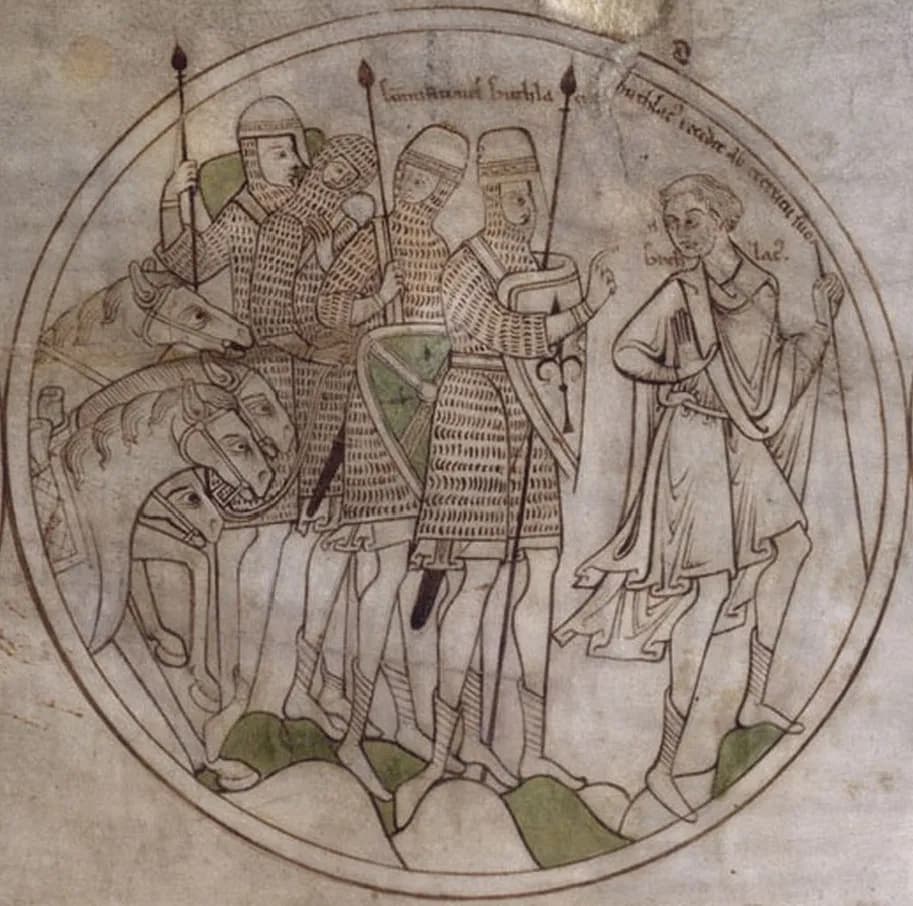
Saint Guthlac of Crowland was a Mercian nobleman who spent his youth leading a war band, gave it up at twenty-four to become a monk, and lived out his last fifteen years as a hermit on a desolate island in the fens of eastern England. 12 He died there on April 11, 714, and the abbey of Crowland grew up over his cell. 12 Almost everything known about him comes from a Life written within a generation by a monk named Felix, who told King Æthelbald that he had it from Guthlac's own old companions. 12
A soldier from a royal house
Guthlac was born about 673, by the reckoning of the 1910 Catholic Encyclopedia, or about 674 according to the Norwegian bishops' saints database. 12 He was of noble stock among the Middle Angles in Mercia. katolsk.no names his parents as Penwald and Tette and says the family was related to the Mercian royal house. 12 Felix records that at his birth a shining hand came down from heaven over the house and blessed it. 2 As a boy he was serious and unusually devout. 12
At about fifteen he went to war. katolsk.no is blunt about what that meant: nine years of what is called a military career and might better be described as a life of plunder and violence, mostly along the Welsh border, which made him rich and drew followers to him from every side. 2 A thirteenth-century catalog of English saints remembered him as "robustus depraedator," a hardy raider. 2 The encyclopedia says that even then "he never quite forgot his early training." 1
Repton and the call to the fens
At twenty-four, in 697, after a night spent thinking over his life, he gave it all up. 2 He was "filled with remorse," says the encyclopedia, and entered the monastery at Repton. 1 It was a double house of monks and nuns where some of the Mercian kings were buried, ruled by an abbess, Ælfthryth. 2 When he took his vows he gave back a third of his plunder to the people he had taken it from. 2 His biographer admits he was not popular at first, chiefly because he would drink nothing intoxicating at all, but the community warmed to him in time. 2
After two years at Repton he wanted something harder. He meant "to emulate the wonderful penance of the Fathers of the Desert." 1 He heard of a place in the fens of Lincolnshire so bleak, and so haunted by spirits and monsters, that no one would live there. 2 This was Crowland, a wet island at a bend in the River Welland that could only be reached by boat. 2 He went there with two companions, about 700; the legend puts his arrival on the feast of Saint Bartholomew, August 24, 699, and Bartholomew became his patron. 12
Fifteen years at Crowland
He fasted every day until sundown and then ate only coarse bread and water. 1 "Like St. Anthony," the encyclopedia says, "he was frequently attacked and severely maltreated by the Evil One." 1 Felix tells of monsters as well as devils; katolsk.no suggests that some of these may have been Britons who had taken refuge in the fens. He was also consoled by visions of angels and of Bartholomew. 2
Like other hermits he grew close to the creatures around him. 12 "The birds and the fishes became his familiar friends," says the encyclopedia. 1 katolsk.no tells how he did not complain of the thieving crows and magpies, saying that people ought to give an example of patience even to wild things. A visitor named Wilfrid was astonished to see two swallows settle on his shoulders, and Guthlac told him that those who live apart from other people become friends of the wild creatures, and that angels visit them too. 2 His biographer says no one ever saw him angry, agitated or sad. 2
Visitors came anyway. The fame of his holiness "brought throngs of pilgrims to his cell." 1 One of them was a bishop, Hedda, who ordained him a priest and consecrated his little chapel. The encyclopedia makes Hedda bishop of Dorchester or of Lichfield; katolsk.no makes him the bishop of Winchester. 12 Another was Æthelbald, a kinsman of the Mercian kings, who spent part of his exile with Guthlac. 12 The hermit told him that he would one day be king. Æthelbald became king in 716. 1
His death, and the abbey
In Holy Week of 714 Guthlac fell ill, said that he would die on the seventh day, and did, "joyfully," on April 11. 1 He sent for his sister Pega, who lived as a hermit nearby at Peakirk, and was buried simply in the earth, as he had asked. 2 A year later, katolsk.no says, Pega had the grave opened to give him a worthier burial and his body was found incorrupt. 2 Miracles were reported at the tomb, which soon drew pilgrims. 1
Æthelbald kept faith with his friend. katolsk.no says he laid the foundation stone of a monastery at Crowland on Saint Bartholomew's day, 716. 2 The encyclopedia credits the monks with turning the fens around it into "one of the richest spots in England." 1 The abbey had a hard history: Danes destroyed it in 870 and killed the abbot, Theodore, and his monks as they said Mass; it burned in 1091; the rebuilding was damaged by an earthquake in 1118 and a fire in 1143. 2 His relics were moved into the abbey church in 1136 and again in 1196. 2 After the dissolution of the monasteries his tomb was so completely destroyed that no trace of it or of the relics has ever been found. 2
Felix's Latin Life, written between 730 and 740, was turned into Old English prose, and an Old English poem on Guthlac, sometimes attributed to Cynewulf, survives in the Exeter Book. 12 katolsk.no acknowledges that some episodes in Felix closely resemble the Life of Saint Antony and Bede's life of Cuthbert, and counts Guthlac second only to Cuthbert among the hermits of England before the Norman Conquest. 2 The Guthlac Roll in the British Library tells his story in a series of drawn roundels, one of which heads this page. 2
What is Saint Guthlac the patron saint of?
Neither source used for this page names a patronage for Saint Guthlac. 12 He was the saint of Crowland and its abbey, and his cult spread from Mercia to Westminster, Saint Albans and Durham and in time across England. 2 In art he carries a scourge. The seal of Henry de Longchamp, abbot of Crowland from 1191 to 1236, shows Bartholomew handing him one, and katolsk.no explains it as a weapon against the devils, not an instrument of penance. 2 A carving at Crowland shows him holding it, with a serpent at his feet. 2
Saint Guthlac's feast day
Saint Guthlac's feast day is April 11, the day of his death. The encyclopedia says that the anniversary "has always been kept as his feast." 1 katolsk.no gives the same date, notes that it was formerly April 12, and adds a feast of the translation of his relics on August 30 and a further commemoration on August 26. 2
Praying with Saint Guthlac
He was not a gentle young man. He led armed men for years and grew rich on what they took, and his conversion began with a night of looking at that honestly. 2 Then he did something about it, and handed back a third of what he had stolen. 2
The fens were his answer to the desert, a place nobody else wanted. 12 Felix filled them with devils, and Guthlac fought them for fifteen years. 12 The same pages show him unbothered by birds stealing from him and unwilling to be angry with anyone. 2 Both are part of the life he chose.
People kept coming to him for advice and prayer, a bishop, a prince in exile, and throngs of pilgrims. 1 He had gone into the marshes to be alone, and he received them. 12
Saint Guthlac of Crowland, pray for us.
Sources
Saints to turn to next
Others in this collection who are turned to for some of the same things.