Saint Gregory II
Died February 11, 731
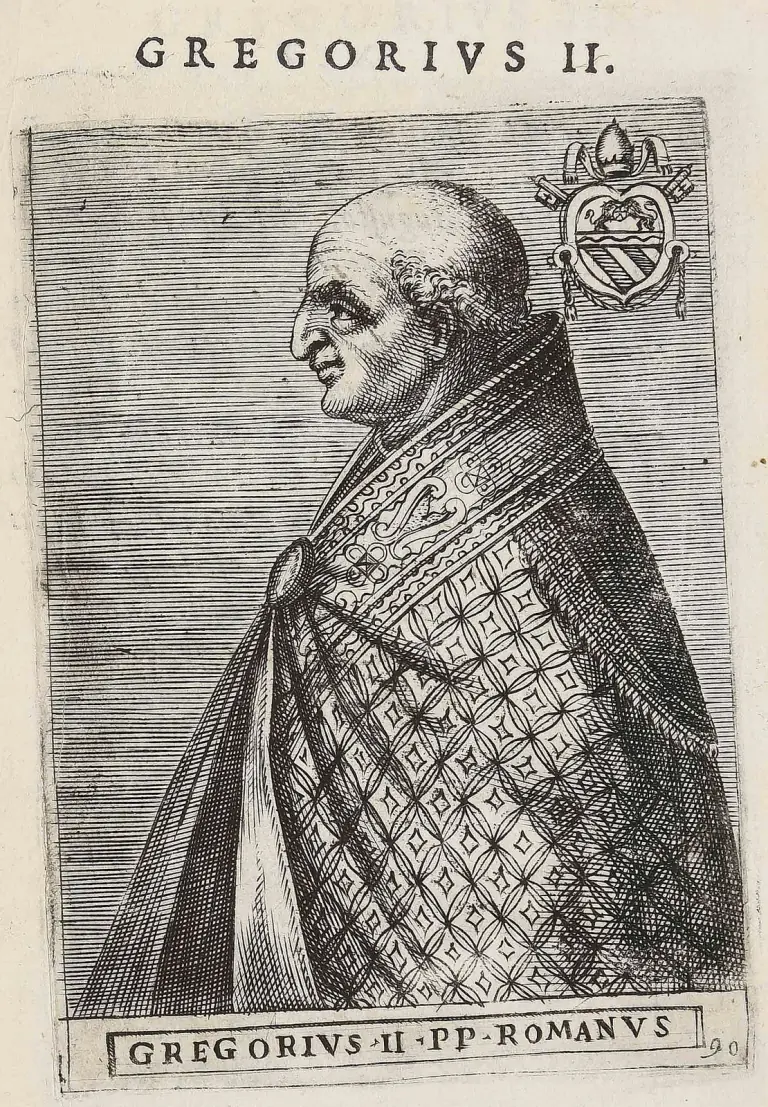
- Known for
- Sending Saint Boniface to preach in Germany; resisting the Emperor Leo III's campaign against the holy images 136
Saint Gregory II was the Roman deacon who became pope in 715 and in 719 sent an English monk named Winfrid, whom history knows as Saint Boniface, to preach the Gospel in Germany. 126 When the Emperor Leo III ordered the holy images destroyed, Gregory refused, and he was still refusing when he died in February 731. 135 The Roman Martyrology keeps him on February 11. 3
A Roman in the papal household
Gregory was a Roman, the son of Marcellus and Honesta. 17 The Norwegian bishops' saints database adds that the family was the wealthy house of the Savelli and puts his birth in 669; Horace Mann, who wrote his entry in the Catholic Encyclopedia, says the year is not known. 12 He was placed in the papal household very young and trained in the schola cantorum, the choir school. 1 Pope Sergius I made him a subdeacon and sacellarius, the paymaster and almoner of the Roman Church, and then gave him charge of the papal library. 1 Mann notes that he is the first papal librarian known to us by name. 1
As a deacon he went with Pope Constantine to Constantinople in 710 or 711, where the emperor Justinian II was pressing Rome to accept the canons of a council held at the palace of Trullo. 12 Mann says the deacon "by his admirable answers" settled every difficulty the emperor raised. 1
Constantine died on April 9, 715, and Gregory was consecrated on May 19. 2 After seven popes of Eastern birth, Rome had a Roman bishop again. 2 The Liber Pontificalis, the old book of the lives of the popes, describes him as chaste, learned in the Scriptures, eloquent and firm of mind. 7 In the East he was nicknamed "Dialogus," because the Greeks confused him with Gregory the Great, the author of the Dialogues. 1
Walls, floods and monasteries
His first work as pope was to repair the walls of Rome. The Lombards had attacked the city before, and the Saracens now held so much of the Mediterranean that people feared a raid on Rome itself. 1 A flood of the Tiber, among other causes, kept him from finishing. 1 Mann's fuller history dates it to about October 716 and says the water stood in the city for eight days. 7
When his mother died he turned the family house into a monastery dedicated to Saint Agatha. 127 He restored others, and in 720, by katolsk.no's account, he sent the abbot Petronax of Brescia to rebuild Monte Cassino, the monastery of Saint Benedict, which had lain in ruins since the Lombards sacked it. 12 He also touched the liturgy of Lent. Until his time the Thursdays of Lent had no public Mass of their own, and Gregory ordered one. 27
Pilgrims came to him from England. Abbot Ceolfrid, who had ruled the twin monasteries on the Wear for twenty-eight years, set out in old age with a complete Bible as a gift for Saint Peter's, the book now called the Codex Amiatinus. 17 Mann's encyclopedia article says he brought it to the pope; his fuller history says the old abbot died on the road, at Langres, on September 25, 716. 17 King Ine of Wessex did reach Rome. Mann credits him with founding the Schola Anglorum, the English quarter by Saint Peter's, while katolsk.no, citing later reports, gives the foundation to Gregory and says Ine entered a Roman monastery in 726 after giving up his throne. 12
Gregory and Saint Boniface
In 718 an English monk named Winfrid arrived in Rome asking to preach to the pagans. 26 Benedict XVI, telling the story from Willibald's eighth-century Life, says the pope received him "with a smile and a look full of kindliness" and talked with him over the following days. 6
On May 15, 719, Gregory gave him a letter sending him to preach in the pope's name, and with it a new name, Boniface, after the martyr the Roman Church had kept the day before. 26 The commission sent him "to the wild nations of Germany" to "go forth and preach the truths of both Testaments." 1 In 722 Gregory called him back to Rome and consecrated him a bishop, katolsk.no says on November 30; Mann's fuller history allows that it may have been 723. 127 He sent him home with a letter of introduction to Charles Martel, the Frankish mayor of the palace, who took Boniface under his protection. 12
Gregory went on writing to him and watching the work. 12 Benedict XVI adds that Boniface kept his communion with the Roman see close to his heart, and that Gregory's successors held him in the same high esteem. 6
The quarrel over the holy images
The Emperor Leo III, called the Isaurian, had saved Constantinople from an Arab siege in 717 and 718, and he paid for his wars with heavy taxes. 2 Gregory led the opposition in Italy to an extraordinary tax that fell on the Church's lands as well, and Mann says Greek officials more than once tried to have him killed. 12 When one plot came to light, the Liber Pontificalis says, the Romans, great and small, swore they would die before they let their bishop be harmed, and the pope, the biographer says, put his trust instead in alms to the poor, in prayer and in fasting. 7
Then, in 726 or 727, Leo moved against the images themselves. 12 Adrian Fortescue, in the Catholic Encyclopedia's article on Iconoclasm, summarizes what followed. The emperor wrote ordering the pope to accept his edict and destroy the images in Rome. Gregory answered with a long defense of them, explaining, "with some surprise that Leo does not already understand it," the difference between an image and an idol. 5 When Leo threatened to come to Rome, smash the statue of Saint Peter and carry the pope off as a prisoner, Gregory replied that he could easily withdraw into the countryside, and that the whole West detested what the emperor was doing. 5 katolsk.no adds his reminder that doctrine is the business of priests and not of princes. 2
Leo wrote again, calling himself emperor and priest at once. Gregory answered that the title had been given to emperors who defended the faith Leo was now attacking. 5 The sources do not agree about these letters. Mann thinks their genuineness less than certain; katolsk.no says they are now accepted as essentially authentic. 12
In 727 Gregory held a council in Rome that restated the Church's teaching on images. 12 He stood by Saint Germanus, the patriarch of Constantinople, who had refused the emperor and been deposed, and he threatened to depose Germanus's successor, Anastasius, unless he gave up the heresy. 12
Loyal to an emperor who wanted him gone
The quarrel set much of Byzantine Italy against the emperor, and some wanted to choose an emperor of their own. Gregory would not allow it. 12 Mann insists that he "never for a moment swerved in his loyalty to the Iconoclast emperor," while opposing him on the faith. 1 Fortescue gives him more of a hand in what was coming apart: he says Gregory refused to send taxes to Constantinople and appointed the duke of Rome himself. 5 Mann answers that the later Greek historians who said Gregory took Rome and the West out of the empire were exaggerating his resistance to an illegal tax. 1
In 729 the exarch Eutychius, the emperor's governor at Ravenna, made common cause with Liutprand, king of the Lombards, and their armies camped before Rome. 12 Gregory went out to the Lombard camp. 2 By the account of the Liber Pontificalis, the king knelt before him, laid his mantle, his spear and his crown before the body of Saint Peter, and reconciled the exarch to the pope. 7 When a rebel calling himself Tiberius rose against the emperor in Tuscany soon afterward, Gregory gave Eutychius troops to put him down. 127
What is Saint Gregory II the patron saint of?
Saint Gregory II's feast day
Saint Gregory II's feast day is February 11. The Roman Martyrology, in the text published by the Italian bishops, enters his burial at Saint Peter's on that day, remembering him as the pope who defended the Church and the veneration of images in the dark days of Leo the Isaurian and sent Saint Boniface to preach the Gospel in Germany. 3 Vatican News lists him on February 11, and katolsk.no gives the same date. 24
It was not always so. Mann, writing in 1902, says the Roman calendar and martyrology then kept him on February 13, while some martyrologies had February 11. 7 February 11 is the date of his burial in 731. 1 katolsk.no says the first trace of his cult is in the ninth-century martyrology of Ado. 2
Praying with Saint Gregory II
Gregory spent sixteen years caught between a Lombard king who wanted Rome, an exarch who wanted him dead and an emperor who wanted him to take down the images in his own churches. 12 The sources do not show him winning much of it. The emperor never gave way, and a harsher decree against the images followed in 730. 25
What they show is a man who would not move on the faith and would not be pushed into rebellion either. 1 When the Romans offered to die for him, the biographer says, he thanked them and asked them to keep faith with the empire. 7 When an emperor threatened him, he answered with an argument about what an image is and why Christians honor it. 5
Against the noise of those years stands the quieter story of Boniface: a monk from Wessex with letters from his bishop, a pope who smiled at his eagerness, and a mission that carried the Gospel into Hesse and Thuringia. 267 The man who received him had grown up in the papal choir school and the library. 1 He turned his mother's house into a monastery, and when Rome was in danger he trusted, by his biographer's account, to alms, prayer and fasting. 17
Saint Gregory II, pray for us.
Sources
- 1.Horace Mann, "Pope St. Gregory II," The Catholic Encyclopedia, vol. 6 (New York: Robert Appleton Company, 1909).
- 2."Den hellige pave Gregor II," compiled by Per Einar Odden, Helgener, salige og andre, katolsk.no, the Catholic Church in Norway (in Norwegian).
- 3.Roman Martyrology, entry for February 11, "San Gregorio II, papa," Santo del giorno, Conferenza Episcopale Italiana (in Italian).
- 4."St Gregory II, Pope," Saints of the day, February 11, Vatican News.
- 5.Adrian Fortescue, "Iconoclasm," The Catholic Encyclopedia, vol. 7 (New York: Robert Appleton Company, 1910).
- 6.Benedict XVI, General Audience on Saint Boniface, March 11, 2009, The Holy See.
- 7.Horace K. Mann, The Lives of the Popes in the Early Middle Ages, vol. 1, part 2 (London: Kegan Paul, Trench, Trübner, 1902), "St. Gregory II," as digitized on the Internet Archive.
Saints to turn to next
Others in this collection who are turned to for some of the same things.