Saint Godelieve
c. 1049 - July 6, 1070
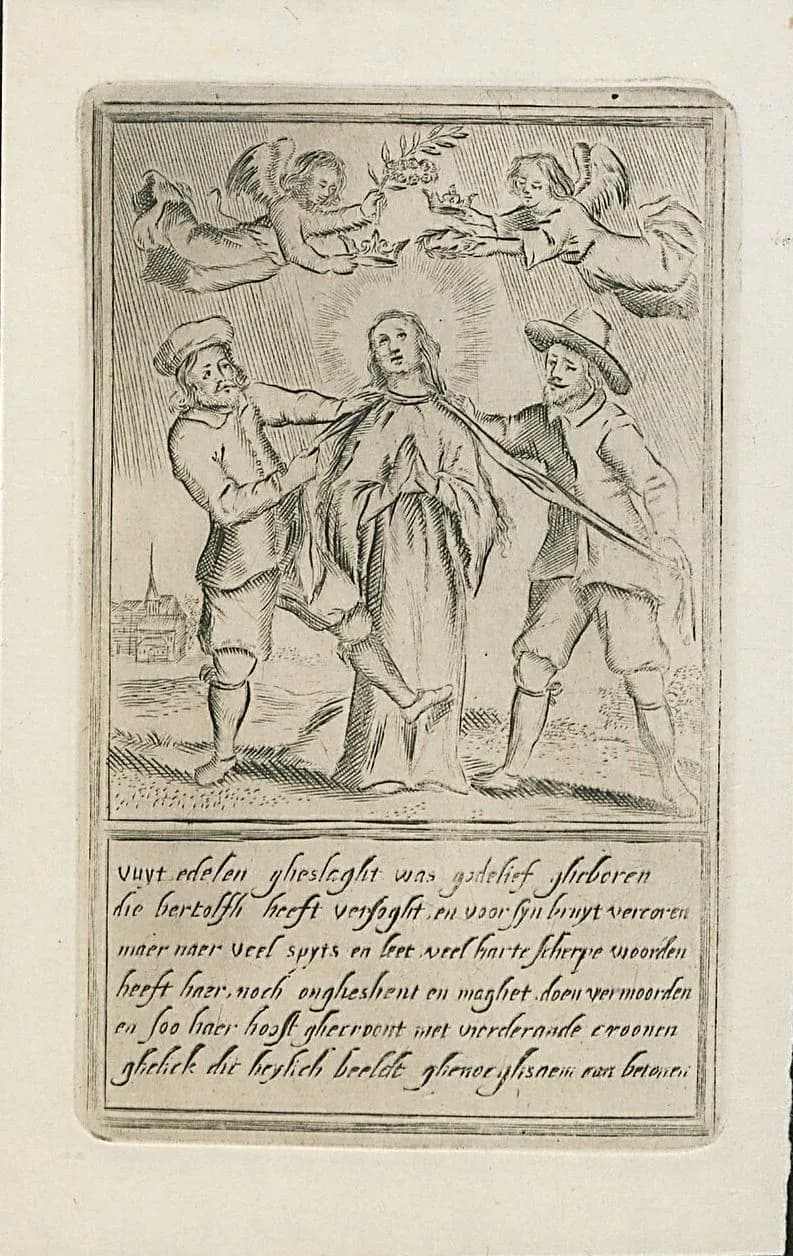
Saint Godelieve was a young Flemish noblewoman who was rejected by her husband on her wedding day, shut up and starved by his mother, and finally strangled by two of his servants at Gistel, near Ostend, in July 1070. 1345 She was about twenty. 1 Fourteen years later the bishop raised her body to the altars, and Gistel has kept her feast ever since. 14 The Church calls her a martyr. 2 The Catholic Church in Norway's biography of her is frank that she can hardly be said to have died for her faith, and that she is honored as an innocent woman killed, whom her own people took for a martyr. 3
A girl from Boulogne
Godelieve was born about 1049 or 1050 in the country around Boulogne, the youngest of three children of a nobleman, Hemfrid, lord of Wierre-Effroy, and his wife Ogina. 13 The encyclopedia gives her birthplace as Hondeforte-lez-Boulogne and the Norwegian biography as Londefort; the parish of Saint Pius X in Wilrijk, writing on Kerknet, says she was born in present-day Wierre-Effroy and that her parents lived at the castle of Londesvoorde. 134 Her family served the counts of Boulogne. 5
As a child, F. M. Rudge writes in the 1909 Catholic Encyclopedia, she "was soon distinguished for a solidity of virtue extraordinary for one of her years." 1 The poor came to her from all sides, and her wish to help them got her into trouble with her father's steward and with her father. 1 By eighteen she was known for her beauty through Artois and into Flanders, and suitors came; she wanted the cloister. 1 One of them, Bertolf of Gistel, would not take no for an answer and enlisted her father's overlord, Count Eustace II of Boulogne, who carried the day. 1
The marriage
At Gistel she found, in the encyclopedia's words, "a bitter and unrelenting enemy in Bertolf's mother," who persuaded her son to abandon his wife on the very day they arrived. 1 The Wilrijk parish names the mother-in-law as Iselinde and says she had opposed the marriage from the start. 4 Godelieve was shut in a narrow cell with barely enough to eat, and still managed to share what she had with the poor; Bertolf, at his mother's urging, spread foul calumnies about her. 1 The Norwegian biography adds that the marriage was never consummated. 3
She escaped to her father, who appealed to the Church and the count: in the encyclopedia's words he roused "the Bishop of Tournai and Soissons and the Count of Flanders" to threaten Bertolf. 1 Bertolf promised to take her back and treat her as his wife. 13 Her return, Rudge writes, "was the signal for a renewal of persecution in an aggravated form." 1 Benoit Lannoo, writing for Kerknet, recounts a later legend from these months: Bertolf set her to the menial work of chasing crows from a cornfield, and when the church bells rang the crows followed her into a barn at her command so that she could go and pray. 5
July 1070
After about a year Bertolf feigned sorrow again and was reconciled with her, the encyclopedia says, "but only to avoid the suspicion of the crime he was meditating." 1 While he was away, in Bruges according to the Norwegian biography, two of his servants came for her at night. 13 They strangled her on his orders. 134 The encyclopedia and the Norwegian biography say they then laid her in her bed so that her death would look natural; the Wilrijk parish and Lannoo say they plunged her into a pond where animals drank, and the Norwegian biography combines the two, with a noose around her neck as they drowned her. 1345 It was July 6, 1070. 13
Bertolf married again almost at once. 13 The Norwegian biography notes that he was never convicted of the crime. 3
History and legend
Her story is unusually well documented for its time. About ten years after her death a monk of Saint-Winoksbergen, the abbey at Bergues, named Drogo, wrote the first life of her, the Vita Godeliph, at the request of Bishop Radbod II of Noyon-Tournai, with a view to her canonization. 45 A copy was found in a manuscript at Saint-Omer in 1906 by the Bollandist Albert Poncelet, and another Bollandist, Maurice Coens, published it in 1926. 4
Later, an anonymous writer, probably a monk of the abbey of Saint Andrew near Bruges, retold the Vita with many additions. 4 The Wilrijk parish lists them: the wood chips, the miraculous meal, the crows, the healing of Bertolf's blind-born daughter Edith by his second marriage, and the seamless shirts that led to Bertolf's conversion. 4 Lannoo says the miracles grew in number from four to seventeen. 5 In 1944 the Bruges diocesan archivist Michiel English published a study that separated history from legend. 4
The encyclopedia tells the end of the legend as straightforward fact. The daughter born of Bertolf's second marriage was blind; "her miraculous recovery of sight through the intercession of St. Godelina so affected her father that, now truly converted," he went to Rome for absolution, made a pilgrimage to the Holy Land, and entered the monastery of St. Winoc at Bergues, where he did severe penance. 1 At his wish his daughter built a Benedictine monastery at Gistel dedicated to Godelieve and entered it. 1 The Wilrijk parish places Edith's foundation in the legend, and says only that a Benedictine abbey was probably founded at the place of her death around 1100. 4
Gistel
On July 30, 1084, Bishop Radbod II came to the church at Gistel and raised her remains to the honor of the altars, which in that period amounted to a canonization. 4 The countess of Flanders, Gertrude of Saxony, wife of Robert the Frisian, was there with her court, along with the abbot of Saint-Winoksbergen and many clergy. 4 The encyclopedia dates the devotion from this exhumation by "the Bishop of Tournai and Noyon." 1 Lannoo suggests why it came so fast: less for the healing water, which was soon credited with curing eye and throat complaints, than for her fidelity in a miserable marriage, which suited the spirituality Pope Gregory VII was promoting. 5
The pond became a well in later tellings, and the abbey built there took its name from it: Ten Putte. 5 Destroyed by the Gueux in 1578, the community moved to Bruges and returned to Gistel in 1891; the Benedictine nuns stayed until the end of 2011. 4 Pilgrims still come to the well with its water, in a domed chapel of 1634, and to see the shirt without a seam that the legend says she made. 4 The parish church of Gistel has a Godelieve aisle with her two reliquary shrines, of about 1820 and 1913. 4 Her procession, which goes back to the fifteenth century and goes out on the Sunday after her feast, has been recognized as Flemish intangible heritage since 2017. 56
What is Saint Godelieve the patron saint of?
Saint Godelieve is traditionally invoked against diseases of the throat and the eyes, and people ask her help with marriage problems and family difficulties, the Wilrijk parish says. 4 The Norwegian biography calls her patron against fever and sore throats, and notes that the water of her well at Gistel is drunk to cure a sore throat, probably because she was strangled. 3
Saint Godelieve's feast day
Saint Godelieve's feast day is July 6, the day of her death, as the Norwegian biography, the Wilrijk parish and Kerknet give it. 345 The Roman Martyrology enters her on July 30, the day the Wilrijk parish gives for her elevation in 1084. 24 Gistel holds both: every year the abbey of Ten Putte keeps a twenty-five-day celebration in her honor, from July 6 to July 30. 4
Praying with Saint Godelieve
There is no way to make this story come out well. A girl who wanted to be a nun was married off, rejected within a day, starved, slandered, driven to flee home, persuaded back, and murdered. 1 The legend later supplied a repentant husband and a healed daughter, and the encyclopedia passes that ending on; the Wilrijk parish counts it among the later additions. 14
What the sources admire in her is mostly what she did not do. She did not stop sharing her scraps with the poor. 1 She went back when she was asked to. 1 Lannoo and CathoBel both say it was her faithfulness in her marriage, in the most thankless circumstances, that made her an example the Church could hold up within fifteen years of her death. 56 It is a hard example. What the Church honored was her faithfulness, not the cruelty done to her, which every source treats as murder. 134
People still bring her their marriages and their families, and their sore throats. 34 Every July Gistel still walks through its streets in her honor, as it has since the fifteenth century. 5 The Wilrijk parish calls her, simply, a saint who remains very current. 4
Saint Godelieve, pray for us.
Sources
- 1.F. M. Rudge, "St. Godelina," The Catholic Encyclopedia, Vol. 6 (New York: Robert Appleton Company, 1909).
- 2.Roman Martyrology, entry for July 30, "Santa Godeleva, martire," as printed in "Santo del giorno," Conferenza Episcopale Italiana (in Italian).
- 3."Den hellige Godeleva av Ghistelles (~1050-1070)," Helgener, salige og andre, katolsk.no, the Catholic Church in Norway (in Norwegian).
- 4."Godelieve van Gistel," Parochie Heilige Pius X, Wilrijk, Kerknet (in Dutch).
- 5.Benoit Lannoo, "Zondag opnieuw Godelieveprocessie in Gistel," Kerknet, July 6, 2022 (in Dutch).
- 6."Une sainte encore très populaire : Godelieve de Gistel," CathoBel, July 6, 2022 (in French).
Saints to turn to next
Others in this collection who are turned to for some of the same things.
- Saint Elizabeth of Portugal1271 - July 4, 1336Marriage and familySuffering and illness
- Saint Lazarus of BethanyFirst centurySuffering and illnessMarriage and family
- Saint Marguerite d'YouvilleOctober 15, 1701 - December 23, 1771Marriage and familySuffering and illness
- Saint Odile of AlsaceLate seventh century - c. 720Suffering and illnessMarriage and family