Saint Odile of Alsace
Late seventh century - c. 720
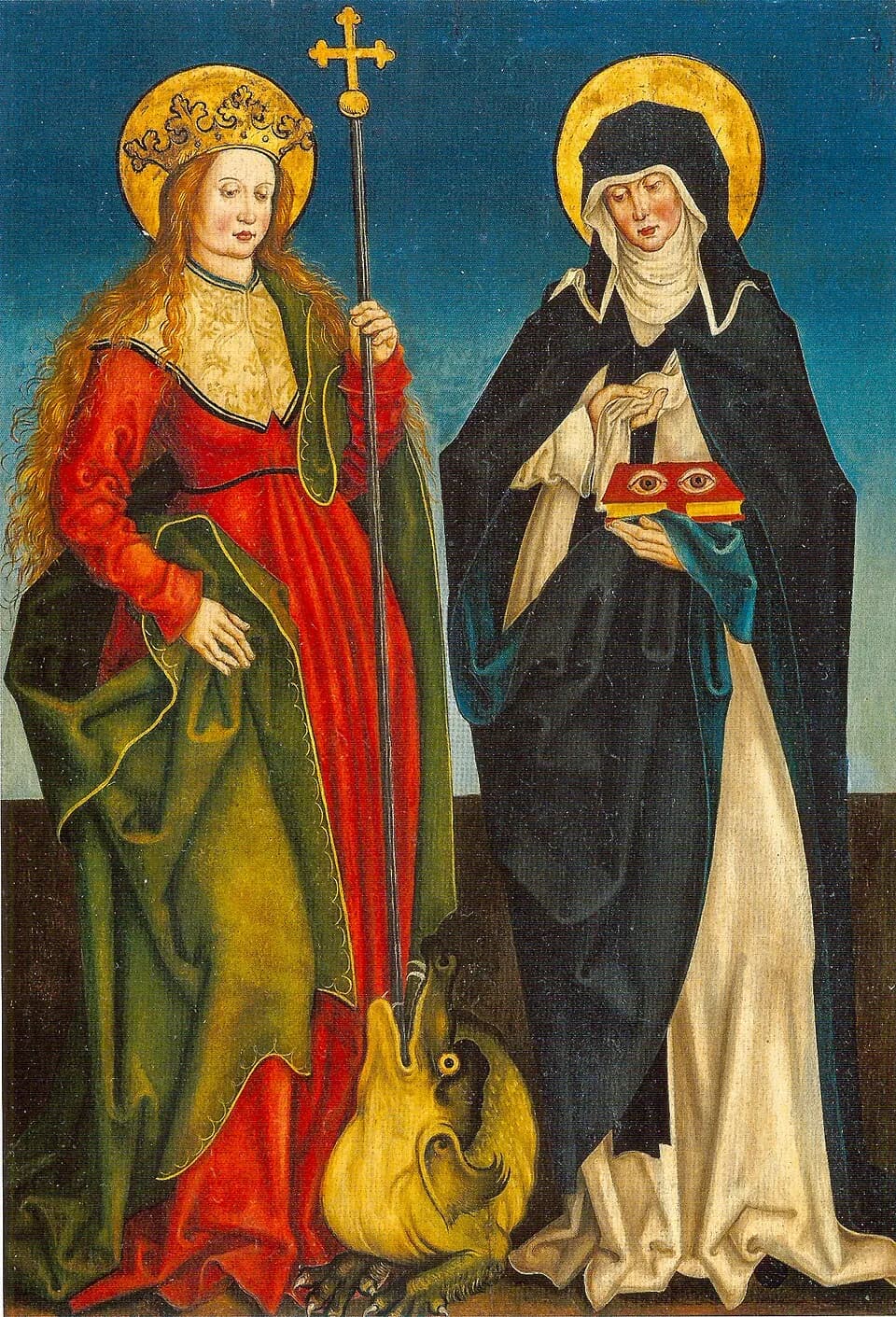
- Patron saint of
- Alsace 147; the blind 8; invoked for diseases of the eyes 78 and for the deliverance of souls in purgatory 7
- Feast day
- December 13 according to the 1913 Catholic Encyclopedia and in Alsace; December 14 elsewhere, according to the Archdiocese of Strasbourg 159
- Born
- At the end of the seventh century according to the 1913 Catholic Encyclopedia; around 662 at Obernai according to the Archdiocese of Strasbourg 14
- Parents
- Adalrich, a Frankish lord in Alsace, called Etichon by the French sources, and Bereswinda 146
- Founded
- The abbey of Hohenburg, about 690, and Niedermünster below it 2
- Represented with
- A book on which lie two eyes 1
Saint Odile was the first abbess of Hohenburg, a convent on a mountain in the Vosges above the Alsatian plain, and she died about 720. 12 The life written more than two centuries later says she was born blind, cast off by her father for it, and given her sight when she was baptized. 134 She is the patroness of Alsace and is invoked for diseases of the eyes, and her feast is December 13, though some calendars keep it on the 14th. 1578
One Vita, and what the historians make of it
Almost everything told of Odile comes from a single Latin life. The 1913 Catholic Encyclopedia dates it to the close of the tenth century, notes a shorter and probably independent text in a manuscript of the early eleventh, and says "internal evidences point to an original eighth-century biography." 1 cath.ch, reporting on the jubilee for the 1,300th anniversary of her death, describes the oldest account as an anonymous Latin manuscript of 950 kept in the library of the abbey of Saint Gall. 7
The encyclopedia separates what it trusts from what it only reports. Her parentage it takes from "a trustworthy statement, apparently taken from an earlier life": she was the daughter of Adalrich, a Frankish lord with large estates in Alsace, and his wife Bereswinda. 1 The foundation of her convent is backed by charters: Charlemagne granted it immunity, and Louis the Pious confirmed and endowed it on March 9, 837. 1 The blindness is another matter. "According to this narrative," the article says, "she was born blind, miraculously receiving her sight at baptism." 1 Its article on Saint Erhard, the bishop said to have baptized her, warns that the legendary account of his life "offers little that is historically certain." 3
Born blind, and sent away
The story as the shrine on her mountain tells it begins with a disappointment. Her father, Duke Etichon, also called Adalric, was hoping for a son, and his first child was a frail, blind girl. 6 The sanctuary says he ordered her killed and that her mother, Bereswinda, talked him out of it. 6 France Catholique has him unable to bear the infirmity and agreeing, as a compromise, to have her sent away. 8 She was given to a nurse and then placed with a community of nuns far from home. The sources name it differently: the sisters of Palm in Burgundy, according to the sanctuary; Baume, according to the Archdiocese of Strasbourg; a monastery near Besançon, according to France Catholique. 468
There, the Vita says, she grew up unbaptized. 4 Erhard, a bishop then traveling in Bavaria, had a vision telling him to go and baptize her; in France Catholique's version he was warned in a dream. 48 The 1913 encyclopedia says he was "recalled to the Rhineland" for it "by Divine inspiration." 3 The archdiocese makes him an Irish monk and bishop of Ardagh; the sanctuary and France Catholique call him bishop of Regensburg, and the encyclopedia says he was born in Ireland, came to the Continent as a missionary bishop, and went on to Ratisbon, the modern Regensburg. 3468 The encyclopedia also records a second account in which she was baptized by Hildulf, with Erhard as her sponsor. 3
At the baptism she received her sight. The archdiocese places the moment exactly: when the holy oil touched her eyes. 4 She was twelve, according to the sanctuary and France Catholique, or thirteen, according to cath.ch. 678 It was then that she was given the name Odile, which the archdiocese explains as meaning daughter of light. 46 France Catholique gives a different root for the name, a Germanic word for wealth or inheritance. 8
Her brother Hugues, and a father who changed
The healing did not soften her father. 4 France Catholique says he was told the news and did not come. 8 Her younger brother Hugues went to bring her home anyway, against their father's express order, according to the sanctuary, and when the two arrived the duke struck Hugues dead in a fit of rage. 46 The 1913 encyclopedia, in its article on Erhard, speaks only of a messenger sent to the duke, who was reconciled "with his disowned daughter." 3
In the sanctuary's telling the reconciliation came slowly. Remorse led him to let her stay at Hohenburg, but he then planned to marry her to a young prince, and she refused for the love of God. 6 She fled, he pursued her as far as the Black Forest near Freiburg, and there, according to tradition, as the sanctuary is careful to put it, a rock opened and hid her. 6 Her father gave way. Urged on by his relative Saint Leger, bishop of Autun, he made over the castle of Hohenburg to her. 6 France Catholique tells the change more simply: the years passed, Odile prayed a great deal for him, and one day a repentant father came and offered her the site for a monastery. 8
Hohenburg and Niedermünster
The 1910 encyclopedia article on the abbey says Odile founded it about 690 and was its first abbess. 2 Many young women joined her, the sanctuary says, to share a life of prayer and charity. 6 The convent stood high on the mountain, and the archdiocese notes that the sick in particular had trouble reaching it, so she built a second house lower down, Niedermünster, a name the archdiocese explains as the lower monastery. 24 cath.ch adds that she built a church there dedicated to Saint Martin and a hospice for the sick; France Catholique says the hospital took in lepers. 78
On her way down from Hohenburg, the sanctuary says, she met a blind beggar dying of thirst, struck a rock, and water came out that has not stopped flowing since. 6
The abbey outlived her by centuries. It seems first to have housed Benedictine nuns, replaced by canonesses in the eleventh century; under the abbesses Relindis and Herrad in the twelfth it was known for strict discipline and for the learning of its nuns. 2 It was confiscated and sold during the French Revolution. 2 The bishop of Strasbourg bought the buildings for his diocese in 1853, and the mountain has belonged to the archdiocese ever since. 29
Her death and her father's soul
The Archdiocese of Strasbourg quotes the end of the Vita, which has her leaving this world on the ides of December and speaks of her being joined to the company of Saint Lucy, whose feast falls on that day. 5 The encyclopedia gives no exact year beyond "about 720." 1 Her grave is in a chapel near the convent church on the mountain, and the sanctuary says her body lies in a sarcophagus that can still be seen in the Chapel of the Tomb. 16
Two of the sources say she prayed for her father's soul, and they do not describe his state in the same way. The sanctuary's retelling says she obtained his deliverance from the torments of hell. 6 cath.ch says she prayed that he would be freed from the flames of purgatory, that she did so in the Chapel of Tears in the convent, and that this is why she is invoked for the deliverance of the souls in purgatory. 7
According to cath.ch, she was canonized in the eleventh century by Pope Leo IX. 7 In 1354 Charles IV, king of Bohemia, had her sarcophagus opened and took a forearm to the cathedral of Saint Vitus in Prague. 7
What is Saint Odile the patron saint of?
Above all, Alsace. The 1913 Catholic Encyclopedia opens its article by calling her "Patroness of Alsace," and the Archdiocese of Strasbourg calls her the region's patron saint. 14 cath.ch says Pope Pius XII proclaimed her patroness of Alsace in 1946. 7
Because of the story of her healing, she is invoked for diseases of the eyes, according to cath.ch and France Catholique, and France Catholique adds that she is patroness of the blind. 78 The encyclopedia records that she is shown holding a book with two eyes resting on it. 1 cath.ch also says she is invoked for the deliverance of the souls in purgatory, because of her prayer for her father. 7
Saint Odile's feast day
The 1913 Catholic Encyclopedia gives her feast as December 13. 1 That is the day the Archdiocese of Strasbourg keeps it, with Lauds, a pontifical Mass and vespers on the mountain. 9
The archdiocese also explains that the date is shared with Saint Lucy, kept on December 13 in the Roman calendar, and that outside Alsace and on the Roman calendar, by its account, Odile's feast falls on December 14. 5 France Catholique lists her under December 14. 8 Both dates are recorded here.
Praying with Saint Odile
The center of her story is a child her father did not want. The sources do not soften that: by one account he wanted her dead, by another he simply could not bear what she was. 68 She was raised by strangers, and when she came home her brother was killed for bringing her. 46 None of the retellings makes it a happy household.
What she is remembered for doing afterward was building. Hohenburg was one house, and the sources say she put a second at the bottom of the hill because the sick could not climb to the first. 24 The beggar at the spring was blind, as she had been. 6
Then there is her father. France Catholique says she prayed for him for years before he changed, and the sanctuary and cath.ch both say her prayer for him went on after his death. 678 They differ on what she was praying him out of, and the page leaves that difference as it found it.
Most of this cannot be checked. The encyclopedia vouches for her parents, her convent and her grave, and reports the rest as the Vita's. 1 What is certain is smaller: a woman founded a house for nuns on a mountain in Alsace, built another below it for people who could not make the climb, and was buried there, where the archdiocese still keeps her feast every December. 129
Saint Odile of Alsace, pray for us.
Sources
- 1.Johann Peter Kirsch, "St. Odilia," The Catholic Encyclopedia, Vol. 11 (New York: Robert Appleton Company, 1911).
- 2.Michael Ott, "Hohenburg," The Catholic Encyclopedia, Vol. 7 (New York: Robert Appleton Company, 1910).
- 3.Peter Nugent, "St. Erhard of Ratisbon," The Catholic Encyclopedia, Vol. 5 (New York: Robert Appleton Company, 1909).
- 4."Sainte Odile," Saint du jour, 13 décembre, Archdiocese of Strasbourg (in French).
- 5."Homélie de Mgr Ravel pour la Sainte-Odile," with a note on the Vita and the feast, Archdiocese of Strasbourg, December 5, 2017 (in French).
- 6."Lieu avec une histoire," Sanctuaire du Mont Sainte-Odile (in French).
- 7.Jacques Berset, "Début du Jubilé de sainte Odile, patronne de l'Alsace, le 13 décembre," cath.ch, December 11, 2020 (in French).
- 8.Défendente Genolini, "Odile, l'aveugle guérie," Saint de la semaine (14 décembre), France Catholique (in French).
- 9."La fête de Sainte-Odile," Archdiocese of Strasbourg, December 12, 2016 (in French).
Saints to turn to next
Others in this collection who are turned to for some of the same things.
- Saint Bridget of Swedenc. 1303 - July 23, 1373PrayerMarriage and familySuffering and illness
- Saint Elizabeth of Portugal1271 - July 4, 1336Marriage and familySuffering and illnessPrayer
- Saint Frances of Rome1384 - March 9, 1440Marriage and familyPrayerSuffering and illness
- Saint Germaine Cousin1579 - 1601Suffering and illnessMarriage and familyPrayer