Saint Lazarus of Bethany
First century
- Known for
- Being raised from the dead by Jesus after four days in the tomb (John 11) 1
- Name
- A contraction of Eleazar, meaning "God hath helped" 3
- Patron saint of
- Siblings, together with Martha and Mary 7
Saint Lazarus of Bethany was the brother of Martha and Mary and a friend of Jesus, who raised him from the dead after he had lain four days in the tomb. 1 "Now Jesus loved Martha and her sister and Lazarus," John says, and the miracle that followed was the one that made the chief priests resolve to kill Jesus, and Lazarus as well. 12 Since 2021 the Church has kept him on July 29, together with his sisters. 6
Who was Lazarus?
The name is a shortened form of Eleazar, and the 1910 Catholic Encyclopedia gives its meaning in Hebrew as "God hath helped." 3 Two men called Lazarus appear in the New Testament. One is the beggar at the rich man's gate in a parable told only in Luke 16; the encyclopedia says Catholic interpreters now commonly take that story as a parable. 3 The other is this Lazarus, the brother of Martha and Mary of Bethany, and the saint of this page. 3
Everything known about him comes from two chapters of John. 123 He lived at Bethany, which John calls "the village of Mary and her sister Martha" and places "only about two miles" from Jerusalem; the encyclopedia's article on the village puts it at fifteen furlongs, or a mile and three-quarters, at the foot of the Mount of Olives. 15 John records no word that Lazarus himself spoke. 12
His illness and death
When he fell ill, his sisters sent Jesus a message with no request in it: "Master, the one you love is ill." 1 Jesus answered that the illness was "not to end in death, but is for the glory of God," and stayed where he was for two more days. 1 Then he told the disciples they were going back to Judea, where, they reminded him, people had just tried to stone him. 1 "Our friend Lazarus is asleep," he said, "but I am going to awaken him." 1 When they took him literally he told them plainly that Lazarus had died, and Thomas said to the others, "Let us also go to die with him." 1
Benedict XVI dwelt on that word "asleep." Jesus was "expressing God's viewpoint on physical death with the metaphor of sleep," he said in 2008: "bodily death is a sleep from which God can awaken us at any moment." 8
By the time Jesus came, Lazarus had been in the tomb four days, and many people had come out from Jerusalem to console his sisters. 1 Martha went out to meet him on the road and said, "Lord, if you had been here, my brother would not have died." 1 Mary said the same words when she came, falling at his feet. 1
"Lazarus, come out!"
Seeing Mary and the mourners weeping, Jesus "became perturbed and deeply troubled," and asked where they had laid him. 1 "And Jesus wept." 1 The bystanders said, "See how he loved him." 1 Pope Francis drew a lesson from that moment: "Jesus could have avoided the death of his friend Lazarus, but he wanted to share in our suffering for the death of people dear to us." 9
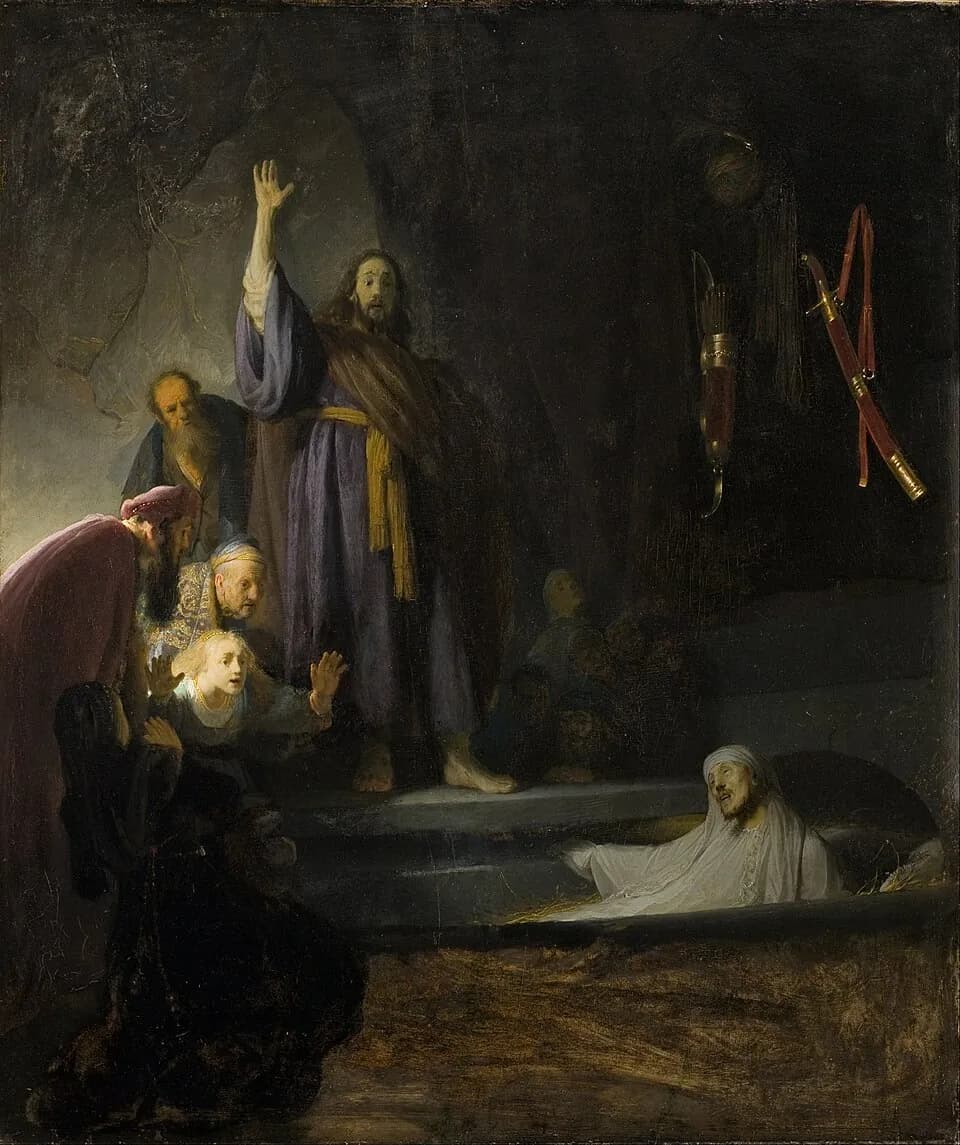
The tomb was a cave with a stone across it. 1 Jesus told them to take the stone away, and Martha objected that after four days there would be a stench. 1 They moved it. Jesus thanked the Father aloud, and then "he cried out in a loud voice, 'Lazarus, come out!'" 1 The dead man came out "tied hand and foot with burial bands, and his face was wrapped in a cloth," and Jesus said, "Untie him and let him go." 1
The 2021 decree on his feast compresses the whole scene into one clause: "Lazarus promptly emerged from the tomb at the command of the One who humiliated death." 6
A marked man
Many who saw it believed in Jesus, and some went and told the Pharisees. 1 The Sanhedrin met, and Caiaphas told them it was better for one man to die than for the whole nation to perish. "So from that day on they planned to kill him." 1 Benedict XVI calls the raising of Lazarus Jesus' last "sign," after which the chief priests decided to kill him and "the same Lazarus who was living proof of the divinity of Christ." 8
Six days before Passover Jesus came back to Bethany. 2 "They gave a dinner for him there, and Martha served, while Lazarus was one of those reclining at table with him." 2 John does not say whose house it was; the encyclopedia identifies the meal with the dinner Simon the Leper gave in Matthew and Mark. 23 A large crowd came, "not only because of Jesus, but also to see Lazarus," and "the chief priests plotted to kill Lazarus too, because many of the Jews were turning away and believing in Jesus because of him." 2 There the Gospels leave him. 3
Legends of his later life
Later centuries filled the gap. The best known story in the West, as the encyclopedia tells it, puts Lazarus and his sisters in a boat without sails or oars that came ashore in Provence, and makes him the first bishop of Marseilles, martyred under Domitian, with his body later moved to Autun. 4 The encyclopedia's verdict is that this tradition "has no solid foundation." 4 It finds no trace of it before the middle of the eleventh century, and suggests it grew from a real fifth-century Lazarus, a bishop of Aix who spent time in Palestine and was buried at Marseilles. 4 It adds that a Greek tradition held his body had been taken to Constantinople. 4
Franciscan Media begins its list with "Legends abound": that he left a written account of what he saw before he was called back, that he followed Peter into Syria, or that he was put into a leaking boat at Jaffa, landed in Cyprus, and died there in peace after thirty years as a bishop. 7 None of these is in Scripture. 3
What is certain, Franciscan Media says, is early devotion. 7 It reports that around the year 390 a pilgrim it calls Etheria described a procession on the Saturday before Palm Sunday to the tomb where he had been raised. 7 The encyclopedia's Bethany article, which credits the account to "St. Silvia," says the people of Jerusalem went out on that day to the church at his tomb, the Lazarium, until the place and the fields around it were full of people. 5 It gives the village's modern name as el-Azariye, after Lazarus, but judges the identification of the present cave as his tomb "merely possible." 5
What is Saint Lazarus the patron saint of?
Saint Lazarus's feast day
Saint Lazarus's feast day is July 29, which he shares with his sisters as the Memorial of Saints Martha, Mary and Lazarus. 67 Before then only Martha was on the General Roman Calendar for that day. 6 On January 26, 2021, the Congregation for Divine Worship explained that the old uncertainty about which Mary was which had been resolved, "as attested by the current Roman Martyrology, which also commemorates Mary and Lazarus on that day," and announced that Pope Francis had "decreed that 29 July be designated in the General Roman Calendar as the Memorial of Saints Martha, Mary and Lazarus." 6
Praying with Saint Lazarus
His sisters did not tell Jesus what to do. They told him who was sick: "the one you love." 1 And then Jesus waited two days, and Lazarus died. 1 Both sisters said the same thing to him when he came, and Francis heard in it the cry "of all of us with them: 'If you had been here!'" 19
Francis said that God's answer to that cry "is not a speech," and that the answer is Jesus himself. 9 At the tomb, Jesus wept. 1 In 2023 Francis said the Gospel "repeats twice that he is moved," and that "today Jesus weeps with us, as he was able to weep for Lazarus." 10
Both Francis's addresses turn on the command at the tomb. "Take away the stone," Jesus says, and in 2020 Francis said: "Take away the stone from your heart! Let the Word of God restore life where there is death." 9 In 2023 he said the miracle's message is that "Jesus gives life even when it seems that all hope has gone." 10
Coming back cost Lazarus something. The chief priests wanted him dead because people believed on his account. 2 He sat at table with Jesus a few days later anyway. 2
Saint Lazarus of Bethany, pray for us.
Sources
- 1.John 11, New American Bible (Washington, D.C.: United States Conference of Catholic Bishops), as published on vatican.va.
- 2.John 12, New American Bible (Washington, D.C.: United States Conference of Catholic Bishops), as published on vatican.va.
- 3.Walter Drum, "Lazarus," The Catholic Encyclopedia, Vol. 9 (New York: Robert Appleton Company, 1910).
- 4.Léon Clugnet, "St. Lazarus of Bethany," The Catholic Encyclopedia, Vol. 9 (New York: Robert Appleton Company, 1910).
- 5.A. E. Breen, "Bethany," The Catholic Encyclopedia, Vol. 2 (New York: Robert Appleton Company, 1907).
- 6.Congregation for Divine Worship and the Discipline of the Sacraments, "Decree on the Celebration of Saints Martha, Mary and Lazarus in the General Roman Calendar," Prot. N. 35/21, January 26, 2021.
- 7."Saints Martha, Mary, and Lazarus," Saint of the Day, July 29, Franciscan Media.
- 8.Benedict XVI, Angelus, St. Peter's Square, March 9, 2008.
- 9.Pope Francis, Angelus, Library of the Apostolic Palace, March 29, 2020.
- 10.Pope Francis, Angelus, St. Peter's Square, March 26, 2023.
Saints to turn to next
Others in this collection who are turned to for some of the same things.
- Saint Rita of Casciac. 1381 - May 22, 1457Marriage and familySuffering and illnessDesperate situations
- Saint Godelievec. 1049 - July 6, 1070Marriage and familySuffering and illness
- Saint Bridget of Swedenc. 1303 - July 23, 1373Marriage and familySuffering and illness
- Saint Clotildec. 474 - June 3, 545Marriage and familySuffering and illness