Saint Glyceria
Second century
- Died
- At Heraclea in Thrace, now Marmara Ereğlisi in Turkey 125; about 177 under Marcus Aurelius, say the Bollandists 1; 177, or 141 under Antoninus Pius, says katolsk.no 2
- Historical record
- Her cult at Heraclea is well attested; her Greek Passion is late and historically unreliable 3
Saint Glyceria was a Christian woman put to death at Heraclea in Thrace, on the European shore of the Sea of Marmara, in the second century. 12 Her shrine there drew pilgrims and at least one emperor, and a fragrant oil was said to flow from her tomb. 137 The story of her trials comes from a Greek Passion written long afterward, which modern scholars regard as unreliable as history, and the Roman Martyrology now keeps her on July 8. 35
What can be known
The surest fact about Glyceria is her cult. Giampietro Cattini, writing for the Italian saints database santiebeati.it, says Heraclea venerated her at least from the fourth century, and that her shrine there became a place of pilgrimage that kept its prestige through the whole Byzantine period. 3 Heraclea was the old Greek city of Perinthus, renamed about four centuries before Christ, and an early see; the 1910 Catholic Encyclopedia records that it once kept her relics. 4
Her story is another matter. The only extended account is a Greek Passion, written several centuries after the events, and scholars agree it is of little historical value, Cattini writes, because it is built from patterns that recur across the passions of the martyrs: the persecuting governor, the shattered idol, the tortures that do no harm, the angels, the jailer converted, the death among the beasts. 3 Read that way, it shows how the Christians of the Byzantine East remembered their martyr more than it shows what happened to her. 3
The Bollandists, the Jesuit editors of the Acta Sanctorum, printed the Acts in Latin from a Greek manuscript in the Vatican Library. 1 They rejected the old attribution to Symeon Metaphrastes, the Byzantine collector of saints' lives, because the style is too terse to be his, and argued from short summaries in the Greek service books that the Acts were written down long before. 1
The story her Acts tell
In the Acts the emperor Antoninus orders every subject to sacrifice to the gods, and above all to Jupiter. 1 The governor, Sabinus, publishes the edict at Trajanopolis: in three days everyone is to purify himself, come to the temple of Jupiter for the emperor's birthday, and offer sacrifice holding a lamp. 1 The Christians of the city meet daily in one small house and pray for peace. Among them is Glyceria, a Roman, the daughter of Macarius, three times consul, who urges them to keep clean the mark of the King whose sign they carry on their foreheads. 1
On the day, the citizens crowd to the temple with their lamps, and Glyceria comes with the sign of the cross traced on her forehead. 1 She tells the governor that as the daughter of a consul she will begin the sacrifice. Asked where her lamp is, she answers that it is written on her forehead, and asks him to put out the smoking lamps. 1 When they are out, she shows the cross, prays to the God who saved the three young men in the furnace and shut the mouths of the lions for Daniel, and the stone statue of Jupiter falls with a crash of thunder and breaks to pieces. 1
The crowd stones her, and the stones stop around her without touching her. 1 They call her a sorceress, and she takes the word: the Greek word, the Bollandists note, was used for a poisoner but has a better sense too, and she answers that the remedies of Christ are working through her. 1 In prison that night a priest named Philocrates signs her with the sign of Christ. 1 Next day the governor has her hung by her hair and torn, then beaten in the face, and an angel strikes the torturers to the ground. 1 He tells her not to be deceived like a woman. She answers that in the spiritual contest Christ crowns women as well as men, because the course of truth is open to everyone who runs it. 1
He shuts her in prison without food and has a tribune seal the door with the governor's ring. 1 Days later, setting out for Heraclea, he opens it expecting to find her dead, and finds her unchained with a tray of bread, milk and water beside her, which angels had brought. 1 At Heraclea the bishop, Dometius, comes out three miles with the Christians of the city to meet her. 1 She is thrown into a furnace, and dew falling from heaven puts out the fire. The skin of her head is then torn from the crown to the forehead, and she is left bound overnight on sharp stones; an angel unbinds her and heals her face. 1
In the morning her jailer, Laodicius, finds the door open and does not recognize her, and in despair is about to kill himself. 1 She stops him: she is the one he is looking for. He believes, puts on her chains and follows her to the governor, and declares himself a Christian. Sabinus has him beheaded on the spot. 1 Glyceria is sent to the beasts. A great lioness runs out and lies down at her feet; a voice from heaven tells her that the doors of the kingdom are open; a second lioness bites her, leaving no wound, and she dies. 1 Dometius buries her in a holy place near the city. 1
katolsk.no tells a different version, in which Glyceria hides her faith out of respect for her parents until the festival, the idol falls in an earthquake, and Laodicius is beheaded as soon as he sees her alive after her fast in the cell. 2
Who she was, by the sources
The details people repeat about her come from the Acts and do not agree well with what is known. The Acts make her father Macarius three times consul; the Bollandists point out that in the second century no one but an emperor was consul three times at Rome, and suggest he held office in Thrace. 1 katolsk.no reports the tradition that he was a Roman senator. 2 The Acts name the emperor Antoninus. The Bollandists take him to be Marcus Aurelius and place the persecution in 177; katolsk.no gives 177 as the usual date and 141, under Antoninus Pius, as the date of other sources. 12 The Catholic Encyclopedia's list of saints whose relics gave oil places her under Antoninus Pius. 7
Whether she was a consecrated virgin is not settled either. The Bollandists give her the title of virgin and martyr in the heading of their commentary, and the Greek office for her day calls her betrothed to the Lord in the beauty of virginity. 1 They also report that the Italian writer Gallonius questioned it, since the Acts never say so; they reply that the Acts praise her family twice over and never mention a husband. 1 The 1897 Martyrology calls her "martyr, a native of Rome," and the current Martyrology calls her simply martyr. 56
One more disagreement concerns the place. The 1910 encyclopedia article on Heraclea calls her "a virgin martyred at Trani." 4 Every other source read for this page, including the Martyrology, places her death at Heraclea. 12356
Her shrine at Heraclea
What followed her death is better documented than the death itself. The Bollandists quote the Byzantine historian Theophylact Simocatta on the emperor Maurice, who was sailing for Heraclea when a storm drove him ashore. He rode the rest of the way, went into the church of the martyr Glyceria, venerated her, and gave money to rebuild the parts the Avars had burned. 1 Cattini and katolsk.no date that visit to 591. 23
Pilgrims came for the oil. 13 A fragrant oil was said to flow from her tomb, and her relics were counted among those that gave it. 37 katolsk.no says it healed many from grave illness and notes that her name means "sweetness." 2 The Bollandists give one story of it from Theophylact. The bishop of Heraclea set a silver basin under the tomb in place of the old bronze one, and the oil stopped; he learned in a dream that the basin had belonged to a sorcerer, put the old vessel back, and the oil flowed again. 1
Some of her relics, by a later tradition, went to the island of Lemnos, while her head stayed at Heraclea; Cattini says neither can be documented with certainty. 3 The Bollandists print a Greek account in which, after the emperor Constantine V had Saint Euphemia's body thrown into the sea, it came ashore on Lemnos where Glyceria's relics already lay, and Euphemia in a dream called Glyceria her sister and companion in martyrdom. 1
What is Saint Glyceria the patron saint of?
No patronage for Saint Glyceria appears in the sources consulted for this page. 123 katolsk.no lists her among the saints whose relics were said to give a healing oil, which the 1911 Catholic Encyclopedia also records. 27 She is often remembered together with Laodicius, her jailer, and the Greek books keep his memory on her day. 12
Saint Glyceria's feast day
Saint Glyceria's feast day is July 8 in the current Roman Martyrology, which the Italian bishops print as: at Marmara Ereğlisi in Thrace, in present-day Turkey, Saint Glyceria, martyr. 5 Cattini explains that July 8 is her day in the ancient Hieronymian Martyrology, and that this is the date kept in the present Roman Martyrology. 3
The Byzantine calendar keeps her on May 13, from the old Greek tradition. 3 So does the older Roman Martyrology: the 1897 English edition enters her on May 13, "At Heraclea, of St. Glyceria, martyr, a native of Rome, who suffered under the emperor Antoninus and the governor Sabinus." 6 The Acts end by naming the thirteenth of May, and the Bollandists, katolsk.no and the 1910 encyclopedia all give that day. 124 Whether the two dates were once two different saints is debated, Cattini writes, though most scholars hold they are the same woman. 3
Praying with Saint Glyceria
Almost nothing in Glyceria's story can be checked, and the Catholic writers who have studied her say so plainly. 3 What can be checked is that a city on the Sea of Marmara kept her grave for centuries, built a church over it, and went on asking her for help long after anyone could have known her. 13
The Acts give her one line worth keeping whatever its source. Told not to be fooled the way women are, she answers that Christ crowns women in the contest as well as men, because the course is open to everyone who runs it. 1 Whoever wrote that down thought it was the point of the story.
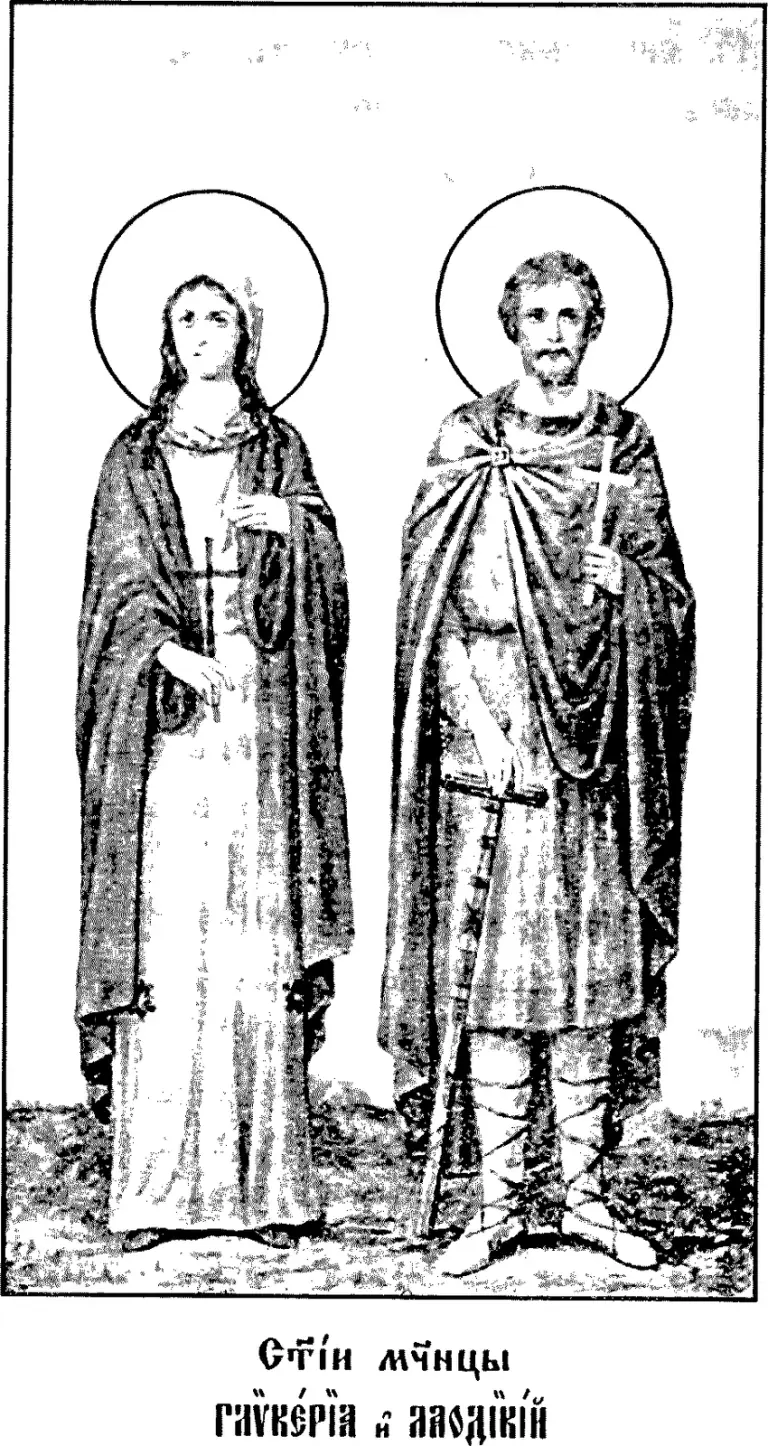
The jailer is the other figure the tradition would not let go. He comes into the account with no name, about to take his own life, and leaves it with a name, beheaded before her and remembered with her on her day in the Greek books. 12 The icon at the top of this page shows them side by side.
Saint Glyceria, pray for us.
Sources
- 1.Godfrey Henschen and Daniel Papebroch, "De SS. Glyceria virgine et Laodicio custode carceris, martyribus Heracleae in Thracia," commentary, Acts of the martyrdom translated from the Greek, and appendix on the relics, May 13, Acta Sanctorum, Maii tomus III (Paris and Rome: Victor Palmé, 1866), pp. 187-192, Internet Archive (in Latin).
- 2."De hellige Glykeria og Laodikios av Heraklea," Den katolske kirke, the saints database of the Catholic Church in Norway, katolsk.no (in Norwegian).
- 3.Giampietro Cattini, "Santa Gliceria, martire ad Eraclea," with the Roman Martyrology entry, Santi e Beati, santiebeati.it (in Italian).
- 4.Sophrone Pétridès, "Heraclea," The Catholic Encyclopedia, Vol. 7 (New York: Robert Appleton Company, 1910).
- 5.Roman Martyrology, entry for July 8, "Santa Gliceria, martire," Santo del giorno, Conferenza Episcopale Italiana (in Italian).
- 6.The Roman Martyrology, May 13 (Baltimore: John Murphy Company, 1897), Internet Archive.
- 7.Michael Ott, "Oil of Saints," The Catholic Encyclopedia, Vol. 11 (New York: Robert Appleton Company, 1911).
Saints to turn to next
Others in this collection who are turned to for some of the same things.