Saint Giuseppe Marello
December 26, 1844 - May 30, 1895
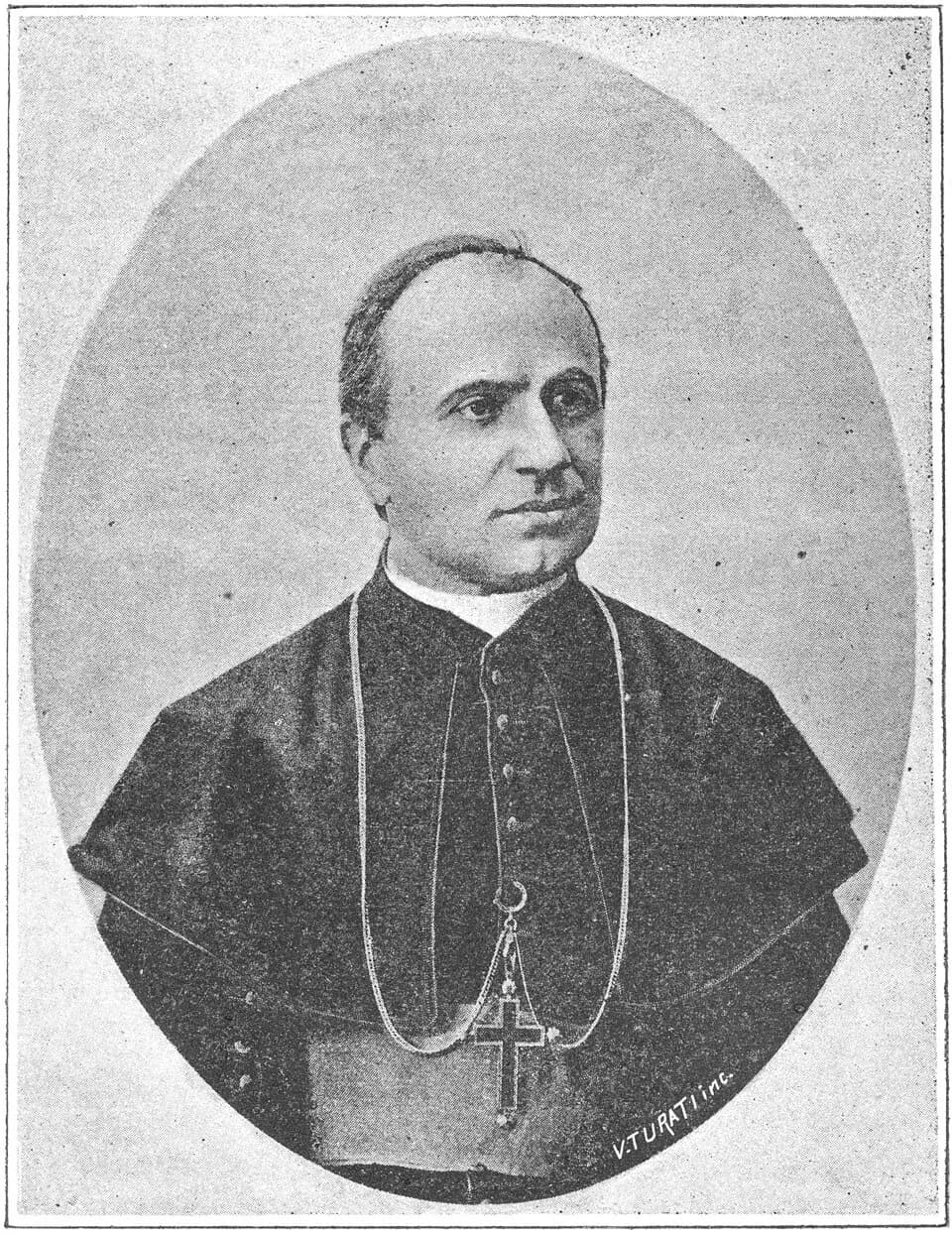
Saint Giuseppe Marello was a priest of Asti, in Piedmont, who served his bishop as secretary and then chancellor, founded a small religious community alongside that work, and was made Bishop of Acqui in 1889. 1 The community was the Oblates of St. Joseph, founded in 1878 to imitate the hidden life of Jesus's foster father, and its priests and brothers now serve in the United States, in Pennsylvania, Connecticut and California. 18 John Paul II, canonizing him in 2001, recalled the line he liked to repeat to them: "Be extraordinary in ordinary things." 2
Turin, San Martino Alfieri and a second start
He was born in Turin on December 26, 1844, and baptized the same day. 18 His father, Vincenzo, kept a cheese shop, according to the biography by Maria Angela Verna and Fr. Gennaro Citera that the Oblates publish; his mother, Anna Maria Viale, died while the boys were small, and the Oblates' timeline dates her death to 1852. 78 Vincenzo took Giuseppe and his younger brother, Vittorio, to his own village of San Martino Alfieri, near Asti, where the Holy See biography says Giuseppe spent his childhood. 17
The Holy See biography credits his devotion to the Virgin Mary with deciding his vocation. 1 He entered the seminary of Asti as a boy. 17 Then, Verna and Citera write, the war of 1859 turned the seminaries into hospitals and barracks, and in 1862 he left, went to Turin to study surveying, and thought of journalism and politics. 7 John Paul II, canonizing him, described the same young man as "good and intelligent," "enthusiastic about cultural and social movements," who "only found in Christ the synthesis of every ideal." 2
In December 1863 he fell gravely ill with typhoid fever. Verna and Citera say he heard something like a voice telling him he would recover if he went back to the seminary, and that he recovered within days. 7 He was back in the seminary at Asti at the beginning of 1864. 78 He was ordained a priest on September 19, 1868. 18
The bishop's secretary
He did not go to a parish. Bishop Carlo Savio of Asti kept him as his secretary, and the Holy See biography records that he later served as chancellor, directing the work of the curia. 17 He heard confessions, gave spiritual direction, taught catechism and worked for the education of the young. 1
In 1869 he went with Savio to Rome for the First Vatican Council. 18 Verna and Citera say he was in Rome for eight months, until the end of July 1870. 7 The Holy See biography notes that Cardinal Gioacchino Pecci, the future Leo XIII, came to appreciate the young secretary there. 1
He worried about the young. Francis, addressing the Oblates in 2024, quoted a letter he wrote on February 20, 1869, to a friend, Fr. Stefano Delaude: "Poor youth, too abandoned and neglected, poor growing generation too often left at the mercy of itself!" 6 Francis heard in it "the heart of a father." 6
Carthusians inside, apostles outside
After his father died in 1873, he wanted to leave the world altogether. The Holy See biography says he thought of a Carthusian monastery; Verna and Citera say he wanted to become a Trappist. 17 Savio talked him out of it, telling him the Lord was asking something different of him, and steered that wish toward a new religious family that would revive the presence of men religious in Asti, a presence the Holy See biography says the revolutionary laws of the time had suffocated. 1
On March 14, 1878, in a rented room of the Michelerio orphanage in Asti, he began with four young men. 78 The Holy See biography names it the Congregation of the Oblates of St. Joseph; the Oblates themselves say the first community was called the "Company of Saint Joseph" and took its present name later. 18 He proposed Joseph as the model of "looking after Jesus," and gave the community three tasks: spreading devotion to Saint Joseph, forming the young, and helping the local churches. 1 Its first work, the Oblates say, was the care of the elderly and the disabled and an orphanage for boys. 8 The Holy See biography adds that he took over a home for the aged that lacked the means to care for its residents. 1
John Paul II gave his motto as "To take care of the interests of Jesus," and said what drew him to Joseph "was the life of hidden service, joined with deep interior life." 2 He repeated two sayings to his men: "Be extraordinary in ordinary things," and "Be Carthusians inside your house and apostles outside." 2 The same idea appears in other English renderings: in his 2000 address John Paul II said Marello urged his sons to be "hermits at home" in order to be "effective apostles away from home," and Francis in 2024 quoted "Be Carthusians indoors, and apostles outdoors." 46 For years, the Oblates say, most people did not know he was their founder at all. 8
Bishop of Acqui
Leo XIII named him Bishop of Acqui, and he was consecrated in Rome on February 17, 1889. 18 The Pope's remark about him survives in two English forms: "Pearl of a Bishop" in the Oblates' timeline, and "a gem of a Bishop" in Verna and Citera. 78 He entered the diocese on June 16, 1889. 78
The Holy See biography says he went out to everyone and worked to unite clergy and faithful, and that he promoted the catechism, the Christian education of the young, and parish missions. 1 Verna and Citera add that he visited every parish of the diocese and ordained forty-five priests in six years. 7 They also say he hid a worsening illness, with migraines and hemorrhages, and forbade the people closest to him to speak of it. 7 John Paul II said that in a few years he "spent himself for his flock, leaving a memory that has only grown with time." 2
Savona
In May 1895 he went to Savona, despite poor health, for the third centenary of Saint Philip Neri. 1 Verna and Citera say he had promised to preside and did not want to let his hosts down, and that he prayed at the shrine of Our Lady of Mercy outside the city, which he had first seen as a boy. 7 He died at Savona on May 30, 1895, in the evening. 17 Verna and Citera put his age at fifty years and five months, and the Diocese of Scranton at 50; the Oblates' founder page says 51. 789 He was buried at Acqui, and in 1923 his body was moved to the Oblates' mother house in Asti. 8
Blessed, then saint
The Holy See biography says the cause began on May 28, 1948; the Oblates date the first diocesan proceedings to 1924 and the decree introducing the cause in Rome to 1948. 178 He was declared Venerable on June 12, 1978. 18 The miracle for his beatification, the Oblates say, was the 1944 healing of an Oblate seminarian, Aldo Falconetti, from tubercular meningitis. 8 John Paul II beatified him at Asti on September 26, 1993. 17
The second miracle, the Holy See biography records, was the sudden, complete and lasting recovery of two children, Alfredo and Isilia Chávez León, from broncho-pulmonitis, an illness it says is usually caused by chronic malnutrition; it was recognized on December 18, 2000. 1 The Oblates place the healing in Peru. 8 John Paul II canonized him on November 25, 2001, the Solemnity of Christ the King, 23 and placed him among the Piedmontese saints of the nineteenth century: "Sts Cottolengo, Cafasso, Don Bosco, Murialdo and Allamano." 2 The Oblates had reached the Diocese of Scranton in 1929, and they now serve in seventeen countries. 9
What is Saint Giuseppe Marello the patron saint of?
None of the sources consulted names a patronage for him, so this page assigns none. The Holy See biography presents him, from his beatification, "as a model for all Pastors of the People of God." 1 Francis, speaking to the Oblates in 2018, joined him with the patron of the universal Church as "the two Josephs." 5 Both are descriptions, and neither is a patronage.
Saint Giuseppe Marello's feast day
His feast is May 30, the day he died in 1895. 17 The beatification formula, as Verna and Citera give it, set his feast "every year on May 30, the day of his birth into heaven," in the places and according to the norms established by law. 7 In the United States the Oblates keep it at their seminary in Laflin, Pennsylvania, in the Diocese of Scranton, with a triduum of Masses beforehand. 9
Praying with Saint Giuseppe Marello
He wanted a cloister and was given a desk. As a young priest, grieving his father, he asked to withdraw to a strict monastery, and his bishop told him the Lord was asking something different of him. 17 He stayed at his work and founded a community that would keep a hidden life of its own kind, Carthusians inside the house and apostles outside it. 12
Most of his priesthood was administration: letters, the curia, a council in Rome, accounts for a home for the elderly. 17 John Paul II called his ideal "the life of hidden service." 2 The saying he left his men, "Be extraordinary in ordinary things," came from a man whose own days were mostly spent that way. 12
His worry for the young was specific. He wrote of a "poor growing generation too often left at the mercy of itself," and Francis noted that he would not join those who stopped at criticizing them. 6 His first Oblates taught catechism under his guidance, and John Paul II told their successors that an Oblate of St Joseph "is essentially a catechist." 47
He kept his illness from his own diocese, the Oblates' biographers say, and he died away from it, in a borrowed house, after a journey his health argued against. 17 The sources do not turn that into a lesson, and it need not be one.
Saint Giuseppe Marello, pray for us.
Sources
- 1."Giuseppe Marello (1844-1895)," biography published by the Holy See for the canonization of November 25, 2001.
- 2.John Paul II, Homily for the Canonization of Joseph Marello, Paula Montal Fornés de San José de Calasanz, Leonie Frances de Sales Aviat and Maria Crescenzia Höss, November 25, 2001.
- 3.John Paul II, Angelus, November 25, 2001.
- 4.John Paul II, Address to the Oblates of Saint Joseph, February 17, 2000.
- 5.Francis, Address to the participants in the General Chapter of the Oblates of Saint Joseph (Josephites of Asti), August 31, 2018. Holy See Press Office bulletin.
- 6.Francis, Address to the General Chapter of the Oblates of Saint Joseph, August 26, 2024.
- 7.Maria Angela Verna and Fr. Gennaro Citera, O.S.J., "A Life for God and Neighbor," Oblates of St. Joseph, US Province.
- 8."St. Joseph Marello, Founder of the Oblates of St. Joseph," with timeline, Oblates of St. Joseph, US Province.
- 9."Oblates of St. Joseph to Celebrate Founder's Feast," Diocese of Scranton, May 30, 2026.
Saints to turn to next
Others in this collection who are turned to for some of the same things.
- Saint Agnes of Montepulcianoc. 1268 - April 1317PrayerWork and vocationDiscernment
- Saint Andrew Avellino1521 - November 10, 1608DiscernmentWork and vocationPrayer
- Saint Benedict of Anianec. 750 - February 11, 821DiscernmentPrayerWork and vocation
- Saint Benedict of Nursiac. 480 - March 21, 547PrayerWork and vocationDiscernment