Saint Germanicus
Died at Smyrna, about 155 or 166
- When
- Probably 155, says the Catholic Encyclopedia 3; 166, says Butler 7; under Marcus Aurelius and Lucius Verus, say Eusebius and the Martyrology 246
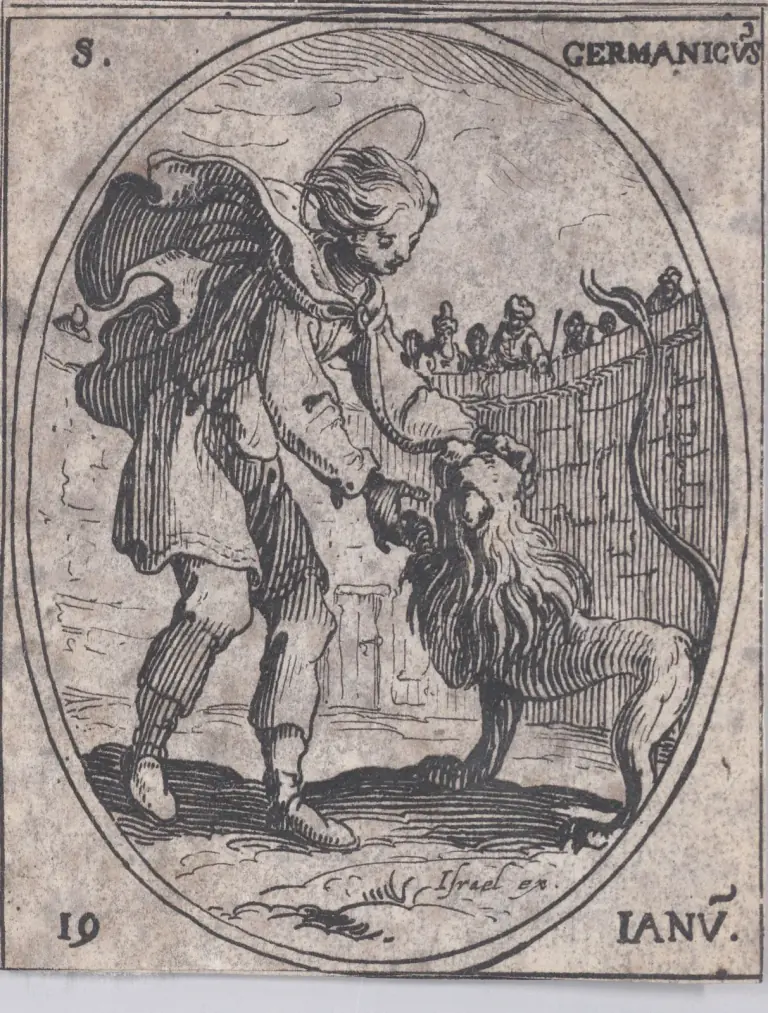
Saint Germanicus was a young Christian thrown to the beasts in the stadium at Smyrna, in what is now Turkey, in the persecution that killed Saint Polycarp. 124 The letter the Church of Smyrna wrote about Polycarp's death says that when the proconsul begged him to spare himself, he drew the animal toward him and provoked it, and that his death set the crowd shouting for Polycarp. 1 He is known from those few lines alone. 12 His feast is January 19. 4
The letter from Smyrna
After Polycarp, the old bishop of Smyrna, was burned alive, his Church wrote an account of it to the Christians of Philomelium "and to all the congregations of the Holy and Catholic Church in every place." 1 The letter is known as the Martyrdom of Polycarp. F.J. Bacchus, writing in the Catholic Encyclopedia, describes how it opens: with "an account of the persecution and the heroism of the martyrs," among whom one Germanicus stood out. 3 Eusebius of Caesarea copied much of it into his Church History in the fourth century. 2
The letter does not tell the other martyrs' stories one by one. It says they were scourged until their veins and arteries showed, that those condemned to the beasts were stretched on spikes and tortured, and that not one of them let out a groan. 1 Then it gives the one name. 1
What the letter says of him
In the translation of Alexander Roberts and James Donaldson the passage reads: "For the most noble Germanicus strengthened the timidity of others by his own patience, and fought heroically with the wild beasts. For, when the proconsul sought to persuade him, and urged him to take pity upon his age, he attracted the wild beast towards himself, and provoked it, being desirous to escape all the more quickly from an unrighteous and impious world." 1
Eusebius tells it a little differently. In Arthur McGiffert's translation he says that Germanicus distinguished himself by "overcoming by the grace of God the fear of bodily death implanted by nature," and that when the proconsul "urged his youth, and besought him, as he was very young and vigorous, to take compassion on himself, he did not hesitate, but eagerly lured the beast toward himself, all but compelling and irritating him." 2
So the two English versions part on one point. In Roberts and Donaldson the proconsul appeals to his "age"; in McGiffert's Eusebius, to his youth. 12 The other sources read for this page all make him young. Butler has the proconsul entreat him "to have some regard for his youth," the 1897 English Martyrology says he died "in the bloom of youth," and the current Martyrology, as the Italian bishops print it, says he was condemned in the flower of his young manhood. 467
"Away with the atheists"
His death had a consequence the letter records at once. "But upon this the whole multitude, marvelling at the nobility of mind displayed by the devout and godly race of Christians, cried out, Away with the Atheists; let Polycarp be sought out!" 1 Eusebius, paraphrasing, has the crowd marveling "at the bravery of the God-beloved martyr." 2 The search that ended with Polycarp in the stadium began with that shout. 13
The letter sets another man beside him. Quintus, a Phrygian lately arrived, had pushed himself and others forward to give themselves up; when he saw the beasts he lost his nerve, and the proconsul persuaded him to swear and to offer sacrifice. 1 The writers draw the lesson: "Wherefore, brethren, we do not commend those who give themselves up [to suffering], seeing the Gospel does not teach so to do." 1 The letter does not say how Germanicus came to be arrested, but it sets the two men side by side: one who came forward and broke, and one who, offered a way out, would not take it. 12
A martyr of Philadelphia?
The letter later calls Polycarp "the twelfth that was martyred in Smyrna (reckoning those also of Philadelphia)." 1 Eusebius has Polycarp suffer "with the eleven from Philadelphia." 2 Butler, retelling it, says Germanicus "had been brought to Smyrna with eleven or twelve other Christians." 7
Neither the letter nor Eusebius says that Germanicus was one of the Philadelphians. The current Martyrology calls him a martyr of Philadelphia, and Vatican News calls him one of eleven Christians of Philadelphia thrown to the beasts. 45 Both also call him a disciple of Polycarp, which the letter does not. 145
When it happened
The letter dates Polycarp's death by the proconsul Statius Quadratus, and Bacchus explains that this points to a Saturday, February 23, in either 155 or 166, depending on when Quadratus governed Asia. 3 After weighing the arguments he calls February 155 "the probable date." 3 Eusebius tells the story under the reign of Marcus Aurelius and his brother Lucius. 2 Butler dates it to the sixth year of those emperors and gives 166 from Tillemont, or 169 from Basnage. 7 Both Martyrologies place Germanicus under Marcus Antoninus and Lucius Aurelius. 46
The letter does not say on what day Germanicus died, only that it was before Polycarp was taken. 1 The current Martyrology says he went before his teacher in martyrdom. 4
What is Saint Germanicus the patron saint of?
Saint Germanicus's feast day
Saint Germanicus's feast day is January 19. 45 The current Roman Martyrology, as the Italian bishops print it, records on that day his passion at Smyrna, under the emperors Marcus Antoninus and Lucius Aurelius: condemned by the judge in the flower of his youth, he set aside by God's grace all fear for his frail body and himself provoked the beast that had been set on him. 4 Vatican News lists him on the same day. 5
The 1897 English Martyrology had him on January 19 too: "At Smyrna, the birthday of blessed Germanicus, martyr," who "provoked the beast which, by order of the judge, was to devour him. Being ground by its teeth, he deserved to be incorporated into the true bread of life, Christ Jesus, for whom he died." 6
Praying with Saint Germanicus
The Church of Smyrna had many dead to write about, and besides its bishop it named only one of them. 1 What it chose to say about him was not how he died but what his dying did for the others: he "strengthened the timidity of others by his own patience." 1
The letter is careful about the difference between courage and recklessness. It praises Germanicus and, in the next breath, warns against Quintus, who rushed forward and then broke. 1 It says nothing of how Germanicus came to the arena. 12 When he was there and the proconsul offered him a way out, he would not take it. 12
The old Martyrology found its own way of saying what his death meant: torn by the beast's teeth, he was made part of the true bread of life. 6 Of his life before the arena nothing at all is known. 12
Saint Germanicus, pray for us.
Sources
- 1.The Martyrdom of Polycarp (the letter of the Church of Smyrna), chapters 1-4, 19 and 21, translated by Alexander Roberts and James Donaldson, Ante-Nicene Fathers, vol. 1 (Buffalo: Christian Literature Publishing Co., 1885), as hosted by New Advent.
- 2.Eusebius of Caesarea, Church History, book 4, chapter 15, translated by Arthur Cushman McGiffert, Nicene and Post-Nicene Fathers, Second Series, vol. 1 (Buffalo: Christian Literature Publishing Co., 1890), as hosted by New Advent.
- 3.Francis Joseph Bacchus, "St. Polycarp," The Catholic Encyclopedia, vol. 12 (New York: Robert Appleton Company, 1911).
- 4.Roman Martyrology, entry for January 19, "San Germanico, martire," Santo del giorno, Conferenza Episcopale Italiana (in Italian).
- 5."San Germanico, martire di Filadelfia," Santo del giorno, 19 gennaio, Vatican News (in Italian).
- 6.The Roman Martyrology, January 19 (Baltimore: John Murphy Company, 1897), Internet Archive.
- 7.Alban Butler, "St. Polycarp, Bishop of Smyrna, M.," January 26, in The Lives of the Fathers, Martyrs, and Other Principal Saints, Vol. I (New York, 1895), Project Gutenberg eBook #20450.
Saints to turn to next
Others in this collection who are turned to for some of the same things.