Saint Gereon
d. probably early 4th century
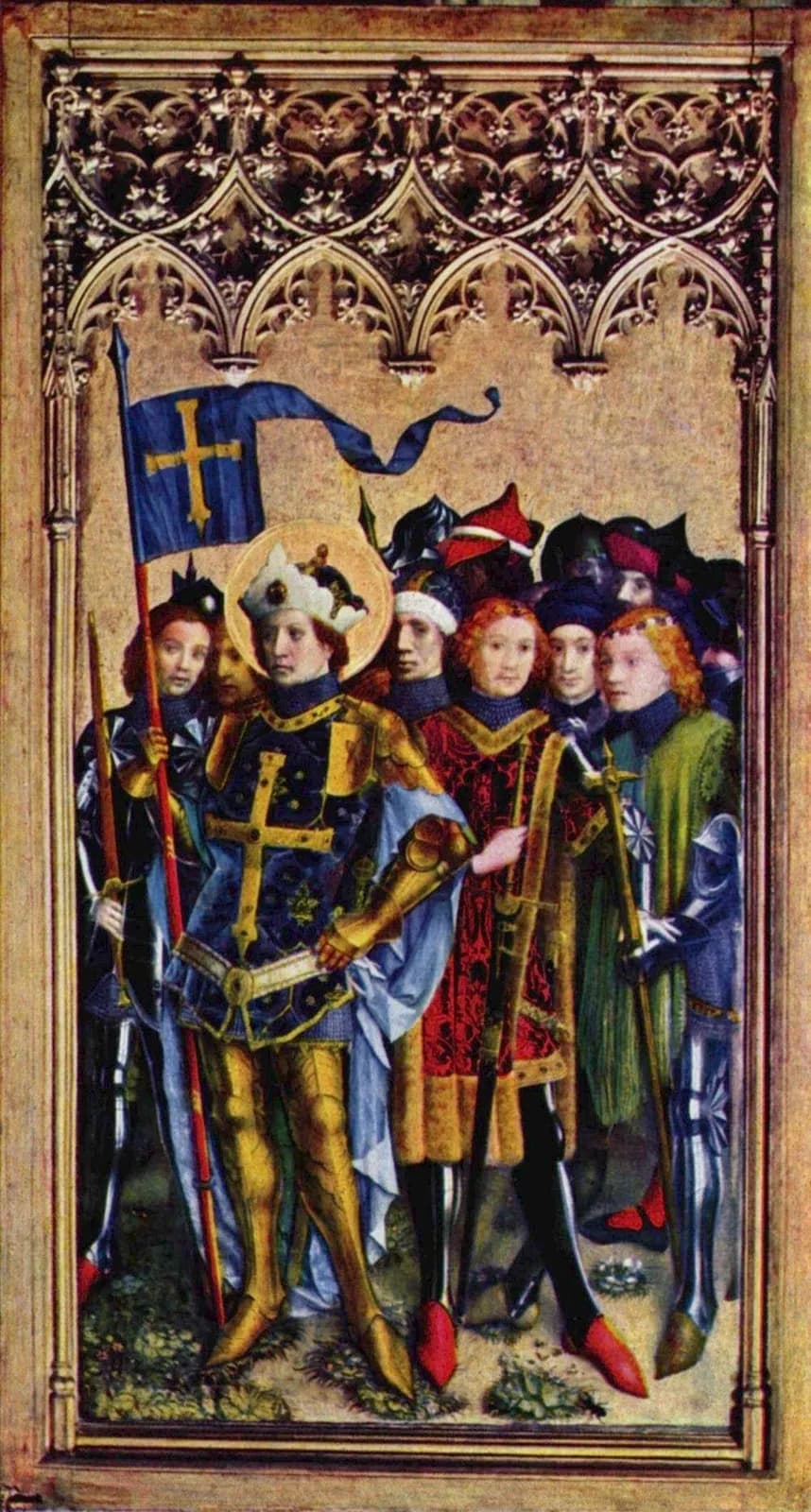
- Earliest record of his name
- The Martyrology of Jerome, early seventh century 1
- Patron of
- Cologne and soldiers; invoked against headaches and migraine 1
- Shown as
- A Roman legionary, or a knight with a cross on his breast, lance, shield and banner 1
Saint Gereon is the soldier martyr of Cologne, honored with his companions on October 10. 12 The Roman Martyrology says only that they bravely offered their necks to the sword for the true faith. 2 A group of martyrs was venerated where his basilica now stands from the fourth century, and the Norwegian bishops' saints database (katolsk.no) treats that as a real historical core; the famous story of a Christian legion massacred to the last man came much later. 1
What can be known
katolsk.no calls Gereon a historical person and says the story of him and his companions has a historical kernel. 1 From the fourth century a group of martyrs, whose names are now lost, was venerated in Roman Cologne at the place where the church of Saint Gereon stands. 1 They were probably killed early in the fourth century, probably by beheading, and their grave was already known in the fifth. 1 They may have been soldiers. 1 Christianity had reached Cologne early, Joseph Lins writes in the 1908 Catholic Encyclopedia, "with the Roman soldiers and traders." 4
Gregory of Tours, who died in 594, tells of fifty martyrs of the Theban Legion buried at Cologne but does not name Gereon, according to katolsk.no. 1 Gereon's name first appears early in the seventh century, in an early version of the Martyrology of Jerome, and the basilica is first called Saint Gereon early in the eighth. 1 He was named among the leading saints of Gaul in the royal acclamations sung for Frankish kings, who called on him for protection. 1 katolsk.no adds that he is in the martyrology of Bede and that his feast was kept in England, in the calendars of Sarum, Durham and Barking. 1
The current Roman Martyrology enters him plainly: at Cologne, Saints Gereon and companions, martyrs, who for the true faith bravely offered their necks to the sword. 2 It does not give a number, a date or a legion. 2
The Theban Legion
Later centuries joined Gereon to a larger story. 1 Francis Mershman, in the Catholic Encyclopedia, summarizes the legend of Saint Maurice: a legion "composed entirely of Christians" was called from Africa to put down a revolt in Gaul, refused to sacrifice to the gods, was decimated twice, and was then massacred at Agaunum, now Saint-Maurice in the Swiss Valais, about 287. 35 Henri Leclercq, writing on Agaunum in the same encyclopedia, says the chief witness is a letter of Saint Eucherius of Lyons written in 450, and that besides the Acts of Agaunum there are "Passiones" of Theban martyrs said to have escaped the massacre and died later in Germany and Italy. 3 He reports that scholars such as Ruinart and Allard held that the martyrdom "cannot be called in question by any honest mind," and then adds: "This optimistic view, however, does not seem to have convinced all the critics." 3
In the legend as katolsk.no tells it, a detachment of the legion had been sent ahead across the Rhine under Gereon, Victor, Cassius, Florentius and Mallosus. 1 After Agaunum the emperor's executioners went after them. 1 They killed Cassius and Florentius with their men at Bonn, and then came to Cologne, where Gereon commanded 318 soldiers. 1 Ordered to sacrifice before marching on, the Thebans refused; Gereon stepped forward to say that as soldiers they would obey any order of the emperor, but as Christians they could never again sacrifice to the Roman gods. 1 They were decimated, refused again, and were all beheaded, Gereon among the last. 1 Their bodies were thrown into a deep well on a field outside the city, afterward called Mechtern, "to the martyrs." 1
katolsk.no is clear about where this comes from. 1 The details belong to the legend, which was written down in the thirteenth century by the Cistercian Helinand of Froidmont, who made Gereon, Victor, Cassius and Florentius martyrs of the Theban Legion. 1 The number grew over the Middle Ages from Gregory's fifty to 290, then 318 or 319, in some versions 392, with 300 more remembered at Xanten. 1 Two pairs of martyrs, at Xanten and at Bonn, were blended together over time. 1 katolsk.no says one of them, probably named Gereon, may have been a martyred soldier, but that a great number of martyrs, or any link with the Theban Legion, is no longer thought possible. 1 It quotes the Bollandist Hippolyte Delehaye, who observed that at Cologne the imagination of hagiographers had a tendency to exaggerate to a degree perhaps without equal. 1 The Martyrology still lists Victor and Mallosus separately at Birten, in the territory of Cologne, and Cassius and Florentius at Bonn, on the same day as Gereon. 2
The golden saints and their church
Tradition says that Saint Helena, mother of Constantine, found the martyrs' bodies in the well, had them buried with honor and built a splendid church over them outside the walls. 1 It was decorated with gold and precious stones, and the people of Cologne called it the church of the golden saints, so that the martyrs themselves became the Sancti aurei. 1 Some have suggested this name lies behind the tradition that the soldiers came from Africa. 1
The Huns plundered the church and the Northmen destroyed it in 882; it lay abandoned until Saint Anno, archbishop in the eleventh century, rebuilt it in Romanesque style. 1 Lins lists Saint Gereon first among the city's noteworthy Romanesque churches. 4 Its core is still the oldest part: a late Roman oval building with ten niches, a martyrs' church from late in the fourth century, and its central ten-sided hall is the only decagon north of the Alps. 1
katolsk.no tells of Bishop Eberigisil of Cologne, a bishop Gregory of Tours mentions, who was struck with a violent pain in half his head. 1 He sent his deacon to the church of the golden saints, where there was said to be a pit into which the martyrs had been thrown together. 1 The deacon gathered some dust from it and brought it back, and the moment it touched the bishop's head the pain was gone. 1
In 1121 Saint Norbert came to Cologne seeking relics, and bones found then were taken to be Gereon and his companions; katolsk.no says there is no historical reason to connect them with the early martyrs. 1 In 1190 the relics were moved into a new crypt, and the Gereon altar was consecrated in August 1191. 1 The top sarcophagus there still bears the late Roman inscription "HIC RECONDITA SUNT CORPORA THEBEORUM MARTYRUM," here were laid again the bodies of the Theban martyrs. 1
What is Saint Gereon the patron saint of?
katolsk.no names Saint Gereon patron of Cologne and of soldiers, and says he is invoked against headaches and migraine. 1 As a soldier saint he was probably patron of the knights of the Cologne region, and like other saints who were beheaded he was called on against pains of the head. 1 He is shown either as a Roman legionary or as a medieval knight with a cross on his breast, lance and shield, often with a banner of the cross, as on the right inner wing of Stefan Lochner's altarpiece of about 1440 in Cologne Cathedral. 1 Mershman notes that Maurice, leader of the legion in the legend, is likewise represented as a knight in armor and is a patron of soldiers. 5
Saint Gereon's feast day
Saint Gereon's feast day is October 10. 12 The current Roman Martyrology commemorates Saints Gereon and companions on that day, with the martyrs of Birten and Bonn beside them. 2 katolsk.no notes that older calendars also have entries on October 9 and 15 that very probably refer to the same group, but that the feast is most often kept on October 10. 1
Praying with Saint Gereon
Very little about Gereon is certain, and the honest sources begin there. 1 Under the legend lies something smaller and harder to doubt: Christians, perhaps soldiers, killed for their faith at Cologne, and a church raised over their grave that people kept coming back to for a thousand years. 14
The Martyrology's entry keeps to that core. 2 It names no number and no emperor, only men who offered their necks to the sword for the true faith. 2
Cologne remembered them in gold and later in stone, and a bishop with a splitting headache sent for dust from the floor of their church. 1 Prayer at the graves of the martyrs is older than any of the stories told about them. 1
Saint Gereon, pray for us.
Sources
- 1."Den hellige Gereon av Köln og hans 318 ledsagere (d. ~304?)," Den katolske kirke (katolsk.no), Catholic Diocese of Oslo (in Norwegian).
- 2.Roman Martyrology, entries for October 10, "Santi Gereone e compagni, martiri," "Santi Vittore e Malloso, martiri" and "Santi Cassio e Fiorenzo, martiri," as printed in "Santo del giorno," Conferenza Episcopale Italiana (in Italian).
- 3.Henri Leclercq, "Agaunum," The Catholic Encyclopedia, Vol. 1 (New York: Robert Appleton Company, 1907).
- 4.Joseph Lins, "Cologne," The Catholic Encyclopedia, Vol. 4 (New York: Robert Appleton Company, 1908).
- 5.Francis Mershman, "St. Maurice," The Catholic Encyclopedia, Vol. 10 (New York: Robert Appleton Company, 1911).
Saints to turn to next
Others in this collection who are turned to for some of the same things.