Saint Gerard of Brogne
c. 895 - October 3, 959
- Born
- At Staves in the county of Namur, toward the end of the ninth century 1; about 895, near Fosses, by katolsk.no 2
- Parents
- Stance, of the family of the dukes of Lower Austrasia, and Plectrude, sister of Bishop Stephen of Liège 125
- Canonized
- 1131, at the Council of Reims 2
Saint Gerard of Brogne was a young nobleman from the county of Namur, in what is now Belgium, who gave up a soldier's career to become a Benedictine monk, founded an abbey on his family's land at Brogne, and spent the rest of his life restoring the Rule of Saint Benedict in monasteries across Flanders and Lotharingia. 123 The 1909 Catholic Encyclopedia credits him with eighteen abbeys and says that through his efforts the order "was soon completely restored throughout this region." 1 He died at Brogne in 959, and the village now bears his name. 12
A soldier at the court of Namur
Gerard was born at Staves in the county of Namur toward the end of the ninth century, by the encyclopedia's account, or about 895 near Fosses, by katolsk.no's. 12 His father, Stance, belonged to the family of the dukes of Lower Austrasia, and his mother, Plectrude, was a sister of Stephen, bishop of Liège. 125 Like most young men of his rank he was trained for war, and he served at the court of Count Berengar of Namur. 125
The sources agree that he was devout from the start. The encyclopedia says his piety "was admirable amid the distractions of camp." 1 Catholic.net's older Spanish life says the count grew so fond of him for his modesty and good sense that he took him into his household and trusted him with important business. 5 On his family's estate at Brogne there was a small chapel, and he turned it into a large church. 1
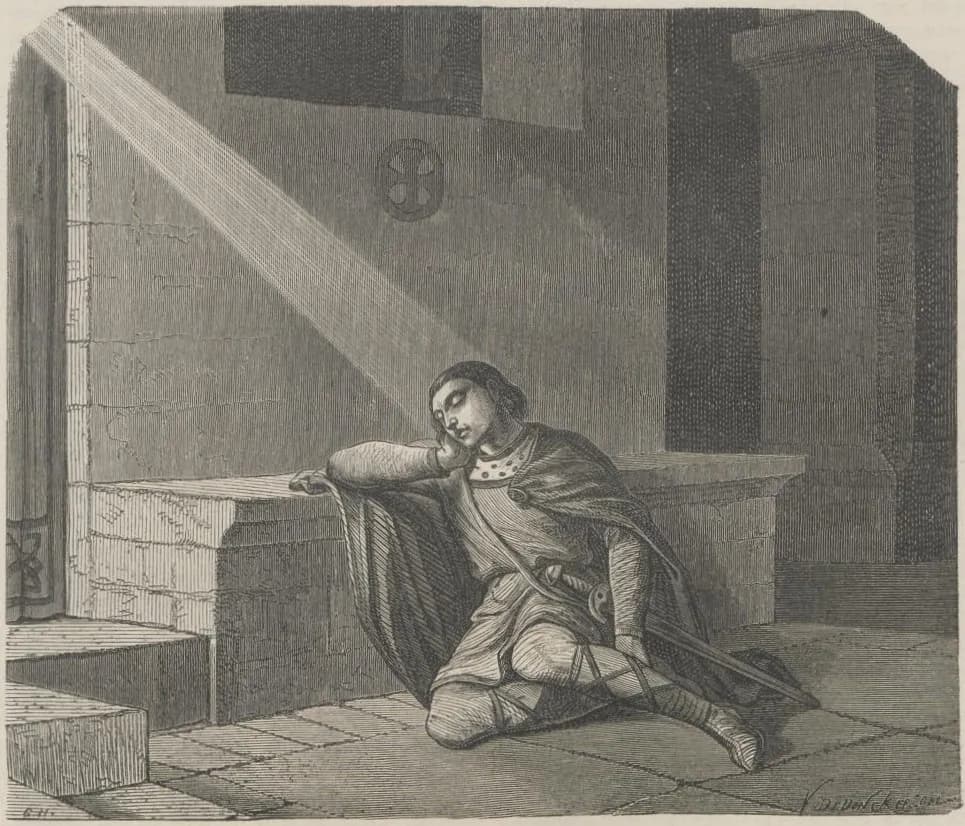
RCF, the French Catholic radio network, tells how this began. Out hunting one day, Gerard stopped to pray in the old chapel on the family land at Brogne, and there he saw Saint Peter, who asked him to found a monastery on the spot. 4 katolsk.no knows the vision too, but calls it legend and places it later, at St-Denis, with Peter asking him to bring the relics of Saint Eugenius home to Brogne. 2 The engraving at the top of this page, from a nineteenth-century Dutch history, shows a young man in a cloak, a sword at his side, asleep in a bare stone chapel in a shaft of light.
Saint-Denis
About 917, the encyclopedia says, the count of Namur sent Gerard on a mission to Robert, younger brother of Eudes, king of France; katolsk.no gives 918. 12 He left his followers in Paris and went himself to stay at the Abbey of St-Denis, where he was so struck by the life of the monks that he decided to join them. 15 With the consent of the count and of his uncle the bishop, he came back, took the Benedictine habit, and gave himself to the study of Scripture and to strict penance. 125 Catholic.net's life says he began his studies like a child, with his letters. 5 He was ordained a priest after eleven years, according to the encyclopedia; after ten, according to katolsk.no; after nine, according to Catholic.net. 125
Brogne, and eighteen abbeys
He then asked to go home to Brogne. 1 katolsk.no says he received permission in 919 to found a monastery on his own land; RCF says the building began in 925, and names the house for Saints Peter and Eugenius, whose relics he had brought from St-Denis. 24 There he put monks in place of the lax clerics who had served the church, and became the first abbot, an office katolsk.no says he held for twenty-two years. 123 For a time he withdrew to a cell near the monastery for a stricter life. 1
His reputation did not let him stay there. The encyclopedia says the archbishop of Cambrai called him out of his retreat to take charge of the community of St-Ghislain in Hainaut; katolsk.no says it was Duke Gislebert of Lotharingia who asked. 12 Either way he did at St-Ghislain what he had done at Brogne, replacing canons whose conduct, in the encyclopedia's words, "had ceased to be exemplary," and enforcing the strictest discipline. 1 Catholic.net's life says that Count Arnulf of Flanders, cured of a painful stone after receiving Communion from Gerard's hands, gave him charge of all the abbeys in his territory. 5
The work spread. The encyclopedia says he became superior of eighteen other abbeys between the Meuse, the Somme and the sea. 1 katolsk.no lists houses in Flanders, Lotharingia and Champagne, as far as Mont-Saint-Michel in Normandy, and says the work took twenty years. 2 RCF says he traveled more than three hundred kilometers to reach abbeys such as Saint-Wandrille. 4 Some monks resisted: katolsk.no says that monks of Saint-Bertin who refused his reform left for England, where King Edmund received them and let them live at Bath. 2
katolsk.no is honest about the results. The reforms were slow to take hold, and in several cases did not last. Perhaps he looked too much to the past, especially to the old eremitic tradition, instead of building something new for his own time; perhaps he failed to win over the local lords and bishops. It is to his credit, it says, that he was not discouraged, and that he went on living a severely ascetic life in the hope of setting his brothers an example. 2 It also remembers him for his infectious good humor. 2
Last years
Catholic.net's life records a miracle at his Mass: a blind woman asked for the water in which he had washed his fingers at the altar, bathed her eyes with it, and saw. 5 When age and illness weighed on him, he put vicars or abbots in charge of the houses he had been governing and went back to Brogne. 1 He still found the strength to travel to Rome for a papal bull confirming the abbey's privileges, and on his return he made a last visitation of all the communities he had reformed. 12 Then he waited for death at Brogne. 1
He died there on October 3, 959. 12 He was canonized at the Council of Reims in 1131. 2 The village of Brogne took the name Saint-Gérard in the seventeenth century, according to katolsk.no. 12 His relics, which katolsk.no regards as authentic, are venerated at Saint-Gérard, at nearby Maredsous and at Ghent. 2 RCF notes that the abbey buildings at Brogne no longer house monks. 4
What is Saint Gerard of Brogne the patron saint of?
No source consulted here names Saint Gerard of Brogne as patron of anything, so this page does not assign him a patronage. 123 He is shown in art as a Benedictine abbot with a whip and a child, or as a priest celebrating Mass. 2 He is not to be confused with Saint Gerard Majella, the eighteenth-century Redemptorist brother, who has his own profile here.
Saint Gerard of Brogne's feast day
Saint Gerard of Brogne's feast day is October 3, the day of his death. 2 The Roman Martyrology enters him that day: in the territory of Namur, Saint Gerard, first abbot of the monastery of Brogne, which he had founded, who worked to renew monastic discipline in Flanders and Lotharingia and brought many communities back to the original observance of the Rule. 35 His feast is kept in the dioceses of Namur, Ghent and Liège. 2
Praying with Saint Gerard
Gerard's turn came in the middle of a career that was going well. He was trusted by his count and sent on embassies, and on one of them he walked into a monastery and saw a life he wanted more. 15 He did not drift into it. He went home, finished the business he had been sent on, asked leave of the count and of his uncle the bishop, and came back to start again with his letters, like a schoolboy. 15
His work afterward was the patient kind: one community at a time, by visitation and example, over twenty years. 12 Not all of it lasted, and the Norwegian bishops' account does not pretend otherwise. 2 What it praises is that he kept going, and that he kept his good humor while he did. 2
At the end he did what he had asked of others. He handed his houses to other men, made one more journey on behalf of his own abbey, visited each community a last time, and went home to Brogne to die in the place where, by RCF's account, he had first been asked to build. 14
Saint Gerard of Brogne, pray for us.
Sources
- 1.Léon Clugnet, "St. Gérard, Abbot of Brogne," The Catholic Encyclopedia, Vol. 6 (New York: Robert Appleton Company, 1909).
- 2."Den hellige Gerhard av Brogne," Den katolske kirke (katolsk.no), Catholic Diocese of Oslo (in Norwegian).
- 3.Roman Martyrology, entry for October 3, "San Gerardo, abate," as printed in "Santo del giorno," Conferenza Episcopale Italiana (in Italian).
- 4."Le saint du jour du 3 octobre: saint Gérard de Brogne," RCF (Radio Chrétienne Francophone), October 3, 2025 (in French).
- 5."Gerardo de Brogne, Santo," Santoral, Catholic.net, with the Roman Martyrology entry in Spanish (in Spanish).
Saints to turn to next
Others in this collection who are turned to for some of the same things.
- Saint Agnes of Montepulcianoc. 1268 - April 1317PrayerWork and vocationDiscernment
- Saint Andrew Avellino1521 - November 10, 1608DiscernmentWork and vocationPrayer
- Saint Benedict of Anianec. 750 - February 11, 821DiscernmentPrayerWork and vocation
- Saint Benedict of Nursiac. 480 - March 21, 547PrayerWork and vocationDiscernment