Saint Fridolin of Säckingen
Sixth or seventh century
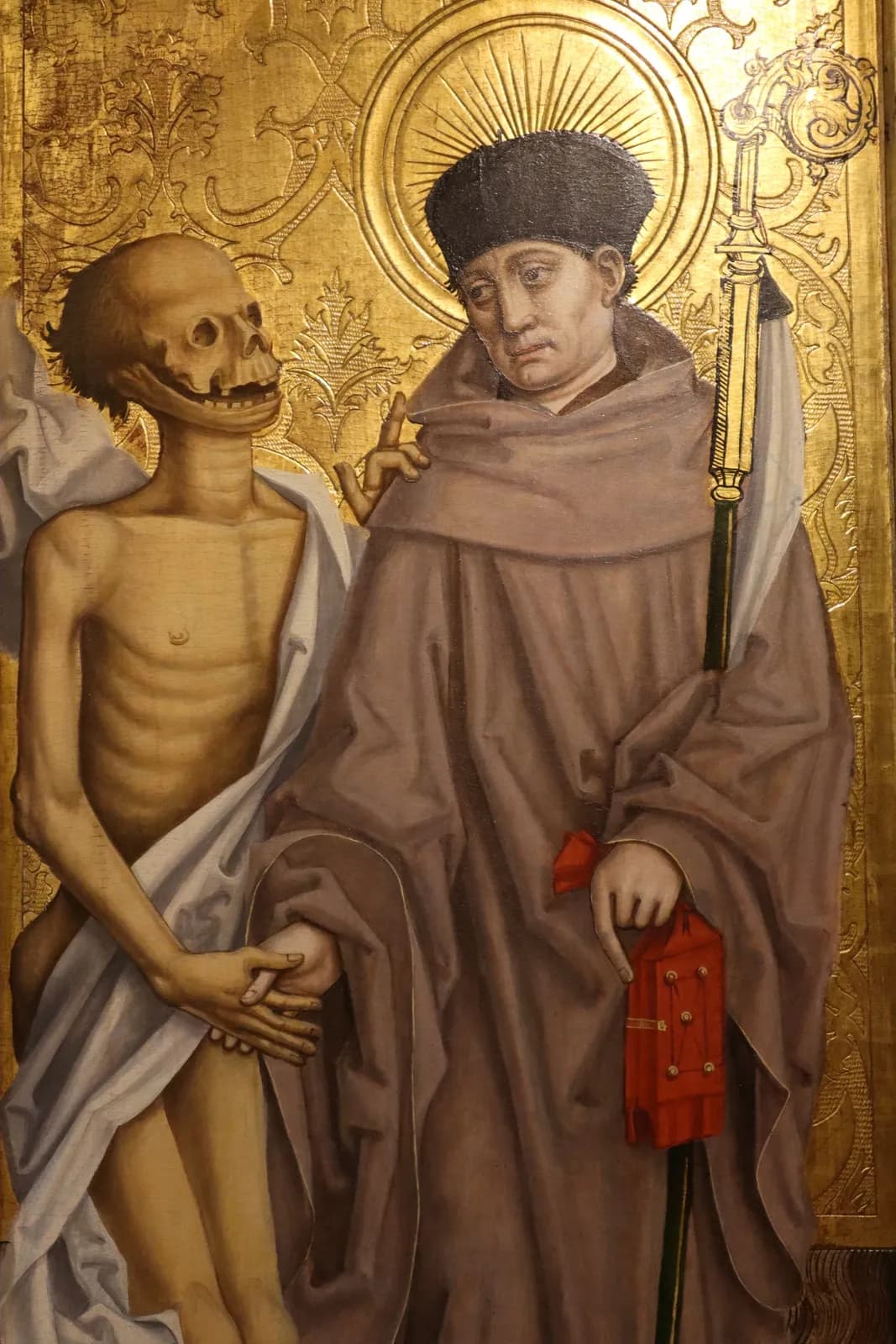
- Lived
- In the sixth century, says the Catholic Encyclopedia 1; died about 538 or 540, or perhaps 650, says katolsk.no 2
- Patron saint of
- Säckingen, Alsace, Strasbourg and the canton of Glarus; carpenters; cattle; good weather; protection from fire and flood 2
Saint Fridolin is honored as the first Irish missionary to the Alamanni on the Upper Rhine and as the founder of the monastery of Säckingen, on an island in the river east of Basel. 12 Almost everything else told of him comes from a Life written by a Säckingen monk at the beginning of the eleventh century, which most modern historians, the 1909 Catholic Encyclopedia says, "justly reject" as unhistorical. 1 What survives the criticism is short: an Irish missionary who preached in Gaul and founded a monastery on the island of Säckingen. 1
Balther's Life
The earliest written account of Fridolin is the Life by Balther, a monk of Säckingen, written at the beginning of the eleventh century. 1 Balther said he had found an older biography in the cloister of Helera on the Moselle, another of Fridolin's foundations, and that having no parchment or ink to copy it, he learned it by heart. 12 Johann Peter Kirsch, who wrote the encyclopedia article, says flatly: "This statement sounds very suspicious," and concludes that Balther had to rely on oral tradition. 1
Kirsch gives his reasons. "Not a single ancient author mentions Fridolin," the Life has no proper chronology, and "the enumeration of so many wonders and visions awakens distrust." 1 The Norwegian bishops' saints database repeats the judgment and names the silent witnesses: neither Gregory of Tours nor the martyrologies of Rabanus Maurus and Notker Balbulus mention him. 2 Older historians, Kirsch adds, believed the Life held a germ of truth. 1
Poitiers and the relics of Saint Hilary
In Balther's telling, Fridolin came of a noble family in Ireland and worked first as a missionary in his own country. 1 He crossed to France and came to Poitiers, where, in answer to a vision, he searched for the relics of Saint Hilary and built a church for them. 1 katolsk.no fills in the setting: Hilary's church had been ruined in the invasions, the relics lay buried under the rubble, and Hilary himself appeared and told Fridolin where to dig. 2 It says King Clovis, who credited a vision of Hilary for his victory over the Visigoths in 507, paid for the new church, and that the bishop of Poitiers made Fridolin abbot of its monastery. 2
Then Hilary appeared to him again in a dream, Kirsch writes, and "commanded him to proceed to an island in the Rhine, in the territories of the Alamanni." 1 katolsk.no adds that he left the monastery in Poitiers to two nephews from Northumbria who had joined him. 2 He went to Clovis, called "Emperor" in the Life, and was granted possession of the still unknown island. 1 On his way east through Helion, Strasbourg and Chur, he founded churches in honor of Saint Hilary in every district. 12 katolsk.no says this is how the cult of Hilary came into Germany. 2
The island of Säckingen
At last he reached the island of Säckingen and recognized it as the island of his dream. 1 The people on the banks of the Rhine used it as pasture for their cattle; Kirsch says they "mistook Fridolin for a cattle-robber and expelled him." 1 He came back with Clovis's deed of gift, and they let him build a church and a monastery on the island. 12 katolsk.no calls Säckingen the oldest monastery in southern Germany, and says he also built a convent for women nearby. 2 The Roman Martyrology speaks of two monasteries founded there in honor of Saint Hilary. 3
katolsk.no paints him as a man the people loved for his kindness. Parents entrusted their children to him, and he started a school for boys on the island, where he encouraged them in all kinds of sports and joined in himself. 2 He then went back to mission work, founded the monastery of the Irish monks at Constance, and carried his preaching as far as Augsburg. 12 For this work on the upper Rhine he is often called its apostle. 2
Urso and the canton of Glarus
The best-known story is told by katolsk.no and not by the encyclopedia. 2 In what is now Switzerland, it says, Fridolin converted a landowner called Urso, who at his death left his great estates, today the canton of Glarus, to Fridolin; the canton's name is said to come from Hilarius. 2 Urso's brother Landolf refused to accept the gift and took Fridolin to court at Rankweil. 2 There, the legend goes, Fridolin prayed at a stone that softened under his arms and knees, went to Urso's grave, raised him from the dead and brought him into court, and Landolf, seeing his half-decayed brother testify, was so frightened that he gave up his own share as well. 2 The stone is still shown in the church at Rankweil, and people with bad knees go to it. 2
What history allows
Kirsch allows the Life one useful fact. In the early Middle Ages there was certainly some connection between Säckingen and Poitiers, from which Säckingen received relics, and this, he suggests, may be why the writer tied Fridolin to the cult of Hilary. 1 "The only portion of the life that can be regarded as historically tenable," he concludes, "is that Fridolin was an Irish missionary, who preached the Christian religion in Gaul, and founded a monastery on the island of Säckingen in the Rhine." 1
There is no exact date. 1 katolsk.no says he died on March 6 around 538, or 540 according to the Bollandists, but that some sources give 650, which it thinks more likely, and that he more probably came from the region of Poitiers than from Ireland. 2 The first document about the monastery itself is from February 10, 878, when Charles the Fat gave the monasteries of Säckingen and of Saints Felix and Regula in Zurich to his wife Richardis; by then, Kirsch says, Säckingen was of great importance. 1
He was buried at Säckingen. 1 katolsk.no says his grave was opened again and again over the centuries to send relics to St. Gall, Einsiedeln, Glarus and Vienna, where some are still kept in St. Stephen's Cathedral, and that around 1750 the abbess had the great silver rococo shrine made that still holds his remains in the former convent church of St. Fridolin. 2
What is Saint Fridolin the patron saint of?
katolsk.no lists Saint Fridolin as patron of Säckingen, Alsace, Strasbourg and the Swiss canton of Glarus, of carpenters and of cattle; he is invoked for good weather and a fruitful climate, in danger of fire and flood, and against cattle diseases, children's illnesses and ailments of the legs and arms. 2 He is shown as an abbot holding his deed of gift, or as a wandering monk with staff and bag, and often with Urso, as a skeleton or rising from a grave; he appears as a pilgrim on the coat of arms of Glarus. 2
Saint Fridolin's feast day
Saint Fridolin's feast day is March 6. 23 The Roman Martyrology enters him that day at Säckingen as an abbot from Ireland who wandered as a pilgrim through France until he founded two monasteries there in honor of Saint Hilary. 3 katolsk.no adds that the diocese of Strasbourg keeps him on March 7, that Switzerland celebrates the translation of his relics on June 25, and that some sources give October 3. 2 Säckingen has held a procession in his honor since at least 1347, on the first Sunday after March 6. 2
Praying with Saint Fridolin
The story of Fridolin is a story of going where he was sent without knowing where it was. In the Life he is given an island nobody can name, sets out toward it anyway, and builds churches along the road until he finds it. 12 The critics doubt the dream. They do not doubt that somebody came from far away and built a monastery on that island. 1
His welcome was not warm. The first people he met took him for a cattle thief and drove him off, and he had to come back with papers before they let him stay. 1 katolsk.no remembers him less for his gifts as a missionary than for his goodness and kindness of heart, and for a school where he played games with the boys. 2
Little of what is told about him can be proved, and his sources say so plainly. 12 What the Church keeps on March 6 is the memory of a founder: the monastery he began was important enough by the ninth century to be given away by an emperor, and Säckingen has held a procession in his memory for nearly seven hundred years. 12
Saint Fridolin of Säckingen, pray for us.
Sources
- 1.Johann Peter Kirsch, "St. Fridolin," The Catholic Encyclopedia, Vol. 6 (New York: Robert Appleton Company, 1909).
- 2."Den hellige Fridolin Vandreren (av Säckingen) (d. 538?)," Den katolske kirke (katolsk.no), Catholic Diocese of Oslo (in Norwegian).
- 3.Roman Martyrology, entry for March 6, "San Fridolino, abate," as printed in "Santo del giorno," Conferenza Episcopale Italiana (in Italian).
Saints to turn to next
Others in this collection who are turned to for some of the same things.
- Saint Agnes of Montepulcianoc. 1268 - April 1317Work and vocationDiscernment
- Saint Albert ChmielowskiAugust 20, 1845 - December 25, 1916DiscernmentWork and vocation
- Saint Andrew Avellino1521 - November 10, 1608DiscernmentWork and vocation
- Saint Angela MericiMarch 21, 1474 - January 27, 1540Work and vocationDiscernment