Saint Frideswide
c. 650 or c. 680 - 727 or 735
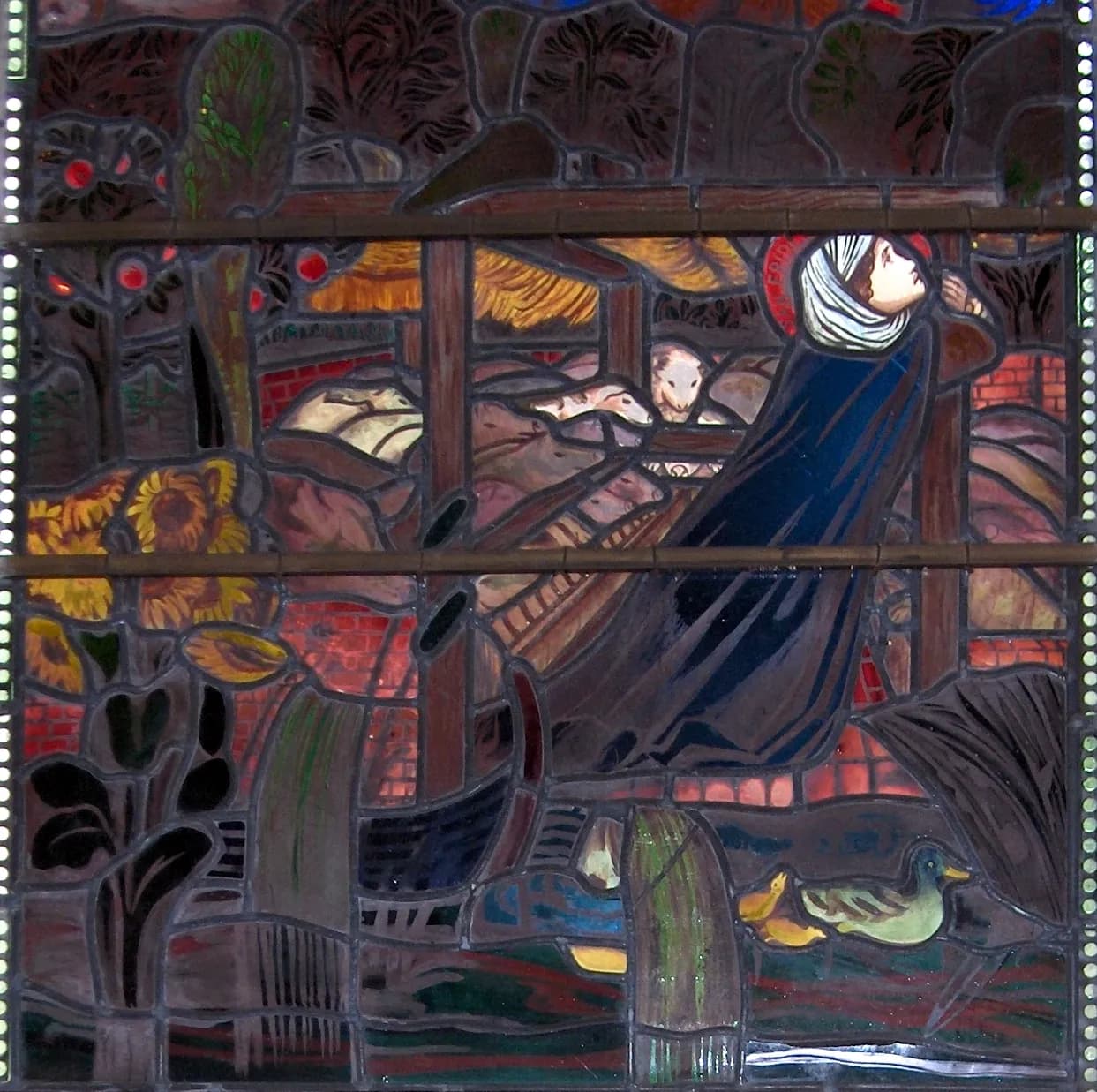
Saint Frideswide is the patron saint of Oxford: an Anglo-Saxon princess who refused to marry, became abbess of a monastery beside the Thames, and was buried in the church that is now Christ Church Cathedral. 123 Almost everything told about her comes from a legend written down some four hundred years after she died, though the 1909 Catholic Encyclopedia judged that its substance "has every appearance of verisimilitude." 1 Her relics had a stranger history than her life, ending up deliberately mixed with the bones of a former nun. 12
What can be known
Frideswide was almost a contemporary of Bede, but the country on the border of Wessex and Mercia where she lived is far less well documented than Bede's Northumbria. 2 The Norwegian bishops' saints database, which gathers the modern scholarship, says that little about her is certain, but that historical and archaeological research has clarified her background. 2 Late in the seventh century what is now western Oxfordshire was ruled by a sub-king under Mercian overlordship, Dida of Eynsham, and he and his wife Safrida were her parents. Dida endowed churches at Eynsham, Bampton and Oxford. 2
She was the first abbess of the double monastery of Saint Mary at Oxford, for both monks and nuns, on the site where the college and cathedral of Christ Church now stand. 2 The Roman Martyrology says the same in its own terms: born of royal stock and made abbess, she governed two communities, one of monks and one of consecrated virgins. 3 The town of Oxford grew up around those buildings. 2
The dates are uncertain. The 1909 Catholic Encyclopedia gives her life as about 650 to 735. 1 katolsk.no heads its page with about 680 to 727, and says she died in 727, or about 735, in her monastery, and was buried there. 2
The legend of King Algar
The story was written down in the twelfth century by the historian William of Malmesbury, from a version attributed to Robert of Cricklade, then prior at Oxford. 2 In its latest form, as the encyclopedia summarizes it, she was brought up to holiness by a woman named Algiva, refused the hand of King Algar, a Mercian, and fled from him to Oxford. 1 "It was in vain that he pursued her; a mysterious blindness fell on him, and he left her in her cell." 1
katolsk.no tells it with more geography. Frideswide had vowed her virginity and wanted to be a nun; to escape the marriage she ran from home and hid for three years at Binsey, close to Oxford. The prince was struck blind for a time and healed at Bampton through her prayers, and after that he let her alone. 2 It notes that Oxford, Bampton and Binsey all lie on the Thames, and it identifies the legend's Algar as the man who later reigned as King Ethelbald of Mercia. 2 From her cell, the encyclopedia says, the monastery eventually grew in which she died. 1
Pollen, who wrote the encyclopedia article, was frank about the dating of the evidence: "The earliest written life now extant was not composed until four hundred years after her death." 1 He still thought the core of the story believable. 1
Fire, canons and a university
Most of the monastery's early records were lost in 1002, when the church was set on fire while Danes who had taken refuge inside were attacked, under the decree of King Ethelred against the Danes in England. 2 A text on the resting places of the saints attests her shrine there in 1004. 2 Early in the twelfth century the house was refounded for Augustinian canons, and her shrine became an important place of pilgrimage. 2
Her relics were solemnly moved to a new shrine on February 12, 1180, a translation still commemorated on that day, and a larger shrine followed in 1289. 12 From 1180, the encyclopedia says, "her fame spread far and wide," because the university was now drawing students from everywhere, and they went in procession to her shrine twice a year. 1 In 1440 Archbishop Henry Chichele of Canterbury formally named her patron of the University of Oxford. 2 katolsk.no adds that those two yearly visits were solemn feasts in her honor, and suggests that this academic connection is why the stained glass in her shrine chapel shows two other learned women, Hilda of Whitby and Catherine of Alexandria. 2
What happened to her bones
In 1525 Cardinal Wolsey closed the priory, with papal permission, to fund his new Cardinal College on the same site, now Christ Church; Henry VIII afterward made her church the cathedral of a new diocese of Oxford. 12 Her shrine was dismantled, and katolsk.no says it was plundered by the king's commissioners in 1538, though Catholics kept her bones safe. 12
Under Edward VI, Catherine Cathie, a former nun who had married the reformer Peter Martyr Vermigli, was buried near the site of the shrine. Under Queen Mary the Catholics removed her remains. 1 Then, the encyclopedia says, after Elizabeth restored Protestantism, James Calfhill, made a canon of Christ Church in 1561, dug up Cathie's bones again, "mixed them up (in derision of the Catholics) with the alleged remaining relics of the saint," and buried the two together. 1 katolsk.no dates this to 1558. 2 It also says Calfhill gave the grave a new epitaph, "Hic jacet religio cum superstitione," here lies religion with superstition. 2 Pollen doubts it: the words appear in printed epitaphs on the episode, but "it does not seem that these words were incised on the tomb, though it is often said that they were." 1
Relics of hers were also kept at Reading, at the New Minster in Winchester and at Saint George's Chapel in Windsor. 2 In modern times parts of the medieval shrine, recovered from a well at Christ Church, have been reassembled, and it still draws pilgrims, especially on her two feasts. 2
What is Saint Frideswide the patron saint of?
Saint Frideswide is the patron saint of Oxford, both the city and the university. 12 The university's patronage was made formal in 1440. 2 For reasons nobody has explained, she was also venerated at Bomy in Artois, in northern France, under the name Frévisse. 2 In art she appears as a crowned nun with an abbess's staff and a scepter and an ox beside her; in some pictures an angel rows her down the Thames with two of her sisters. 2
Saint Frideswide's feast day
Saint Frideswide's feast day is October 19, the day of her death and her principal feast, and the day on which the Roman Martyrology commemorates her. 13 The translation of her relics is kept on February 12. 12 katolsk.no notes that the October feast is celebrated in the Archdiocese of Birmingham, which includes Oxford. 2
Praying with Saint Frideswide
Strip the legend down and what remains is a young woman who wanted a life given to God and was expected to make a political marriage instead. 12 Whoever Algar really was, she said no, and the story remembers her saying it at the cost of three years in hiding. 2
Her monastery outlived her by eight centuries, and a university grew up around it that took her as its patron. 12 She could not have known that. She founded a house of prayer on a river crossing, and the rest came after.
The end of her story is hard to read. A canon of her own church mixed her bones with a stranger's to mock the people who honored them. 1 They lie together still in the cathedral, and pilgrims still come on her feast. 2 Whatever Calfhill meant by it, the grave he made has gone on being prayed at.
Saint Frideswide, pray for us.
Sources
- 1.John Hungerford Pollen, "St. Frideswide," The Catholic Encyclopedia, Vol. 6 (New York: Robert Appleton Company, 1909).
- 2."Den hellige Frideswida av Oxford (~680-727)," Den katolske kirke (katolsk.no), Catholic Diocese of Oslo (in Norwegian).
- 3.Roman Martyrology, entry for October 19, "Santa Fridesvida, vergine," as printed in "Santo del giorno," Conferenza Episcopale Italiana (in Italian).
Saints to turn to next
Others in this collection who are turned to for some of the same things.