Saint Frederick of Utrecht
d. July 17 or 18, 838
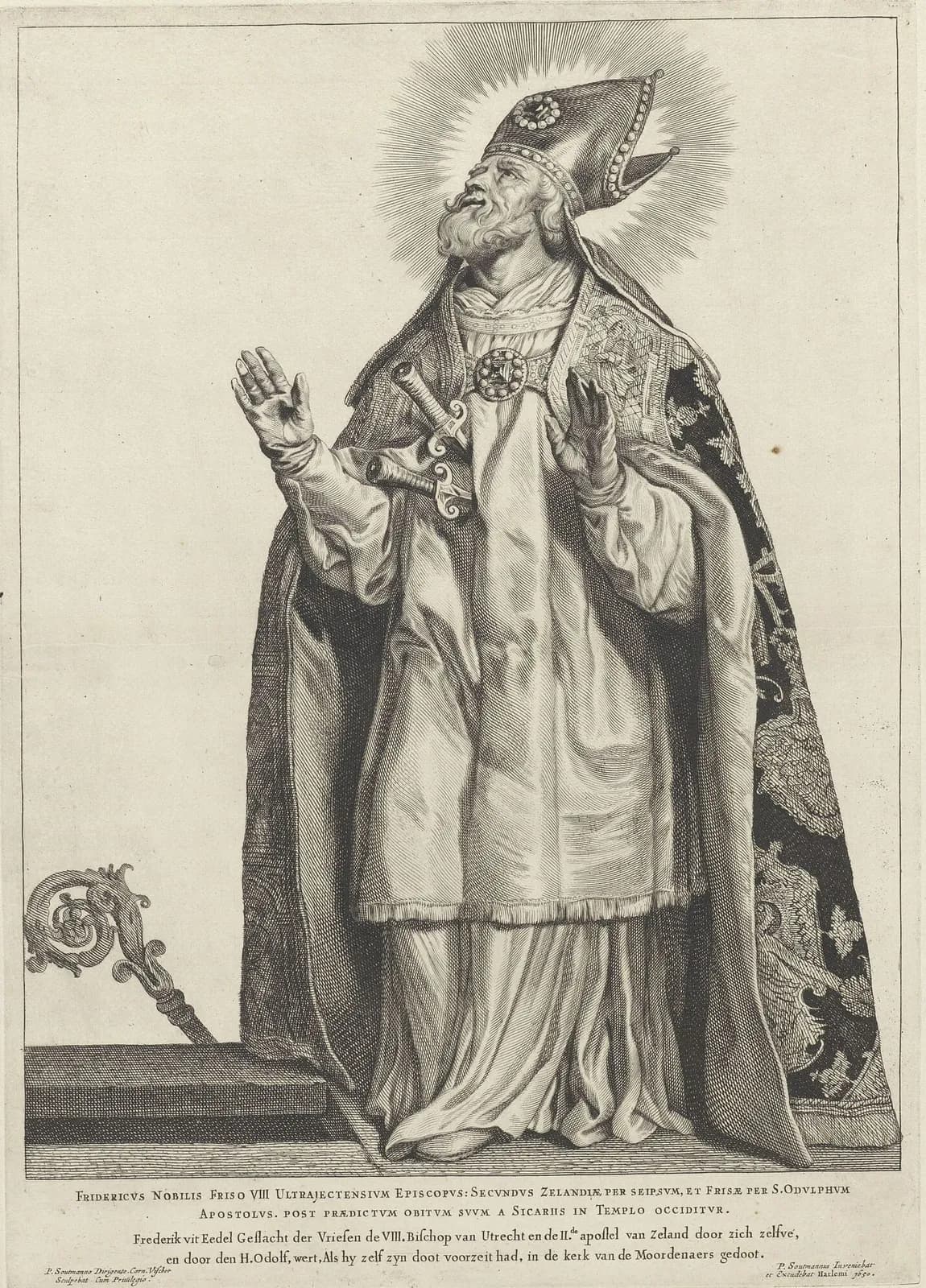
- Family
- A Frisian noble line; great-grandson of King Radbod, says Butler 1; grandson, says CatholicCulture 3
- Bishop of
- Utrecht, the eighth after Saint Willibrord, from about 820 1
- Died
- Stabbed after Mass at Utrecht, on July 17, 838, says Butler 1; July 18, 838, says CatholicCulture 3
- Buried
- The church of Saint Savior (Oude-Munster), Utrecht 1
Saint Frederick was a Frisian noble who became bishop of Utrecht about 820 and spent his episcopate on the last pagan corners of his diocese. 12 In 838, as he went to kneel in a chapel to give thanks after Mass, two men stabbed him, and he died within minutes, praying a verse of the psalms. 13 The medieval life says the empress Judith had him killed for rebuking her; some later historians blamed the islanders of Walcheren, whose marriages he had broken up. 1
A Frisian at Utrecht
Frederick came, in Alban Butler's words, "of a most illustrious family among the Frisons." 1 Butler, following the medieval life of the saint, makes him a great-grandson of Radbod, king of the Frisians before the Franks conquered them; CatholicCulture.org makes him a grandson. 13 He was brought up among the clergy of the church of Utrecht, the see Saint Willibrord had founded, and Butler says his fasts and his night watches in prayer were extraordinary. 1
Once he was a priest, Bishop Ricfrid gave him charge of instructing the catechumens, the adults preparing for baptism. 13 CatholicCulture puts it as being "in charge of newly converted Christians." 3 The Roman Martyrology, as the Italian bishops print it, remembers him above all as a man who shone in the study of Holy Scripture. 2
Bishop of Utrecht
When Ricfrid died, which Butler dates to 820, Frederick was chosen to succeed him as the eighth bishop of Utrecht after Willibrord. 1 Butler says he protested his unworthiness with tears before the clergy and people, and accepted only when the emperor Louis the Pious, whom Butler calls Louis Debonnaire, compelled him. 1 He went to his metropolitan, the archbishop of Mainz, received ring and crosier at Aachen, and was consecrated there in the emperor's presence; Louis urged him to root out what was left of idolatry in Frisia. 1 Clergy from his church met the new bishop and escorted him with honor from the Rhine to Utrecht. 1
Butler sets the scene. Charlemagne's severity had turned the conquered Frisians and Saxons against the empire, he writes, and Louis had won them back with lighter taxes and leniency. 1 Frederick set about his own work at once. 1 The Martyrology says he gave care and effort to the evangelization of the Frisians. 2 Butler says he sent "zealous and virtuous laborers" into the north of his diocese, and CatholicCulture names Saint Odulph among the priests he sent "to areas where the people were still pagan." 13 In Butler's life of Odulph, Frederick persuaded him by urgent entreaties to leave his parish in Brabant and become his assistant in reforming the Frisians, a work Butler says cost Odulph extraordinary labor. 1 Odulph spent his old age at Utrecht and died a canon of the cathedral. 1
CatholicCulture says that what is known of Frederick was recorded by contemporaries "who praised his wisdom, prudence, piety, and virtues," and that poems and hymns were written in his honor. 3 Butler names one of them: a poem in praise of his virtue by his contemporary Rabanus Maurus. 1 Both sources say he composed a prayer to the Holy Trinity, which, CatholicCulture writes, "was used in the Netherlands for centuries." 13
Walcheren and the court
Butler describes the people of Walcheren, an island of Zeeland, as the most resistant in the diocese to the gospel. 1 When Frederick divided the northern districts among his missionaries, he kept that hardest field for himself. 1 What troubled him most there, Butler says, were marriages contracted within the forbidden degrees of kinship. 1 He preached, fasted and prayed, called the island's leading men together, broke up many such unions, and reconciled to the Church those who did penance. 1 CatholicCulture says the islanders "resented the bishop's concern for them." 3
The other trouble was at court. 13 Louis the Pious had married Judith, daughter of Count Welf, in 819, and Butler, who is hard on her, describes years of scandal and intrigue that drove the emperor's elder sons into rebellion. 1 He reports that the medieval life of Frederick called the marriage itself incestuous, and that Mabillon and others rejected this as fabulous. 1 Whatever the truth, Butler says Frederick, whose see lay near the court at Aachen, admonished her "with an apostolic freedom and charity," and earned her fury and resentment. 1 CatholicCulture says it was Louis's sons who asked the bishop to speak to their stepmother. "The bishop corrected her gently but honestly," it adds. 3
Death after Mass
One day, as he came from the altar after saying Mass and went to kneel in the chapel of Saint John the Baptist for his thanksgiving, he was stabbed by two assassins. 1 CatholicCulture says two men attacked him with knives. 3 He died within a few minutes. 13 Butler says he died reciting a verse he gives as "I will please the Lord in the land of the living," from the hundred and fourteenth psalm in the numbering he used. 1 CatholicCulture renders the dying prayer as "I walk before the Lord in the land of the living," from Psalm 116. 3
Who sent the killers is disputed. 1 The author of his life says the empress Judith did, and Butler adds that William of Malmesbury and several Dutch historians say the same; Butler writes that this "seems clearly to have been the true cause and manner of his martyrdom." 1 He reports that Baronius, Mabillon, Le Cointe and Baillet thought instead that the killers came from Walcheren, sent by islanders whose marriages Frederick had dissolved, though he answers that this view lacks the authority of the ancient historians. 1 CatholicCulture tells of both enmities and does not say which led to the murder. 3
Butler gives the date as July 17, 838, "as Mabillon has proved"; CatholicCulture gives July 18, 838. 13 He was buried in the church of Saint Savior at Utrecht, which Butler calls the Oude-Munster. 1
What is Saint Frederick the patron saint of?
None of the sources consulted names a patronage for Saint Frederick of Utrecht. 123 He is remembered at Utrecht as one of its early bishops, and Butler says his reputation for holiness made him "one of the most illustrious prelates of the Church" in his time. 1 The prayer to the Trinity that he wrote, CatholicCulture notes, was prayed in the Netherlands for centuries. 3
Saint Frederick's feast day
Saint Frederick's feast day is July 18. 123 Butler places him under that day, and CatholicCulture lists him on it as bishop and martyr. 13 The current Roman Martyrology also enters him on July 18, but as a bishop only, praising his study of Scripture and his work among the Frisians and saying nothing about how he died. 2
Praying with Saint Frederick
Frederick did not want to be a bishop, and Butler says he wept when he was chosen. 1 Once he was, he took the hardest island for himself and stayed with the slow work of reforming people who did not want it. 13
Both the court and Walcheren had reason to hate him, and the sources still disagree about which of them killed him. 13 The disagreement does not change what he did. He told an empress and a whole island the same thing about marriage. 1
He was killed in a chapel, at his thanksgiving after Mass, and he died praying a psalm about living before God. 13 The Martyrology, which says nothing of the killing, remembers him for the Scriptures he studied and the Frisians he served. 2
Saint Frederick of Utrecht, pray for us.
Sources
- 1.Alban Butler, "Saint Frederic, Bishop of Utrecht, M." and "St. Odulph, Canon of Utrecht, C.," July 18, in The Lives of the Fathers, Martyrs, and Other Principal Saints, Vol. VII (New York: P. J. Kenedy, 1908), via Project Gutenberg.
- 2.Roman Martyrology, entry for July 18, "San Federico, vescovo," as printed in "Santo del giorno," Conferenza Episcopale Italiana (in Italian).
- 3."St. Frederick, Bishop and Martyr" and "St. Frederick," Liturgical Year, July 18, CatholicCulture.org (Trinity Communications).
Saints to turn to next
Others in this collection who are turned to for some of the same things.
- Saint Anthony Mary ClaretDecember 23, 1807 - October 24, 1870Work and vocationCouragePrayer
- Saint Arnold JanssenNovember 5, 1837 - January 15, 1909Work and vocationCouragePrayer
- Saint Ferdinand III of Castilec. 1198 - May 30, 1252Work and vocationCouragePrayer
- Saint Hugh of Grenoble1053 - April 1, 1132Work and vocationCouragePrayer