Saint Francis Jerome
December 17, 1642 - May 11, 1716
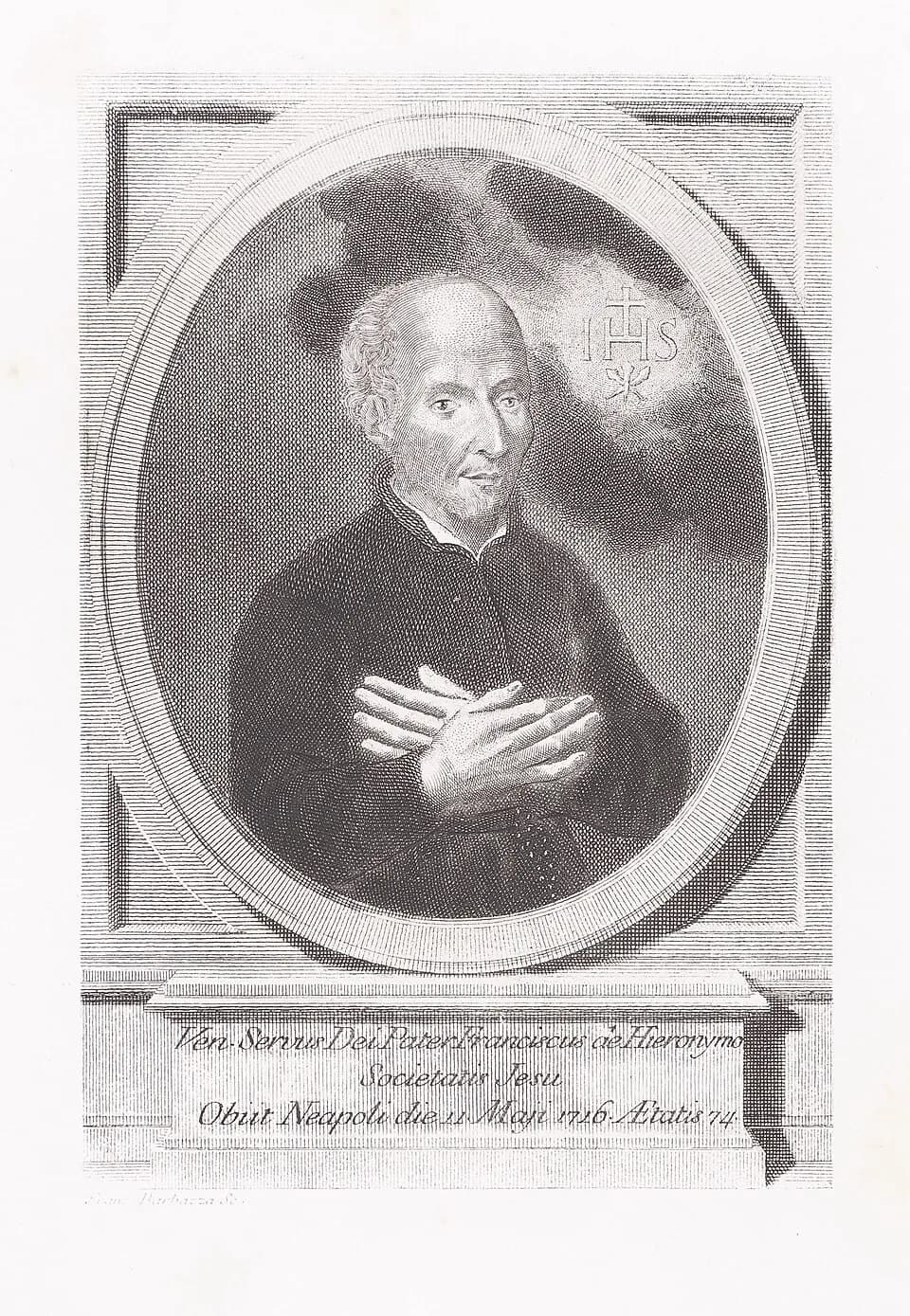
Saint Francis Jerome, born Francesco de Geronimo in 1642, was a Jesuit priest who begged to be sent to the missions of the Far East and was told to stay in Naples, where he preached in the streets, the prisons and the galleys for forty years. 12 He died there on May 11, 1716, and Pope Gregory XVI canonized him in 1839. 1 The Roman Martyrology keeps him on May 11, and the Jesuits on July 2. 35
The eldest of eleven
He was born on December 17, 1642, at Grottaglie, a small town in Apulia a few leagues from Taranto, the eldest of eleven children. 123 An old life in EWTN's library names his parents as John Leonard di Girolamo and Gentilesca Gravina. 4
As a boy he went to live with a community of Theatine priests near his home. The Jesuits put this at about age ten; katolsk.no, the website of the Catholic Church in Norway, says it followed his first Communion at twelve, and that he earned his board as sacristan of their church before they set him to teaching catechism. 23 At sixteen he entered the Jesuit college at Taranto for humanities and philosophy. 1 From there he went to Naples to study law and theology at the Gesu Vecchio, a college "which at that time rivalled the greatest universities in Europe." 12
He was ordained a priest in March 1666, on the 18th by the encyclopedia's account and the 20th by the Norwegian one, with a dispensation because he was under age. 134 The Jesuits then hired him to supervise the boarders at their College of Nobles, where the students called him "the holy prefect, il santo prefetto." 12 He stayed four years, or five. 14 He entered the novitiate on July 1, 1670, at twenty-eight. 123
Naples instead of Japan
After a single year as a novice he was sent out with an experienced missioner, Father Agnello Bruno, and the two spent three years preaching through the towns and villages around Lecce and Otranto. 134 In 1674 he was called back to Naples to finish his theology, and he passed his last examination in the spring of 1676. 234
What he wanted was Asia. He wrote to his superiors again and again asking to be sent to the Far East, and the EWTN life says the particular hope was Japan, when word came that the mission there might reopen. 14 The answer was that he should treat Naples as his India. 4 The encyclopedia records the end of the matter in one sentence: "Francis understood this to be the will of God, and insisted no more." 1 Naples it was, from 1676 until his death. 1
A lamb and a lion
His base was a congregation of workmen that met at the Jesuit house, and he turned its members into helpers. 12 Inside the congregation he set up a mutual fund that paid a sick member four carlines a day and gave the dead a decent funeral. 1
On the third Sunday of every month he held a general Communion at the Gesu Nuovo. For nine days beforehand he walked the main streets ringing a small bell and calling out a line of Scripture to announce it. 14 His biographer counted 15,000 men on an ordinary month. 1
The rest was preaching, out of doors. He is said to have spoken as often as forty times in a day, in short sermons, "choosing those streets which he knew to be the centre of some secret scandal." 1 He set up his platform beside the dancers and mountebanks. 4 The encyclopedia describes a tall, pale, hollow-cheeked man with a weak voice that grew strong when he called people to repent, and it preserves what the crowd said of him: "He is a lamb, when he talks," and "a lion when he preaches". 1 He used props. Sometimes he held up a skull, and sometimes he stopped mid-sentence, bared his shoulders and scourged himself with an iron chain until he bled. 1 It was less improvised than it looked: the Jesuit archives hold a thick collection of his sermon plans. 1
He went where other preachers did not: the prisons, the brothels and the royal convict galleys in the bay, which the encyclopedia calls "sinks of iniquity." 123 He wrote that he had brought many Turkish and Moorish galley slaves to baptism, twenty of them on one Spanish ship. 13 The two refuges for penitent women in Naples soon held 250 each, and he sheltered 190 of their children in a third house. 1
One exchange from the confessional shows the lion at rest. A man admitted he had kept away from God for exactly fifty years and begged not to be sent off. Why avoid so tender a parent, Francis asked him: "Nay, rather turn and meet Him who has been running after you so long." 4
Silenced twice
Success made enemies. Some clergy told the archbishop that a priest who preached in the street and spent his days with the worst sinners was hardly fit to give retreats to priests and nuns, and the archbishop forbade him to preach outdoors. 23 He did not protest. He sat in the confessional at the Gesu instead. 34 In time the archbishop saw that the complaints came from jealousy and restored his faculties. 23
Then his own superiors stepped in. The provincial judged that the work outside took too much from community life, and Francis had to ask leave for everything he did in the city; often he was refused, or another priest was sent. 23 Katolsk.no dates the whole period of opposition from 1688 to 1694, when the provincial relented. 23
From 1702 he spent half of each year on missions outside Naples. 23 He gave more than a hundred, in every province of the kingdom but Calabria, and never stayed more than ten days. 14 His farewell to each town was "adieu, to meet again in Paradise." 4
The wonder-worker and Saint Cyrus
Naples held him to be a great miracle-worker, and his biographers and the witnesses at his canonization credited him with cures of every kind. 1 He denied having any such gift. According to katolsk.no he put the healings down to the prayers of Saint Cyrus, the physician and martyr of Alexandria, to whom he was devoted. 3
The encyclopedia is wary of the stories. It says the summary drawn up for his cause is "a work to be used with caution," and that the fullest life of him "strives too much after the edification of the reader." 1 What it does report is that he "had a mystical soul": he was seen walking through Naples with tears running down his face, too lost in prayer to notice who greeted him. 1
Death and canonization
His health broke in Lent of 1715, when a fever struck him as he was giving a retreat to the students of the College of Nobles. 4 Pleurisy kept him in the infirmary for two months. 23 When someone reminded him of the good he had done, he answered, "Nothing, nothing," and added that "the fault I have most to apprehend is my slothfulness." 4
He died on May 11, 1716, at seventy-four, having been a Jesuit for forty-six years. 124 The funeral turned into a procession, and Swiss guards had to hold back the crowd from the body. 14 He was buried at the Gesu Nuovo, and after the Second World War his remains were taken to the Jesuit church in Grottaglie, where he was born. 3
A decree of May 2, 1758, declared his virtues heroic; the encyclopedia names Benedict XIV as the pope and the EWTN life Benedict XIII. 14 The suppression of the Jesuits then stalled the cause for half a century. 1 Pius VII beatified him in 1806. 13 Gregory XVI canonized him on Trinity Sunday, May 26, 1839. 14
What is Saint Francis Jerome the patron saint of?
Saint Francis Jerome's feast day
Praying with Saint Francis Jerome
He asked for Japan and was given the city he already lived in. 14 The sources do not say that he stopped wanting the other thing. The EWTN life says only that his desire had always been to die for the faith, and that he came to look on Naples as the part of the vineyard he was meant to work. 4
The six years of restriction are the hardest part to read. He was thought unsuitable by some and inconvenient by others, and the people who curtailed him were his archbishop and his provincial. 23 He kept asking permission, kept being refused, and heard confessions. 34 Katolsk.no says he later counted those years as a time of spiritual growth. 3
There is a great deal of noise in his story: the bell, the skull, the chain, crowds of fifteen thousand. 14 Under it is something quieter. He worked out those short sermons on paper beforehand. 1 He built a sick fund for laborers and sheltered the children of the women he had brought to the refuges. 1 And a man who had hidden from God for fifty years was told, gently, that God had been running after him the whole time. 4
At the end, praised for all of it, he said it was nothing and that what he feared most in himself was laziness. 4 To the people crowding his sickroom he said, "Weep not; I go to heaven, where I shall remember you, and be better able to assist you." 4
Saint Francis Jerome, pray for us.
Sources
- 1.Francis Van Ortroy, "St. Francis de Geronimo," The Catholic Encyclopedia, Vol. 6 (New York: Robert Appleton Company, 1909).
- 2."Saint Francis Jerome," Saints and Blessed, The Society of Jesus (Jesuit General Curia), originally collected and edited by Tom Rochford, SJ.
- 3.Per Einar Odden, "Den hellige Frans di Girolamo (1642-1716)," Den katolske kirke (the Catholic Church in Norway), last updated December 24, 2005 (in Norwegian).
- 4."St. Francis of Girolamo," EWTN, Catholicism: Saints (an unsigned life, with no source given on the page).
- 5.Roman Martyrology, entry for May 11, "San Francesco De Geronimo," as printed in "Santo del giorno," Conferenza Episcopale Italiana (in Italian).
Saints to turn to next
Others in this collection who are turned to for some of the same things.