Forty Martyrs of Sebaste
Martyred under Licinius, c. 320
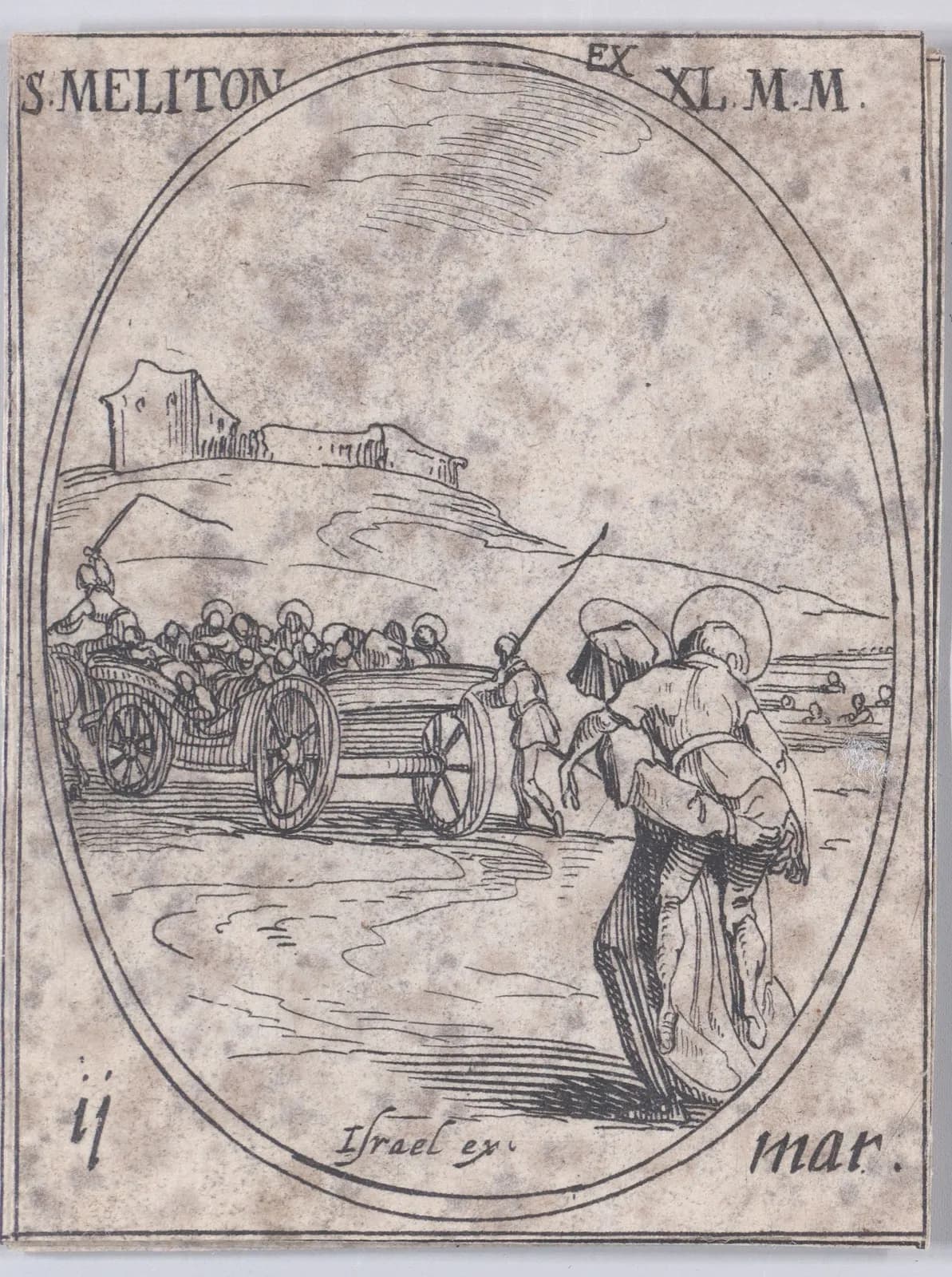
- Earliest account
- A homily of Saint Basil the Great, preached fifty or sixty years later 1
The Forty Martyrs of Sebaste were Christian soldiers of the Roman army who, under the emperor Licinius, were left naked overnight on a frozen pond in Lesser Armenia to die of cold. 13 One of them gave up, and a guard who had been watching took his place, so the number stayed at forty. 1 Saint Basil the Great preached on them within sixty years, and the 1909 Catholic Encyclopedia calls their martyrdom "historic beyond a doubt." 1
Soldiers under Licinius
Licinius ruled the eastern half of the empire after Constantine had granted Christians freedom of worship in 313. 2 Johann Peter Kirsch, in the 1909 Catholic Encyclopedia, says he persecuted the Christians of the East "after the year 316." 1 The Norwegian bishops' saints database, katolsk.no, says that as he prepared to turn on Constantine he feared mutiny in the army, and that about 320 he ordered the Christians of the region to renounce their faith on pain of death. 2
katolsk.no tells the story as later tradition gives it. The governor of Lesser Armenia, Agricola, read the decree to the troops, and forty soldiers of the Twelfth Legion, stationed at Sebaste, refused. 2 They came from different nations; their officer was called Candidus. 2 They were arrested, questioned and imprisoned, and katolsk.no says that in the night they heard a voice telling them to hold out to the end. 2 When the governor tried flattery and then ordered them chained, the eldest, Kyrion, told him the emperor had given him no right to put them in chains, and Agricola, embarrassed, sent them back to prison unbound. 2
The Roman Martyrology, as the Italian bishops print it, calls them soldiers of Cappadocia, bound to one another by faith and by obedience to the will of the heavenly Father rather than by blood, and says they suffered prison and cruel torture before the end. 3 katolsk.no adds that their story varies in its details and that there is some doubt about how far those details can be trusted. 2
The frozen pond
Kirsch gives the heart of it from Saint Basil. The forty "had openly confessed themselves Christians" and were condemned by the prefect "to be exposed naked upon a frozen pond near Sebaste on a bitterly cold night, that they might freeze to death." 1 Warm baths stood ready beside the lake for anyone who gave in. 1
One did. He left his companions and went to the baths. 1 katolsk.no names him Meletius and says the sudden change from ice to hot water killed him. 2 One of the guards, Kirsch writes, "beheld at this moment a supernatural brilliancy overshadowing them," declared himself a Christian, stripped and lay down beside the thirty-nine, "Thus the number of forty remained complete." 1 In katolsk.no's telling he was a keeper of the prison called Aglaius, the only one of the guards awake, and he counted thirty-nine crowns of light above the men on the ice and understood that the one who had fled had lost his. 2
At daybreak, Kirsch says, the stiffened bodies, some still showing signs of life, were burned and the ashes thrown into a river. 1 katolsk.no agrees, and adds that the martyrs appeared in a dream three days later to Peter, bishop of Sebaste and brother of Saint Basil, who gathered their remains by night and buried them with honor. 2 The Martyrology gives a different end: their legs were broken, and so they completed their martyrdom. 3
Basil, Gregory and the spread of the cult
The earliest account is the homily Saint Basil preached on their feast while he was bishop of Caesarea in Cappadocia, between 370 and 379, in a church built in their honor. 1 Kirsch reasons that the feast was therefore older than Basil's episcopate, and that a eulogy preached "only fifty or sixty years after" puts the martyrdom beyond doubt. 1
Basil's brother, Saint Gregory of Nyssa, was "a special client" of the Forty. 1 Two of his sermons on them survive, preached in a church dedicated to them, and when his parents died he buried them beside the martyrs' relics. 1 Saint Ephrem the Syrian wrote hymns in their honor. 1 Christians gathered what remained of the martyrs, Kirsch says, and the relics were divided among many cities, so that their veneration spread widely and many churches were built for them. 1
There is also a document called the Testament of the Forty Martyrs, which Kirsch mentions and katolsk.no describes as possibly contemporary. 12 It gives their last messages from prison, asks that they be buried together, and ends with their names. 2 katolsk.no notes that among those names is Eunoicus, a young servant they had asked to be freed if he was spared, so it seems he was not. 2
The relics found at Constantinople
The historian Sozomen tells how some of their relics came to light in Constantinople in the fifth century. 14 A deaconess named Eusebia had kept "the holy remains of forty soldiers, who had suffered martyrdom under Licinius at Sebaste in Armenia" in her house outside the walls, and had them buried secretly with her. 4 The place was built over and forgotten. 4
According to Sozomen, the Empress Pulcheria was shown the place in visions, and the Forty themselves appeared to her "arrayed in shining robes." 4 An old monk and a priest who remembered the burials helped locate the tomb, and the diggers found two silver caskets among perfumes. 4 Pulcheria gave the relics a costlier casket and placed them in the church of Saint Thyrsus, after a public festival with a procession and psalms, "at which I was present," Sozomen writes. 4
In the West
Devotion to them reached the West early. 1 Saint Gaudentius, bishop of Brescia at the beginning of the fifth century, received some of their ashes on a journey in the East and placed them in the altar of the basilica he built, and his sermon at its consecration survives. 12 katolsk.no says he received them at Caesarea in Cappadocia, from the church dedicated to them there. 2
At Rome, beside the church of Santa Maria Antiqua in the Forum, a chapel dedicated to the Forty Martyrs was found with a fresco of their martyrdom from the sixth or seventh century, on which their names had once been written. 1 katolsk.no dates its excavation to 1901. 2 katolsk.no adds that in art they are shown naked on the frozen lake, often holding palms while angels crown them. 2
What are the Forty Martyrs of Sebaste the patron saints of?
The Forty Martyrs' feast day
Praying with the Forty Martyrs
The story everyone remembers has two turns in it, and only one is a triumph. A guard walked out onto the ice. 1 But before that, a man who had come that far could not go on, and went to the baths. 1
The sources do not make a villain of him. katolsk.no says the warmth killed him; Kirsch says only that he left. 12 Either way, the forty who are honored include a man who was not there at the start, and leave out one who was.
They were soldiers, and what they had to do was not fight but lie still through one night of cold. 13 Basil preached on them in a church built in their name, and his brother Gregory laid their own parents to rest beside the relics. 1
Forty Martyrs of Sebaste, pray for us.
Sources
- 1.Johann Peter Kirsch, "Forty Martyrs," The Catholic Encyclopedia, Vol. 6 (New York: Robert Appleton Company, 1909).
- 2."Førti martyrer av Sebasteia (d. 320)," Den katolske kirke (katolsk.no), Catholic Diocese of Oslo (in Norwegian).
- 3.Roman Martyrology, entry for March 9, "Santi quaranta soldati di Cappadocia," as printed in "Santo del giorno," Conferenza Episcopale Italiana (in Italian).
- 4.Sozomen, Church History, Book IX, chapter 2, trans. Chester D. Hartranft, Nicene and Post-Nicene Fathers, Second Series, Vol. 2 (Buffalo, NY: Christian Literature Publishing Co., 1890), via New Advent.
Saints to turn to next
Others in this collection who are turned to for some of the same things.