Saint Flavian of Constantinople
Died 449
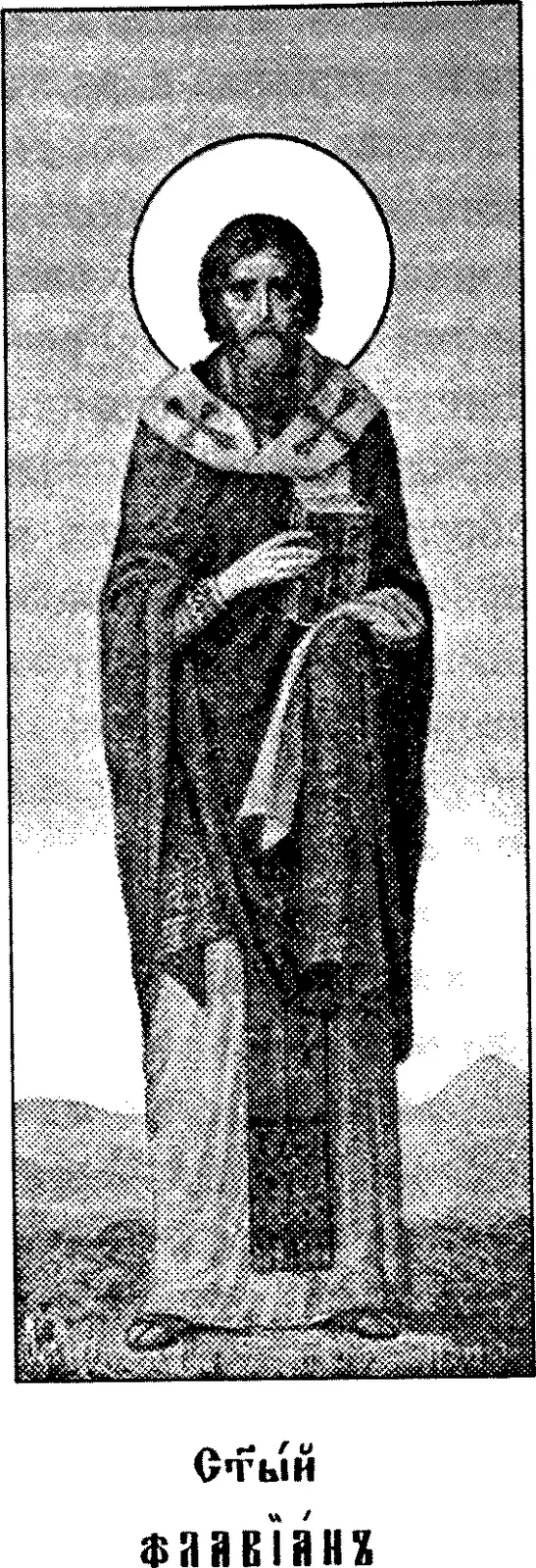
Saint Flavian was the bishop of Constantinople who in 448 condemned the monk Eutyches for teaching that Christ had only one nature after the incarnation, and to whom Pope Leo the Great addressed the letter known as the Tome. 124 A year later a council packed against him at Ephesus deposed him, and he was so badly beaten that he died in exile a few days afterward. 12 The Council of Chalcedon honored him as a martyr for the faith. 12 His feast is February 17. 6
A refusal at the start
Almost nothing is known of Flavian before he became bishop. The Catholic Encyclopedia says he was a priest and skeuophylax, keeper of the sacred vessels, of the church of Constantinople, "noted for the holiness of his life." 1 Butler calls him "a priest of distinguished merit." 2 He succeeded Saint Proclus, in 447 by Butler's date. 12
He made an enemy at once. Chrysaphius, a eunuch who was chamberlain and favorite of the emperor Theodosius II, had the emperor ask the new bishop for a gift in thanks for his appointment. 12 Flavian sent blessed bread, as was customary, and was told that gold was what had been meant. 12 He answered, Butler says, that the revenues of the church "were designed for other uses, namely, the honor of God and the relief of his poor." 2
Butler adds a second offense: Chrysaphius, working through the empress, had Flavian ordered to make the emperor's sister Pulcheria a deaconess of his church, and Flavian refused that too. 2 Pulcheria, both sources agree, was his steady friend. 12 The empress who sided with Chrysaphius is Eudocia in the encyclopedia and Eudoxia in Butler. 12
Eutyches
The quarrel that killed him began at a synod Flavian held in Constantinople in November 448. 12 Eusebius of Dorylaeum accused the archimandrite Eutyches, head of a large monastery near the city and a relative of Chrysaphius, of heresy. 12 Eutyches had opposed Nestorius so fiercely, Butler says, that he fell into the opposite error and denied two distinct natures in Christ after the incarnation. 2
He came to the synod with court officials and a troop of guards, and said he acknowledged two natures before the union and one after it. 2 He would not dispute, only state his faith. 2 The encyclopedia says Flavian "exercised clemency and urged moderation," but when Eutyches would not make an orthodox declaration, he pronounced sentence of deposition and excommunication. 1 Butler says thirty-two bishops and twenty-three abbots signed it. 2
Flavian wrote to Rome. His letter to Leo is not triumphant. He begins with grief "over the capture of one of the clergy who are under me, and whom I could not save nor snatch from the wolf, although I was ready to lay down my life for him." 3 He sent the minutes of the synod so that the pope could see the case for himself. 3
Leo answered on June 13, 449, with the letter the Church remembers as the Tome. 14 He found Eutyches "very unwary and exceedingly ignorant," a man who had not grasped "the rudiments of the Creed." 4 Then he set out the faith Flavian had defended. In Christ, he wrote, "majesty took on humility, strength weakness, eternity mortality," without loss to either nature, so that one and the same Mediator "could both die with the one and not die with the other." 4 "For each form does what is proper to it with the co-operation of the other." 4
The pope did not close the door on the man. If Eutyches repented, Leo told Flavian, "no mercy that is shown to him when penitent can be found fault with," because the Good Shepherd came to save souls and not to lose them. 4 He named his legates for what followed: Bishop Julius, the priest Renatus, the deacon Hilary and the notary Dulcitius. 24
The Robber Council
Eutyches complained that the synod had been unjust and its acts tampered with. The emperor ordered them reviewed in April 449, and nothing was found against Flavian. 12 Chrysaphius turned instead to Dioscorus, bishop of Alexandria, and the emperor summoned a council to Ephesus with Dioscorus in the chair. 12 Flavian and six bishops who had sat with him in 448 came as defendants, with no voice. 1
It opened on August 8, 449. 2 Butler describes soldiers in the church and the pope's letters never read. 2 Eutyches was cleared and Flavian deposed. 12 Leo's deacon Hilary, the future pope, cried out "Contradicitur," and Butler says some bishops threw themselves at Dioscorus's feet begging him to stop. 12 Dioscorus called in the imperial commissioners, and the proconsul entered with soldiers and a crowd carrying chains and clubs. 2 Flavian handed his written appeal to the papal legates. 25
Then he was attacked. Butler says Dioscorus, Barsumas and others threw him to the ground and kicked and beat him. 2 The current Roman Martyrology says he was struck with fists and kicks by the followers of Dioscorus. 6 The encyclopedia says he died three days later in his place of exile, at Hypaepa in Lydia, in August 449. 1 Butler says he died "within a few days," not at Ephesus "as some have said by mistake," but in exile at a place two days' journey away near Sardis. 2
Vindicated
Leo heard the news from Hilary, who had escaped Ephesus "with great difficulty," and wrote to Theodosius that "bishop Flavian gave them an appeal in writing," asking for a general council. 5 At a council in Rome he called what had happened at Ephesus not a judgment but a robbery. 1 His letter commending Flavian did not reach him alive. 1
When Theodosius died, Pulcheria brought her friend's body back to Constantinople, where it was received in triumph and buried among his predecessors. 12 In 451 the Council of Chalcedon annulled the acts of Ephesus and praised Flavian as a martyr for the faith. 12 Hilary, as pope, had his death pictured in a Roman church he built. 12 Dioscorus was condemned at Chalcedon and died in exile. 2
What is Saint Flavian the patron saint of?
Saint Flavian's feast day
Saint Flavian's feast day is February 17. The current Roman Martyrology commemorates him on that day as the bishop of Constantinople who defended the Catholic faith at Ephesus, was beaten by the followers of Dioscorus and condemned to exile, and died soon after. 6 Butler also places him on February 17. 2
The Catholic Encyclopedia gives February 18, saying that "in the Greek Menology and the Roman Martyrology his feast is entered 18 February, the anniversary of the translation of his body." 1 That was the Roman date in 1909; the current Martyrology has him on the 17th. 16
Praying with Saint Flavian
The first thing recorded of Flavian as bishop is a refusal to pay for his own appointment, and the treasure he would not spend was, in the answer Butler records, meant for God and the poor. 2 It made an enemy who pursued him for the rest of his life. 12
His letter to Leo about Eutyches reads as grief more than victory. He calls the condemned monk one of his own clergy, a man he could not snatch from the wolf, though he would have given his life to. 3 Leo, in reply, was sterner about the error and gentler about the man than many would be: mercy, he wrote, could not be faulted if Eutyches repented. 4
Flavian did not live to see the reversal. He was deposed, beaten, sent away, and dead within days, and the letter that would have told him Rome stood behind him arrived too late. 12 Chalcedon's verdict came two years after his death. 12
Saint Flavian of Constantinople, pray for us.
Sources
- 1.F. M. Rudge, "St. Flavian," The Catholic Encyclopedia, Vol. 6 (New York: Robert Appleton Company, 1909).
- 2.Alban Butler, "St. Flavian, M., Archbishop of Constantinople," February 17, in The Lives of the Fathers, Martyrs, and Other Principal Saints, Vol. I (New York, 1895), Project Gutenberg eBook #20450.
- 3.Flavian of Constantinople to Pope Leo, Letter 22 in the letters of Leo the Great, trans. Charles Lett Feltoe, Nicene and Post-Nicene Fathers, Second Series, Vol. 12 (1895), New Advent.
- 4.Leo the Great to Flavian, Letter 28 (the Tome), trans. Charles Lett Feltoe, Nicene and Post-Nicene Fathers, Second Series, Vol. 12 (1895), New Advent.
- 5.Leo the Great and the Roman synod to Theodosius Augustus, Letter 44, trans. Charles Lett Feltoe, Nicene and Post-Nicene Fathers, Second Series, Vol. 12 (1895), New Advent.
- 6.Roman Martyrology, entries for February 17, Santo del giorno, Conferenza Episcopale Italiana (in Italian).
Saints to turn to next
Others in this collection who are turned to for some of the same things.