Saint Felix of Nola
c. 200 - c. 260
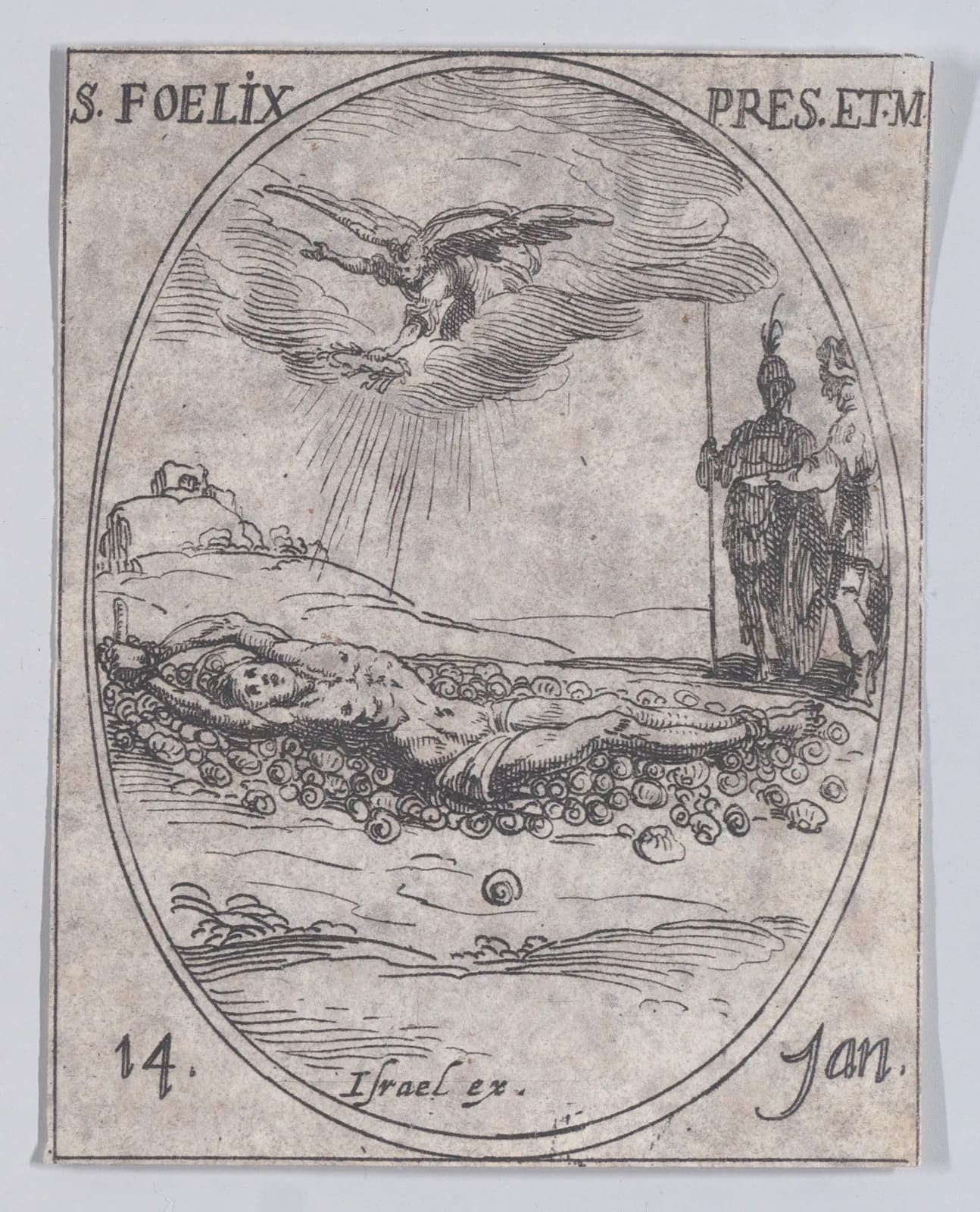
- Died
- January 14, year uncertain 1; about 260 2; 255 according to Catholic Culture 5; the Spanish Martyrology says the third or fourth century 6
Saint Felix of Nola was a priest near Naples who was beaten, chained and imprisoned in the persecution of Decius in 250, escaped, by Paulinus's account, with the help of an angel, carried his starving bishop home on his back, and later turned down the bishop's chair to farm a few rented acres and give the harvest away. 12 He died in old age, around the middle of the third century, without being put to death, yet he was honored as a martyr for what he suffered. 12 Almost all we know comes from the poems of Saint Paulinus of Nola, who gave up a governor's career to live beside his tomb. 24
One witness
The 1909 Catholic Encyclopedia names the source plainly: "The poems and letters of Paulinus on Felix are the source from which St. Gregory of Tours, Venerable Bede, and the priest Marcellus have drawn their biographies." 1 The Norwegian bishops' saints database (katolsk.no) is more precise. The little that is known comes chiefly from two of Paulinus's poems, written more than a hundred years after Felix died, and Paulinus worked into them much of the legend that had grown up in the meantime. 2
Paulinus wrote fourteen poems for Felix's feast, one a year, between 393 and 407, gathering what he could from clergy and pilgrims. 2 Bede later summarized them in prose, and from there the story reached the Acta Sanctorum. 2
A priest of Nola
Felix was born at Nola in Campania, not far from Naples. katolsk.no makes him the elder of two sons of Hermias, a wealthy soldier of Syrian origin who had retired to Nola and bought land there; the younger son followed his father into the army. 2 Felix was drawn to the Church instead. After his father's death "he distributed almost all his goods amongst the poor," and Maximus, bishop of Nola, ordained him a priest. 1 katolsk.no adds the steps, lector, then exorcist, then priest, and says the bishop came to look on him as his successor. 2
In 250 the emperor Decius began his persecution. Maximus fled into the hills and left the diocese in Felix's hands. 12 Felix drew attention by his pastoral work, and was arrested in the bishop's place. 2 In the encyclopedia's words, "he was cruelly scourged, loaded with chains, and cast into prison." 1 Catholic.net adds that the floor of his cell was strewn with broken glass. 6
The angel, the bishop and the spider
One night, the encyclopedia says, "an angel appeared to him and bade him go to help Maximus. His chains fell off, the doors opened, and the saint was enabled to bring relief to the bishop, who was then speechless from cold and hunger." 1 katolsk.no describes a long, hard search before Felix found the old man lying ill and helpless, fed him a little food and wine, and carried him on his back to Nola under cover of darkness, leaving him with a devout old woman. 2 Catholic.net tells it differently: unable to rouse the bishop, Felix prayed, and a cluster of grapes appeared, which he squeezed onto his lips. 6 The grapes became one of his emblems. 25
The persecutors came for Felix again. In the encyclopedia's telling, "his escape was miraculously effected by a spider weaving her web over the opening of a hole into which he had just crept. Thus deceived, they sought their prey elsewhere." 1 katolsk.no has him trapped in a corner between two walls of a ruined house when the spider spun its web in front of him. 2 Catholic Culture places the two men together in a vacant building, with the web across the door. 5 He then hid in a dry well for six months, the encyclopedia says, until the persecution ended with Decius's death in 251. 12
The bishop who would not be
When Maximus died, the people wanted Felix as their bishop, which had also been Maximus's wish. 2 He persuaded them to choose another priest, Quintus, because Quintus had been ordained before him. 12 katolsk.no notes that the difference was a single week; Catholic Culture says seven days. 25
His own property had been confiscated in the persecution, and he refused to take it back. 1 Instead he rented a small plot, three acres in the encyclopedia's figure, and farmed it with his own hands. 12 "Whatever remained over he gave to the poor," the encyclopedia says, "and if he had two coats at any time he invariably gave them the better." 1 The Roman Martyrology, as the Italian bishops print it, sums up the rest: when peace returned he went back to his people and lived in poverty to an advanced old age, an unconquered confessor of the faith. 3
He died on January 14, the day he is still remembered, but the year is uncertain. 1 katolsk.no gives about 260, Catholic Culture 255. 25 He was buried in a cemetery outside Nola whose name, Coemeterium Nolanum, wore down over the centuries into Cimitile. 2
Paulinus and the shrine at Cimitile
Crowds began coming to his grave soon after his death, and it became known for miracles. 2 More than a century later it caught the attention of a young Roman official from Bordeaux. 2 Benedict XVI, in a general audience on Paulinus in 2007, describes how, as governor of Campania, Paulinus was moved by "the simple and intense faith with which the people honoured the tomb of a saint, Felix the Martyr, at the Shrine of present-day Cimitile." 4 He built a hospice for the poor there and a road for the pilgrims. 4
Years later Paulinus and his wife Therasia sold their possessions and settled beside "the Basilica of the Patron Saint, Felix," living, the pope says, "in chaste brotherhood." 4 Paulinus served as doorkeeper of the church, and in 400 began a new basilica beside the old one over the grave, which was too small for the crowds; it was finished in 403. 21 Benedict XVI quotes Paulinus explaining the paintings he put on its walls: "It seemed to us useful to portray sacred themes in painting throughout the house of Felix." 4 Around 409 Paulinus became bishop of Nola himself. 2
The pope saw the poems as more than a local devotion. Paulinus was "convinced as he was that the Saint's intercession had obtained the grace of conversion for him," and he wrote to Felix: "In your light, joyful, I loved Christ." 4 The encyclopedia notes that five churches were built in Felix's honor outside Nola, where his remains are kept, with some relics also at Rome and Benevento. 1 katolsk.no places most of them today in the cathedral of San Felice in Nola. 2
Other Felixes
The Roman Martyrology alone has sixty-six saints named Felix, and katolsk.no warns that hagiographers have confused them freely. 2 The encyclopedia mentions "another Felix of Nola, bishop and martyr under a Prefect Martianus," whom some consider the same man. 1 katolsk.no adds that early martyrologies also mixed him up with a Felix "in Pincis," whose own legend, a teacher stabbed to death by his pupils with their styluses, belongs to someone else. 2
What is Saint Felix of Nola the patron saint of?
Saint Felix is invoked against perjury and against diseases of the eyes. 25 katolsk.no explains both: accused people were later made to swear at his tomb, called the Ara Veritatis, where a false oath was believed always to recoil on the one who swore it, and a liquid that seeped from the tomb was held to help the eyes. 2 Catholic Culture also lists him as patron of spiders, of domestic animals and of the city of Nola. 5 Paulinus told of lost farm animals found again through his intercession. 2
Saint Felix of Nola's feast day
Saint Felix of Nola's feast day is January 14, the day of his death. 12 The current Roman Martyrology commemorates him on that day as a priest of Nola. 36 His memorial was removed from the General Roman Calendar in 1969 and left to local calendars. 2 Nola keeps the day with great festivities, and Cimitile holds two processions, on January 5 and January 14. 2
Praying with Saint Felix of Nola
Felix was not killed. He was beaten, chained and starved, and then he lived for years afterward as a poor farmer in the town where it happened. 12 The sources cannot agree whether to call him martyr or confessor, and the disagreement is itself telling: the Church has long counted suffering that did not end in death as a witness worth honoring. 23
Twice in his story he gives up something he could have kept. He would not be bishop over a man ordained a week before him, and he would not take back land that had been taken from him. 12 Neither refusal is dramatic. Both left him poorer, and he seems to have been content with that.
His most famous moment is not his own escape but going back for someone else. A man who has just walked out of prison spends the night searching the hills for an old bishop, feeds him and carries him home. 12 A century later Paulinus came to that man's tomb as a governor, and came back to spend the rest of his life beside it. 24
Saint Felix of Nola, pray for us.
Sources
- 1.Ambrose Coleman, "St. Felix of Nola," The Catholic Encyclopedia, Vol. 6 (New York: Robert Appleton Company, 1909).
- 2."Den hellige Felix av Nola (prest) (~200-~260)," Den katolske kirke (katolsk.no), Catholic Diocese of Oslo (in Norwegian).
- 3.Roman Martyrology, entry for January 14, "San Felice da Nola, sacerdote," as printed in "Santo del giorno," Conferenza Episcopale Italiana (in Italian).
- 4.Benedict XVI, General Audience, "Saint Paulinus, Bishop of Nola," December 12, 2007, vatican.va.
- 5."January 14," Liturgical Year calendar, Catholic Culture (Trinity Communications), with the entry for Saint Felix of Nola.
- 6."Félix de Nola, Santo," with the Roman Martyrology entry for January 14, Catholic.net (in Spanish).
Saints to turn to next
Others in this collection who are turned to for some of the same things.
- Saint Ubald of Gubbioc. 1084 - May 16, 1160ProtectionCouragePoverty and simplicity
- Saint Wenceslausc. 903 - September 28, 935CouragePoverty and simplicityProtection
- Saint Anthony the Abbotc. 251 - c. 356Poverty and simplicityProtection
- Saint Leonard of NoblacSixth century; died 559 by one accountProtectionPoverty and simplicity