Saint Ubald of Gubbio
c. 1084 - May 16, 1160
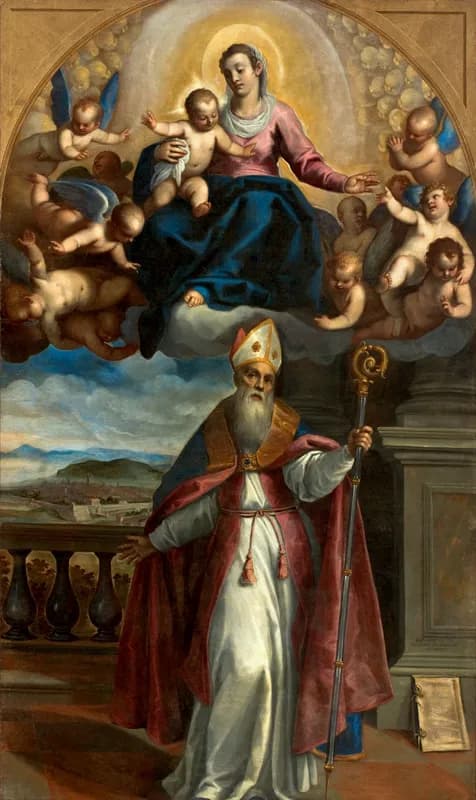
Saint Ubald was bishop of Gubbio, the Umbrian town where he was born, from 1129 until he died on May 16, 1160. 2 Before that he had spent years turning the lax canons of its cathedral into a community that kept silence, fasted, and owned nothing, and he went on living among them as bishop. 24 The town has never let go of him: the 1912 Catholic Encyclopedia reported that every family in Gubbio had at least one member named after him. 1
An orphan among the canons
The year of his birth is not known for certain. The Diocese of Gubbio thinks 1084 or 1085 most likely; the encyclopedia says only "towards the beginning of the twelfth" century. 12 He was the only son of Rovaldo Baldassini, of a family the diocese describes as recently ennobled and perhaps German in origin, and he had an older sister named Sperandia. 2
He lost his father as a small child. 12 The diocese says his mother also died young and that an uncle took him in and set him on the path to the priesthood; Catholic Culture says instead that his mother was an invalid, which is why the uncle raised him. 23 The encyclopedia has him educated by the prior of the cathedral. 1
His first schooling, by the diocese's account, was with the canons of San Secondo, a house he stayed fond of all his life, followed by a short spell of study at Fano. 2 Back in Gubbio he was received among the cathedral canons at San Mariano and did not like what he found. Their way of life was too relaxed, and he returned to San Secondo. 12
In 1104 a new bishop, John of Lodi, a disciple of Saint Peter Damian, sent him back to San Mariano to help reform it by example. The bishop died the following autumn, but the diocese credits that single year with fixing the young man's vocation as a reformer of the clergy. 2
Prior and reformer
He was ordained a priest in 1115, at thirty, and elected prior of the cathedral canons the next year. 2 Now he could act. He went to study a rule already working elsewhere and brought it home. The diocese says it was the rule of Santa Maria in Porto, near Ravenna. 2 The encyclopedia, as printed, sends him to "Vienna," to the canons founded by Blessed Peter de Honestis under statutes approved by Paschal II, and says he stayed three months. 1
The diocese lists what changed. A wall went up around the canons' house. The outer door was shut at night. Silence was kept in church and in the dormitory, and no more than two canons could go out at a time, with the prior's leave. There were many fasts, daily reading of the Bible, and hospitality to the poor. 2
Because the canons were to own nothing, he broke up the estate his father had left him. A small part went to relatives, and the rest to the poor and to the community. 12 At first only three of the canons followed him. The others came round little by little. 2
In 1126 a fire destroyed Gubbio, the canons' house with it, and the community scattered to churches in the countryside. Ubald withdrew into solitude at Fonte Avellana, where the superior, Peter of Rimini, told him his place was in Gubbio. He went back and joined in the rebuilding. 2
The bishop who swore he would not be one
The encyclopedia says several bishoprics were offered to him and he refused them all. 1 The diocese gives one by name. In 1126 Perugia acclaimed him its bishop, and he went to Rome with four of his canons to beg Pope Honorius II to excuse him, which the pope did. 2
Gubbio was another matter. In the encyclopedia's telling, the see fell vacant and the people sent Ubald with some clerics to ask Honorius for a new bishop; the pope consecrated Ubald and sent him home. 1 In the diocese's, the pope chose him in 1129 and would not be moved, though Ubald laid his right hand on an altar and swore he would never accept. His first biographer, Giordano, says he suffered from a sore on that hand for the rest of his life and put it down to the oath. 2 Catholic Culture dates his appointment to 1128. 3
He governed for thirty-one years. He went on living with the canons at San Mariano and kept their poverty: little food, often only hard bread, and thin clothes in winter. 2
Stories from Gubbio
The diocese preserves three stories of him as bishop. In the first, he went to complain to the foreman building the new town wall that a drainage channel was ruining the bishop's vineyard. The man shoved him into a pit of lime. Ubald climbed out and walked home without a word. When the foreman was arrested and facing exile or worse, the bishop claimed the case for his own court, embraced him, and forgave him. 2
In the second, set between 1135 and 1140, two factions came to blows over the election of the town's consuls. The bishop ran to the place and dropped to the ground as though he had been struck. The fighting stopped at once. Everyone rushed to see whether he was alive, and he got up slowly, thanked them for their concern, and told them to forget their grievances. 2
The third is a siege. In 1153 eleven cities and lords, led by Perugia, surrounded Gubbio, which had neither the defenses nor the food to hold out. Ubald called the people to the cathedral and to three days of penance, and promised them victory if they repented. A night sortie then took the besiegers by surprise and scattered them. 2 Catholic Culture adds, without detail, that he lived in the time of Frederick Barbarossa and "was able to defend his city against the anger of the German Emperor." 3
Death and the mountain
His last illness was long and painful; the encyclopedia says two years. 12 At Easter 1160 a delegation led by one of the consuls asked him to say Mass for them once more, and he had himself carried to the cathedral while every bell in the town rang. 2 He asked for the last anointing on Pentecost, May 15, and died the next day. 2 The encyclopedia agrees on the season but prints the year as 1168. 1
The diocese says the crowd around the body was so great that the funeral could not begin for four days. 2 He was buried in the cathedral, and for a year pilgrims kept coming with lighted candles. 12 Pope Celestine III canonized him by a bull of March 5, 1192, at the request of Bishop Bentivoglio. 12
On September 11, 1194, the same bishop moved the body to a small church on Monte Ingino, the hill above the town. 2 A legend the diocese reports as a legend says the saint asked in a dream that his body be put on a cart drawn by untamed bullocks, which climbed the hill and stopped there. 2 The encyclopedia says the body was found "flexible and incorrupt" at the time of his canonization, and that the present church was built in 1508 at the wish of the Duke of Urbino. 1 It has come down into the town only five times since, the diocese says, most recently in 1994. 2
What is Saint Ubald of Gubbio the patron saint of?
Saint Ubald is the patron saint of Gubbio; the encyclopedia calls him so and describes the town's pilgrims visiting "their heavenly protector." 1 He is also invoked against evil spirits. The encyclopedia cites the Office for his feast, in which the faithful are taught to turn to him "contra omnes diabolicas nequitias," against every wickedness of the devil, and Catholic Culture likewise says his aid "is popularly invoked against evil spirits." 13
Saint Ubald of Gubbio's feast day
His feast is May 16, the day the diocese gives for his death. The Roman Martyrology enters him on that date as the bishop who worked to renew the common life of the clergy, and Vatican News and Catholic Culture list him the same day. 2345 The encyclopedia describes the feast at Gubbio as kept "with great solemnity," with religious and civil processions that recall the festivals of medieval Italy. 1
Praying with Saint Ubald of Gubbio
He never went far for long. Apart from some schooling at Fano, a stay to learn a rule, a retreat to Fonte Avellana and his journeys to Rome, the whole life happened inside one small town. 2 The reform he is remembered for was the reform of his own house. 24
It began with three men. The rest, the diocese says, were drawn in little by little by the strict gentleness of their prior. 2
He tried hard to avoid being a bishop, to the point of an oath on an altar, and then served for thirty-one years. 2 The stories Gubbio kept about him are about a man who would rather be knocked into a lime pit than see someone exiled for it. 2
People bring him their fear of evil, as the Office of his feast teaches them to. 13 The record of his own life is plainer: a siege and a street fight, and each time a bishop who walked toward it. 2
Saint Ubald of Gubbio, pray for us.
Sources
- 1.Anthony Allaria, "St. Ubaldus," The Catholic Encyclopedia, vol. 15 (New York: Robert Appleton Company, 1912).
- 2."Sant'Ubaldo," life of the saint in seven parts (in Italian), Diocesi di Gubbio.
- 3."St. Ubaldus," Liturgical Year, May 16, Catholic Culture; life excerpted from Pius Parsch, The Church's Year of Grace.
- 4."Sant'Ubaldo, vescovo," Santo del giorno, 16 maggio (from the Roman Martyrology), Conferenza Episcopale Italiana.
- 5."St. Ubald, Bishop of Gubbio," Saint of the Day, 16 May, Vatican News.
Saints to turn to next
Others in this collection who are turned to for some of the same things.