Saint Leonard of Noblac
Sixth century; died 559 by one account
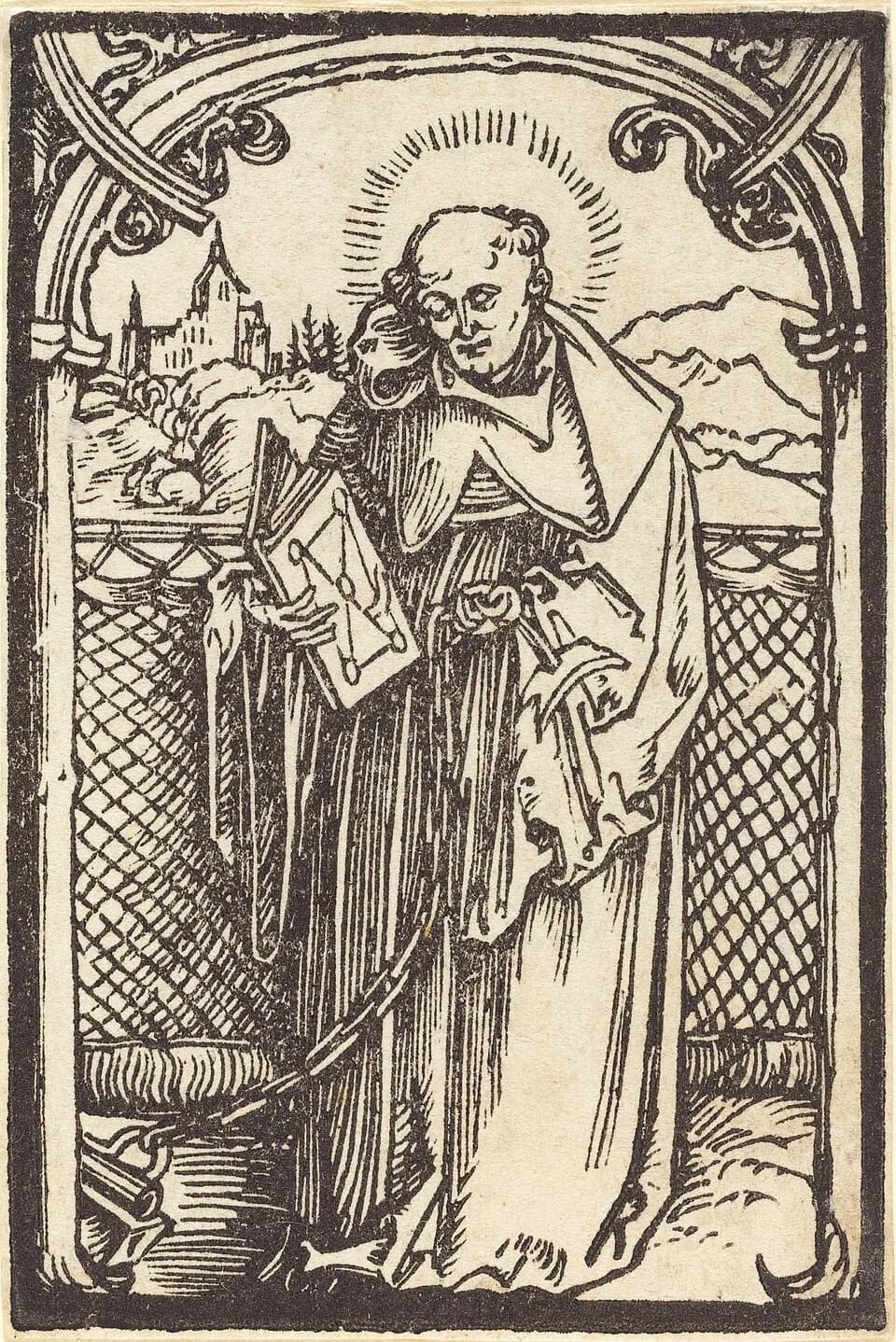
- Patron saint of
- Prisoners and captives, childbirth, and horses, per Catholic Culture 3; invoked for captives, women in confinement, and sick people and beasts, per the Catholic Encyclopedia 1
- Born
- In Limoges at the beginning of the sixth century, per Vatican News; to a noble Frankish family, per the legend 12
- Shown with
- Chains in his hands 1
- Earliest account
- A Life written in the eleventh century, which the Catholic Encyclopedia says "has no historical value whatever" 1
Nothing certain is known about Saint Leonard of Noblac, and his own encyclopedia entry says so in its first sentence: the earliest Life was written in the eleventh century and "has no historical value whatever." 1 Yet from that century on he became one of the most widely invoked saints in Western Europe, the hermit of Limoges whom prisoners called on to break their chains, and whose church filled up with the irons of those who said he had. 134 He is the patron of prisoners and of women in labor, his images show him holding chains, and his feast is November 6. 123
A famous saint with an unknown life
The Catholic Encyclopedia's article on him was written by Albert Poncelet, whose own bibliography points to his work on Leonard in the Acta Sanctorum, and he does not soften anything. 1 "Nothing absolutely certain is known of his history," he begins, and calls what follows "this extraordinary legend." 1 He then makes the contrast that sums up the whole subject: "The veneration of this saint is as widely known as his history is obscure and uncertain." 1
He adds that there is "no trace" of that veneration before the eleventh century, the same century the Life was written. 1 Everything below about Leonard's life, then, is the story medieval Christians told about him. It is reported as that, and where the sources tell it differently, each version is given.
The legend: a godson of Saint Remy at the court of Clovis
In the version the encyclopedia summarizes, Leonard came from a noble Frankish family in the time of King Clovis, and Saint Remy of Reims was his godfather. 1 The Golden Legend, the thirteenth-century collection of saints' lives, says his parents and kinsmen were "chief and highest in the palace of the king of France," and that he was "baptized in the holy font of S. Remigius, archbishop of Rheims." 4 Catholic Culture says he was converted along with the king by Remigius. 3 Vatican News tells it differently again: it has him born in Limoges at the beginning of the sixth century. 2
The detail that made him famous comes next. The encyclopedia says he "secured from the king the release of a great number of prisoners." 1 The Golden Legend puts it more strongly: Leonard "gat so much grace of the king, that all the prisoners that he visited were anon delivered." 4 Vatican News has him working with the Archbishop of Rheims "in order to free captives taken prisoner in wars." 2
Clovis then offered him a bishopric, which he refused. 14 The encyclopedia sends him to a monastery at Micy, near Orléans. 1 Catholic Culture also names Micy and says he was under the direction of Saints Mesmin and Lie. 3 The Golden Legend has him go to Orléans with his brother Lifardus, preach there, and live "a little while in a convent," until Lifardus left to live alone by the Loire and Leonard was "warned by the Holy Ghost to preach in Guienne." 4 The encyclopedia says only that he went to Aquitaine and preached the Gospel there. 1
The queen in the forest and the land at Noblac
He settled as a hermit in a forest near Limoges, where, according to the Golden Legend, the king kept a hunting lodge. 34 On one hunting trip the queen, who was pregnant, went into labor there; it went on so long that she was close to dying, "so that the king and all the meiny wept." 4 Leonard heard the crying as he passed, and the king, learning that he was a disciple of Remigius, asked him to pray. "And anon as he had made his prayer, he gat of God that he required." 4 Catholic Culture says the queen was safely delivered of a son. 3
The king offered gold and silver, and Leonard told him to give it to the poor: "I have no need of such things, it sufficeth me to despise the riches of the world and to serve God in this wood." 4 Offered the whole forest, he asked instead for as much of it "as I may go about with mine ass in a night." 4 The encyclopedia describes the gift more plainly as a domain at Noblac, near Limoges, where he founded a monastery. 1 Catholic Culture puts Noblac about 21 kilometers from Limoges and says a village grew up around the abbey, later named Saint-Léonard de Noblat after him. 3
The Golden Legend gives him two monks for company and says that, because their water was a mile away, he had a dry pit dug and filled it by prayer. 4 It claims he named the place for the gift itself: he "called that place noble, because he had received it of a noble king." 4 Vatican News says the monastery he built "is still a stop on the Cammino of Santiago." 2
Chains at the tomb
The Golden Legend says that anyone in prison who called on him found that "his bonds and fetters were broken," and that the freed prisoners came to Noblac "presenting to him their chains or irons." 4 Some stayed and became monks. 4 After his death, it says, "the fetters and irons hang tofore his tomb." 4 That is the reason the encyclopedia gives for his image: "He is generally represented holding chains in his hands." 1
One of its stories gives the flavor of the rest. The viscount of Limoges had a great chain made and fixed to a trunk in a lightless room of his tower, as a terror to criminals, and one of Leonard's own servants was chained there "without deserving." 4 He prayed, and Leonard appeared to him "in a white vesture" and told him to get up and carry the chain to the church. 4 The man did, and hung it before the tomb. 4
How a hermit of Limoges became a saint of all Europe
Once it began in the eleventh century, the cult spread fast. 1 The encyclopedia lists churches dedicated to him in France and across Western Europe: England, Belgium, Spain, Italy, Switzerland, Germany ("more particularly in Bavaria"), Bohemia and Poland. 1 Pilgrims, "among them kings, princes, and high dignitaries of the Church," came to Noblac, and at the end of the eleventh century "his name had already become renowned among the Crusaders captured by the Mussulmans." 1
Catholic Culture's page connects that to a particular prisoner: Bohemond of Antioch, a leader of the First Crusade, who was released from captivity in 1103, visited Noblac and left an offering in thanks, and whose example brought gifts that paid for the Romanesque church and its bell tower. 3 The same page says Noblac became a stage on the pilgrimage road to Santiago de Compostela, and counts 177 churches dedicated to him in England alone. 3
The encyclopedia records that in one small Bavarian town, Inchenhofen, about 4,000 "favours granted through his intercession" were written down between the fourteenth and eighteenth centuries. 1 Bavaria still keeps the day: Catholic Culture notes that on November 6 he is honored with a festival at Bad Tölz. 3
Not the only Leonard
The Golden Legend itself warns that there was "another Leonard, which was of the same profession and of one virtue, of whom the body resteth at Corbigny," and tells his story separately, with its own date of around 570. 4 Leonard of Noblac is also sometimes called Leonard of Limoges or of Limousin; the encyclopedia files him under the second name. 13
What is Saint Leonard of Noblac the patron saint of?
Above all, prisoners. Catholic Culture says he became their patron because he secured the release of prisoners, and lists him as patron of prisoners, prisoners of war and captives. 3 The encyclopedia says the miracles credited to him were the delivery "of captives, women in confinement, those possessed of an evil spirit, people and beasts afflicted with diseases." 1
Catholic Culture says his intercession was credited with miracles "for the release of prisoners, women in labour and the diseases of cattle," and its patronage list includes childbirth and horses. 3 That list goes on to a long run of trades, among them blacksmiths, coopers, locksmiths and miners. 3 This page records the patronages the sources agree on: prisoners, women in labor, and animals, particularly horses and cattle. 13
Saint Leonard of Noblac's feast day
Praying with Saint Leonard
Very little of what is told about Leonard can be checked, and the scholar who knew his records best said so without hedging. 1 What can be checked is what people did with his name. For seven centuries and more, prisoners, captured crusaders, pilgrims and women in a dangerous labor called on him, and some of them walked to Noblac afterward carrying the irons they had worn. 134
In the legend, the request he made of the king was for prisoners, and the offer he refused was gold and a bishop's chair. 14 When he did accept land, he asked for only as much as he could go around with his donkey in a night. 4 Whatever the facts were, that is the life the people who prayed to him believed in: a man with a place at court who spent his credit there on people in cells.
The legend puts him near a woman in labor who might have died, alongside a king who could do nothing for her but weep. 4 It keeps him with the people whose lives were out of their own hands: in chains, in childbirth, or standing over a sick animal. 13
His image is a monk holding chains. 1 The Golden Legend describes his church hung with "the great multitude of irons of diverse manners," left by people who believed he had freed them. 4 Poncelet, who would not vouch for a word of the Life, still recorded the four thousand favors written down in a single Bavarian town. 1
Saint Leonard of Noblac, pray for us.
Sources
- 1.Albert Poncelet, "St. Leonard of Limousin," The Catholic Encyclopedia, Vol. 9 (New York: Robert Appleton Company, 1910).
- 2."St. Leonard, Hermit," Saint of the Day, November 6, Vatican News.
- 3."St. Leonard of Limoges," Liturgical Year calendar, November 6, Catholic Culture (Trinity Communications), with an entry excerpted from thisismiddleton.co.uk.
- 4.Jacobus de Voragine, "The Life of S. Leonard," The Golden Legend, translated by William Caxton, edited by F. S. Ellis, Vol. 6 (London: Temple Classics, 1900), Internet Medieval Sourcebook, Fordham University.
Saints to turn to next
Others in this collection who are turned to for some of the same things.
- Saint Anthony the Abbotc. 251 - c. 356PrayerPoverty and simplicityProtection
- Saint Gilesc. 650 - early 8th centuryPoverty and simplicityProtectionPrayer
- Saint Francis of Assisic. 1181 - October 3, 1226Poverty and simplicityPrayer
- Saint Rochc. 1295 - 1327 by tradition; 1340s - c. 1376-1379 by recent researchProtectionPoverty and simplicity