Saint Felix IV
Died 530
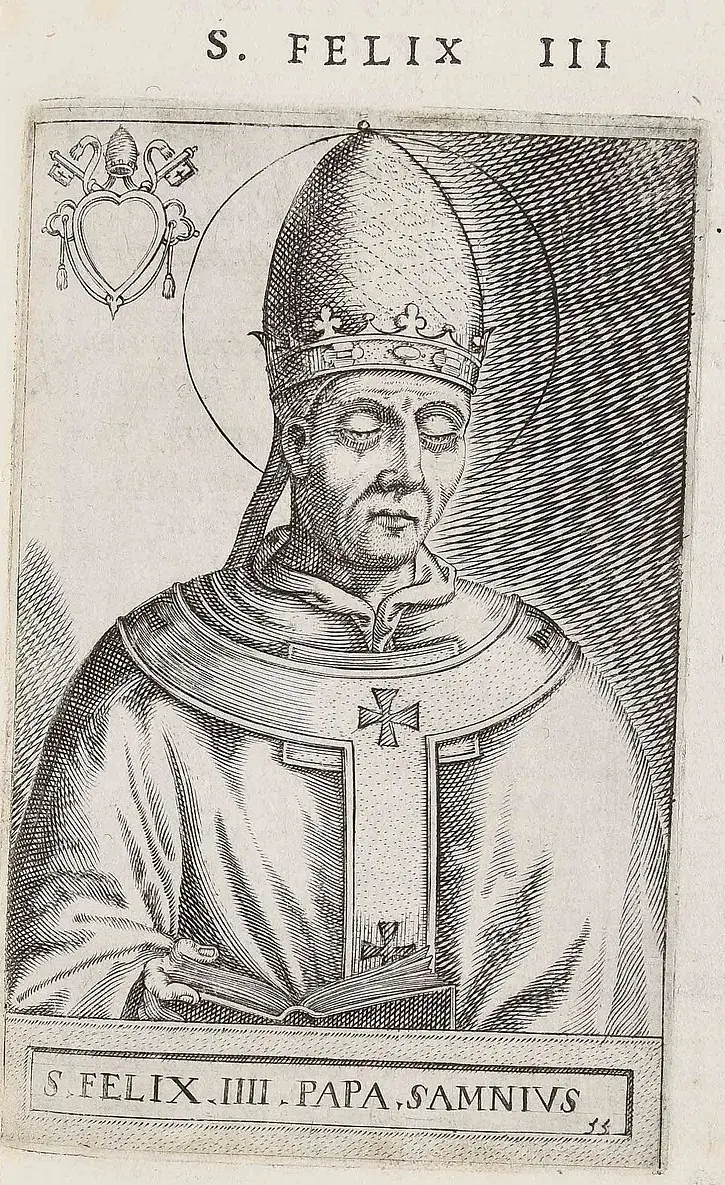
Saint Felix IV was pope from 526 to 530, chosen at the wish of Theodoric, the Arian king of Italy, after Pope John I had died in the king's prison at Ravenna. 13 He turned two ancient buildings in the Roman Forum into the church of Saints Cosmas and Damian, whose apse mosaic survives, and sent to Gaul the propositions on grace that became the canons of the Second Council of Orange in 529. 17 Some sources number him Felix III, a difference that goes back to an antipope. 2 His feast is October 12. 4
Felix III or Felix IV?
The Catholic Encyclopedia, the Liber Pontificalis in Loomis's translation, the Holy See and the current Roman Martyrology all call him Felix IV. 1364 The Norwegian bishops' saints database (katolsk.no) files him as "Felix III (IV)"; other writers have "Felix IV (III)" and "Felix III (or IV)." 2710
The extra number belongs to a man who was never a lawful pope. In 355, when the emperor Constantius exiled Pope Liberius, the Roman archdeacon Felix let Arian bishops consecrate him in Liberius's place, and was driven out when Liberius returned. 9 Later legend confused him with a Roman martyr of the same name and made him a saint. 9 Because this antipope was afterward counted among the lawful popes, katolsk.no explains, the pope of 526 was called Felix IV instead of III for centuries. 2 The Holy See's list still runs from Felix III, pope from 483 to 492, straight to Felix IV. 6 The 1580 engraving on this page has it both ways: it is headed "S. Felix III" above a caption that reads "S. Felix IIII."
A Samnite chosen by a Gothic king
Felix was a Samnite, the son of Castorius. 13 katolsk.no says he was a Roman deacon in 519 and went with the legation to Constantinople that restored the unity of the Church; by the time of his election the encyclopedia calls him a cardinal-priest. 21
Pope John I died in prison at Ravenna on May 18, 526, a victim, in J.P. Kirsch's words in the encyclopedia, "of the angry suspicions of Theodoric, the Arian king of the Goths." 1 Rome then went without a bishop for fifty-eight days. 3 katolsk.no describes a deadlock between a party friendly to the Goths and one looking to Byzantium, which included most of the senate, until Theodoric stepped in, wanting a pope the Goths could trust. 2 Kirsch puts it that "the clergy and laity yielded to the wish of the Gothic king and chose Felix pope." 1 He was consecrated on July 12, 526. 13
Theodoric died seven weeks later, on August 30. 13 A letter in the name of his grandson and heir, the boy-king Athalaric, preserved by the royal minister Cassiodorus, thanks the senate for obeying the late king, who, "although it had reference to a form of faith alien from his own," had chosen "such a Pontiff as could rightfully be displeasing to none." 10 To the losing side it adds: "There is no disgrace in being conquered when the King's power has helped the winning side." 10 Hodgkin takes it as evidence of a contested election referred to the king. 10
Favor at court
Kirsch says Felix used the favor he enjoyed at court "to further the interests of the Roman Church." 1 With Athalaric still a minor, the government passed to his mother Amalasuntha, Theodoric's daughter, whom Kirsch calls "favorably disposed towards the Catholics." 1
The Roman clergy complained that the civil power was usurping their privileges; a royal officer had even taken one of their deacons into custody. 110 The reply, drafted by Cassiodorus, ruled that a lawsuit against a member of the Roman clergy must go first to the pope, and that anyone who went straight to the secular courts would forfeit ten pounds of gold, to be given by the pope to the poor. 110 Kirsch says the edict covered civil and criminal charges alike; Hodgkin reads it as civil only. 110
katolsk.no notes that Felix ordained an unusually large number of priests, fifty-five, and takes it as a deliberate effort to fill the Roman clergy with men who shared his views. 2 Early in his pontificate, it adds, he wrote to Bishop Caesarius of Arles approving a period of testing for laymen before ordination, and deploring ordained men who went back to secular life. 2
Saints Cosmas and Damian in the Forum
Amalasuntha gave the pope two ancient buildings in the Roman Forum: the Temple of Romulus, built in memory of the son of the emperor Maxentius, and the hall beside it, which the encyclopedia calls the Roman land registry office. 1 Loomis describes the hall as a pagan building dedicated by Vespasian and used as a storehouse for census returns and survey records, with the marble plan of Rome fixed to its eastern wall. 3 Felix made the two into the church of Saints Cosmas and Damian, which still stands. 12
He added an apse at the eastern end and covered it with a mosaic, which Loomis describes as Christ among the clouds attended by saints and apostles, with dedicatory verses "which may be still read beneath it." 3 The encyclopedia's article on the two physician martyrs calls the mosaics "still among the most valuable art remains of the city." 8 On one figure the sources part company. katolsk.no says the mosaic includes a picture of Felix himself, the oldest surviving portrait of a pope; Kirsch says the figure of the pope there is "a later restoration." 21
The Liber Pontificalis also credits Felix with rebuilding the basilica of the martyr Saturninus on the Via Salaria after a fire, and Loomis notes that Pope Symmachus had already built an oratory to Cosmas and Damian. 3
Grace and free will
The other work he is remembered for was done by letter. In southern Gaul the teaching on grace and free will later called Semipelagianism, which katolsk.no traces to John Cassian and Faustus of Riez, still had a following. 27 When Bishop Caesarius of Arles met opposition to his Augustinian view at a synod in Valence in 528, he turned to the pope. 27
Early in 529 Felix sent him a set of "Capitula," propositions taken, Nicholas Weber writes in the encyclopedia, "almost in their entirety from the works of St. Augustine" and from the Sentences of Prosper of Aquitaine. 72 They became the basis of the twenty-five canons issued by the Second Council of Orange, which met under Caesarius on July 3, 529, with fourteen bishops present. 71 Felix also approved, Kirsch says, Caesarius's own treatise against Faustus on grace and free will. 1
He did not see the end of it. His successor, Boniface II, confirmed the council's acts on January 25, 531, and Weber notes that the Council of Trent drew freely on its canons when it condemned Luther. 72
A successor named from the sickbed
In 530 Felix fell seriously ill. 12 Rome was split between those who looked to Byzantium and those who supported Gothic rule, and Kirsch says he "wished to ensure the peace of the Roman Church by naming his successor." 1 He handed his pallium to his archdeacon, Boniface, on condition, katolsk.no says, that it come back to him if he recovered; he made it known publicly that he had chosen Boniface to follow him, and that he had informed the court at Ravenna. 12
Loomis summarizes the mandate itself, found in the chapter library at Novara: Felix told the clergy, senate and people of Rome that he had chosen Boniface, and bade them accept him on pain of suspension from communion. 3 Loomis thinks Felix, himself Theodoric's appointee, wanted a successor who would go on favoring the Goths. 3 The senate replied by forbidding the clergy to plan a pope's succession in his lifetime; katolsk.no calls Felix's step wholly unconstitutional. 32
It did not work. Kirsch says only that his wishes were disregarded. 1 The Liber Pontificalis tells what followed: Boniface was ordained by one faction and the deacon Dioscorus by the other, the same Dioscorus who had argued Rome's case in Constantinople in 519, and there was strife among the clergy and in the senate for twenty-eight days, until Dioscorus died. 3 Loomis concludes that the great majority of the clergy had been for Dioscorus. 3
His death and burial
When he died is uncertain, and the sources give several answers. The Liber Pontificalis says he died on October 12 and was buried in Saint Peter's on October 15. 3 Loomis points out that Boniface II was ordained on September 22, 530, so Felix must have died that month, probably on the 21st, and the October date may be a copyist's slip. 3 katolsk.no gives September 22, with a question mark, and burial at Saint Peter's on October 12. 2 Kirsch says only "probably towards the end of September, 530," and the Holy See's list gives September 20 or 22. 16
His epitaph, which Loomis translates from Duchesne's edition, ends: "For his humble piety he was preferred to many of the proud / And by singleness of heart he won a lofty place; / He was bountiful to the poor, he comforted the wretched, / He increased the wealth of the apostolic see." 3 katolsk.no reads that last line as one more sign of the royal favor he enjoyed. 2
What is Saint Felix IV the patron saint of?
Saint Felix IV's feast day
Saint Felix IV's feast day is October 12. 4 The current Roman Martyrology, as the Italian bishops print it, commemorates him at Rome on that day as the pope who turned two temples of the Roman Forum into a church in honor of Saints Cosmas and Damian and worked hard for the right faith. 4 October 12 is also the date the Liber Pontificalis gives for his death. 3
Older calendars kept him on January 30. Kirsch gives that date, and the 1897 English Martyrology entered on it "St. Felix, pope, who labored much for the Catholic faith," much the same words the current Martyrology still uses of him. 154 katolsk.no gives his memorial as September 22, formerly January 30. 2 This page follows the current Martyrology.
Praying with Saint Felix IV
Felix owed his office to a king of another faith who had just let his predecessor die in prison. 12 The sources do not hide it, and the king's grandson put it in writing for the senate: they had been outvoted by royal power, and there was no disgrace in that. 10 Out of that beginning came a church that has stood in the Forum for nearly fifteen centuries. 13
His part in the argument over grace was to gather what Augustine and Prosper had already written and send it to the bishop who needed it. 7 He died before the council that used it was confirmed. 72
His last act is the one historians argue over. Afraid of what a divided election would do to Rome, he named his own successor from his sickbed and handed over his pallium, and the senate and most of the clergy refused to accept it. 123 The epitaph over his grave remembered other things: humility, a single heart, gifts to the poor and comfort for the wretched. 3
Saint Felix IV, pray for us.
Sources
- 1.Johann Peter Kirsch, "Pope St. Felix IV," The Catholic Encyclopedia, vol. 6 (New York: Robert Appleton Company, 1909).
- 2."Den hellige pave Felix III (IV)," Den katolske kirke, the saints database of the Catholic Church in Norway, katolsk.no (in Norwegian).
- 3.The Book of the Popes (Liber Pontificalis), vol. 1, "LVI. Felix IV (526-530)" and "LVII. Boniface II (530-532)," translated with notes by Louise Ropes Loomis (New York: Columbia University Press, 1916), Internet Archive.
- 4.Roman Martyrology, entry for October 12, "San Felice IV, papa," Santo del giorno, Conferenza Episcopale Italiana (in Italian).
- 5.The Roman Martyrology, January 30 (Baltimore: John Murphy Company, 1897), Internet Archive.
- 6."Los Sumos Pontífices," list of the popes with dates of pontificate and place of origin, The Holy See (in Spanish).
- 7.Nicholas Weber, "Councils of Orange," The Catholic Encyclopedia, vol. 11 (New York: Robert Appleton Company, 1911).
- 8.Gabriel Meier, "Sts. Cosmas and Damian," The Catholic Encyclopedia, vol. 4 (New York: Robert Appleton Company, 1908).
- 9.Johann Peter Kirsch, "Felix II," The Catholic Encyclopedia, vol. 6 (New York: Robert Appleton Company, 1909).
- 10.Cassiodorus, Variae, book VIII, letters 15 and 24, in The Letters of Cassiodorus, translated by Thomas Hodgkin (London: Henry Frowde, 1886), via Project Gutenberg.
Saints to turn to next
Others in this collection who are turned to for some of the same things.
- Saint AgathoDied January 10, 681DiscernmentStudy and teaching
- Saint Angela MericiMarch 21, 1474 - January 27, 1540Study and teachingDiscernment
- Saint Augustine of HippoNovember 13, 354 - August 28, 430Study and teachingDiscernment
- Saint Bonaventure1217 or 1221 - July 15, 1274Study and teachingDiscernment