Saints Faustinus and Jovita
d. c. 118-121
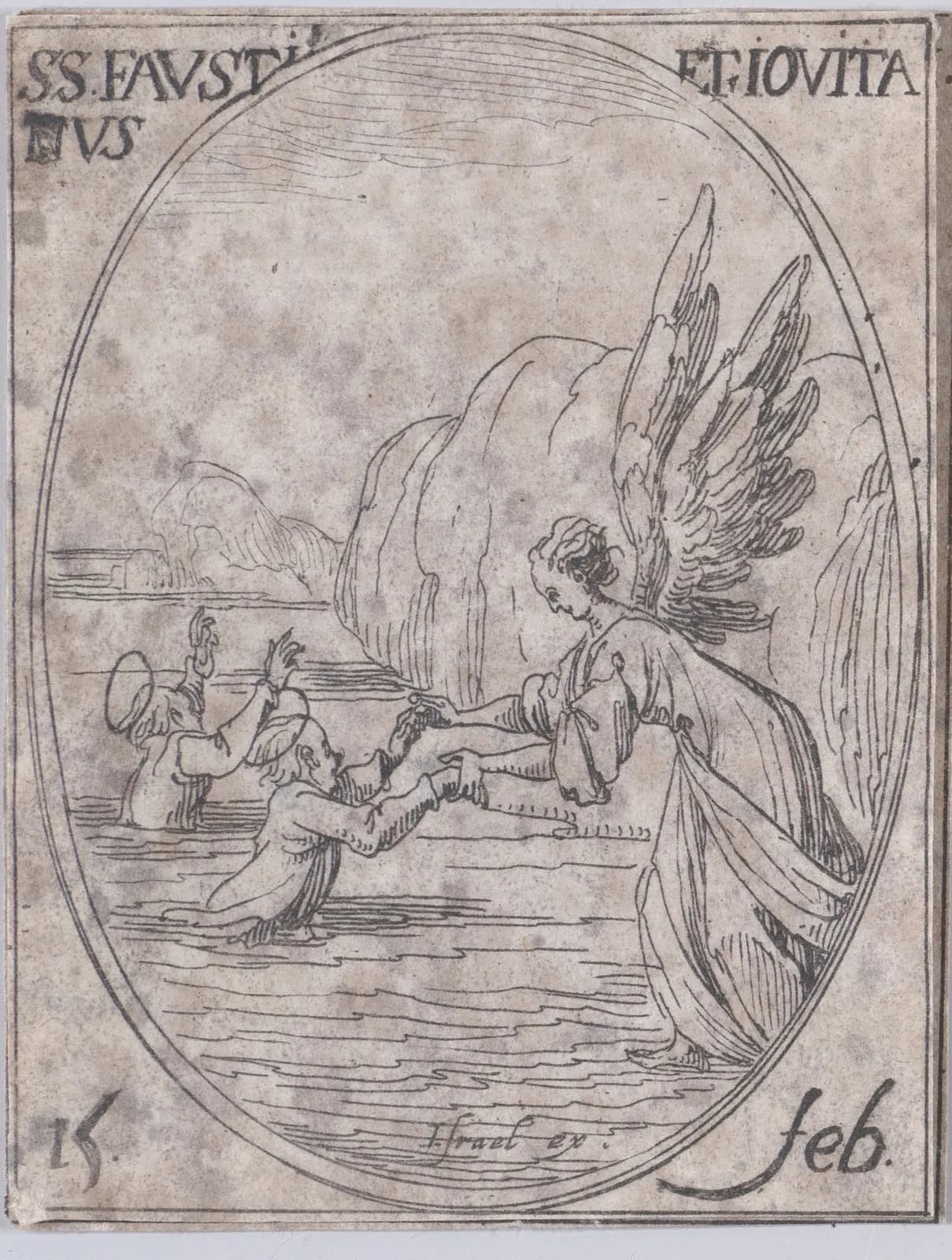
- Died
- Beheaded at Brescia under Hadrian: in 120, say the Bollandists; as early as 118, says Paul Allard 12
- Historical record
- Their existence and martyrdom are well attested; their Acts are chiefly legendary 12
- Relics
- Brescia, with Rome, Bologna and Verona 1
Saints Faustinus and Jovita are martyrs of Brescia, in northern Italy, beheaded there in the reign of the emperor Hadrian, and they have been the city's chief patrons from time immemorial. 14 The 1909 Catholic Encyclopedia says that nearly everything told of them has been questioned except their existence and their martyrdom, which the early martyrologies and the devotion of their city put beyond doubt. 1 Their story as it is usually told comes from a legend, and the page says where it does. 12
What is known
Umberto Benigni, writing on Brescia in the 1907 Catholic Encyclopedia, says that the Faith probably reached the city from Milan, and that "during the reign of Hadrian, Brescia was the scene of the martyrdom of Sts. Faustinus and Jovita." 4 J. F. X. Murphy, in his 1909 article on the two, calls them "members of a noble family of Brescia," the elder, Faustinus, a priest and the younger, Jovita, a deacon. 1
He is plain about the rest. "The many 'Acts' of these saints are chiefly of a legendary character," he writes, and the Jesuit scholar Fedele Savio "calls in question nearly every fact related of them except their existence and martyrdom." 1 Those two facts, Murphy says, are "too well attested by their inclusion in so many of the early martyrologies and their extraordinary cult in their native city, of which from time immemorial they have been the chief patrons." 1
The year is uncertain. Murphy reports that the Bollandists date their death to 120 and that the historian Paul Allard places it as early as 118. 1 katolsk.no, the saints database of the Catholic Diocese of Oslo, gives the same two dates and heads its entry with about 121. 2 It adds that their Passio was written in the ninth century, and that their many supposed Acts are mainly legendary even though the oldest go back that far. 2
The legend
The legend, as katolsk.no retells it, makes them brothers and knights of the city's nobility, converted by Bishop Apollonius, who ordained Faustinus a priest and Jovita a deacon. 2 While the bishop stayed in hiding during the persecution, they preached openly, and the pagan nobles of Brescia turned against them. 2 The governor, Italicus, waited for the new emperor Hadrian to pass through, denounced the brothers to him, and had them arrested and threatened with death unless they sacrificed. 2
Brought before Hadrian at Brescia and ordered to worship the sun god, they refused and damaged his statue. 2 In the legend they are thrown to the beasts in the arena, and the animals lie down at their feet. 2 Many in the crowd are converted, among them Afra, the governor's wife, and a man named Calocerus. 2 The brothers are tortured and sent to Milan, to Rome and to Naples; set adrift at sea in a small boat, they are brought to land by an angel. 2 At last the emperor sends them back to Brescia, where they are beheaded on a February 15 outside the Porta Matolfa and buried in the nearby cemetery of San Latino. 2
katolsk.no is careful to add that beyond their martyrdom at Brescia under Hadrian, and their open confession of the faith, nothing else can be said of them with certainty. 2 Murphy's own summary follows the outline of the legend, with the brothers arraigned before Hadrian, tortured at Brescia, Rome and Naples, and beheaded at Brescia, before he reports how little of it Savio would allow. 1
Brothers, or a brother and a sister
Even Jovita is uncertain. 2 The ninth-century Passio calls the two brothers, but katolsk.no notes that the martyrology of Usuard treats Jovita as a virgin, and that because Jovita is also a woman's name, the pair are sometimes called Faustinus and Jovinus to avoid the confusion. 2 It reports that many scholars identify them with Faustinian and Juventia, martyrs in Britain, who were kept on February 16 in the old Roman Martyrology. 2
When the Roman calendar was revised in 1969, their feast was removed from the universal calendar and left to local calendars. 2 katolsk.no quotes the official commentary on that revision as saying that their Acts are entirely invented, and that they make Jovita a deacon although she was a woman. 2 It adds that the saints are not to be confused with the figures of the invented Acts, and so they remain in the current Roman Martyrology on February 15. 23
The cult at Brescia
Whatever the legend, the devotion is old. 12 katolsk.no says that Pope Gregory the Great, about the year 600, mentioned a church in Brescia dedicated to the two martyrs, probably San Faustino ad Sanguinem, built over an early Christian cemetery and now called Sant'Angela Merici. 2 In its crypt, reached by a narrow stair, two old frescoes show Faustinus and Jovita, and tradition holds that they died there. 2
In the ninth century Bishop Ramperto revived the cult. 24 Benigni says he brought Benedictines to Brescia, who built a church to which they moved the relics of the two martyrs. 4 katolsk.no dates Ramperto's episcopate from 815 to 842, says he endowed a monastery beside the church in 841, and in 843 placed the relics in a marble sarcophagus with a lead tablet recording the original inscription. 2 The rebuilt church, it says, was consecrated in 1142, the relics were laid on its high altar in 1223, and on December 11, 1455, the sarcophagus was found behind the altar of the crypt and solemnly opened, with Ramperto's inscription still inside. 2
Murphy says that Rome, Bologna and Verona share their relics with Brescia. 1 katolsk.no adds that their cult was neglected for a time in the ninth century and then flourished again, and that even when the monastery was badly governed in the fourteenth and fifteenth centuries, the people's loyalty to the patron saints kept them attached to it. 2
What are Saints Faustinus and Jovita the patron saints of?
Faustinus and Jovita are the patron saints of Brescia, which Murphy says they have been "from time immemorial." 1 katolsk.no says they were named patrons of the city in 1438 and are also patrons of the diocese, and of a long list of towns in the provinces of Brescia, Bergamo, Cremona, Belluno and Parma, among them Sorbolo, where tradition says they stopped on their last journey back to Brescia. 2
Saints Faustinus and Jovita's feast day
The feast of Saints Faustinus and Jovita is February 15, by tradition the day of their death. 12 The current Roman Martyrology enters them on that day at Brescia, as martyrs who, after many struggles for the faith of Christ, received the victorious crown of martyrdom. 3 katolsk.no gives the Latin of the 2004 edition: "Bríxiæ in Venétia. sanctórum Faustíni et Iovítæ, mártyrum, qui, post multa certámina ob Christi fidem suscépta, victrícem martýrii corónam accepérunt." 2
katolsk.no adds that the Martyrology of Jerome kept them on February 16, the day usually given to Bishop Faustinus of Brescia, and that since 1969 their feast belongs to local calendars rather than the universal one. 2
Praying with Saints Faustinus and Jovita
Very little is known about Faustinus and Jovita, and the Church has said so. 12 The encyclopedia and the 1969 reform agree that the stories told of them are legend. 12 What remains is that two Christians of Brescia died for their faith in the second century, and that their city never forgot them. 12
The tradition, before the marvels begin, keeps one plain detail: when their bishop was in hiding, they preached in the open. 2 Murphy gives the same reason for their arrest, "their fearless preaching of the Gospel." 1
Their names come down through the martyrologies and through the people of Brescia, who built churches in their honor and kept their relics. 12 It is the devotion of an ordinary local church, and the reason their martyrdom is not in doubt. 1
Saints Faustinus and Jovita, pray for us.
Sources
- 1.John F. X. Murphy, "Sts. Faustinus and Jovita," The Catholic Encyclopedia, Vol. 6 (New York: Robert Appleton Company, 1909).
- 2."De hellige Faustinus og Jovita av Brescia (d. ~121)," Den katolske kirke (katolsk.no), Catholic Diocese of Oslo (in Norwegian).
- 3.Roman Martyrology, entry for February 15, "Santi Faustino e Giovíta, martiri," as printed in "Santo del giorno," Conferenza Episcopale Italiana (in Italian).
- 4.Umberto Benigni, "Brescia," The Catholic Encyclopedia, Vol. 2 (New York: Robert Appleton Company, 1907).
Saints to turn to next
Others in this collection who are turned to for some of the same things.