Saint Fara of Faremoutiers
Died c. 655 or 657
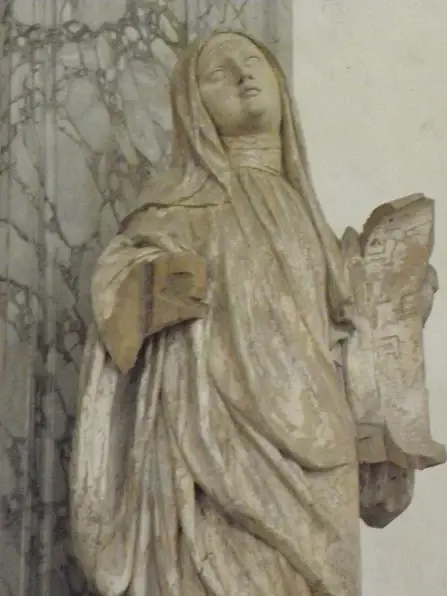
- Family
- Daughter of Agneric, an officer of King Theodebert II; sister of Saint Faro, bishop of Meaux, and Saint Cagnoald 12
- Took the veil
- In 614, from Gondoald, bishop of Meaux 1
- Abbess of
- Brie, later Faremoutiers, near Meaux: founded soon after 614 (Butler) or about 625 (Nominis) 123
- Rule
- The rule of Saint Columban 1
Saint Fara, or Burgundofara, was the daughter of a Frankish nobleman near Meaux who was blessed as a child by Saint Columban, refused the marriage her father arranged, and became abbess of the double monastery at Brie, later called Faremoutiers after her. 12 She governed it under Columban's severe rule for about forty years, and Bede records that English kings sent their daughters to her. 23 Her feast is December 7. 4
A household Columban blessed
Her father Agneric was one of the chief officers at the court of Theodebert II, king of Austrasia, Alban Butler writes, and he and his wife Leodegonda had four children: Cagnoald, who became a monk under Columban at Luxeuil; Faro, later bishop of Meaux; Fara; and Agnetrudis. 1 In old writings, he notes, Faro is called Burgondofaro and Fara Burgondofara, names he takes to mean that they were of Burgundian descent, as Nominis, the French bishops' saints site, also says of her. 12
In 610, Butler continues, Columban was driven out of Luxeuil and on his way into exile stayed at Agneric's house two leagues from Meaux. 1 He blessed the whole family and consecrated Fara to God "in a particular manner." 1 How old she was is not agreed: Jonas of Bobbio, who wrote her life, says she was an infant; Butler reports that one later historian made her fifteen and another ten. 1
"Do you think I am afraid of death?"
When she was of age her father proposed an honorable marriage. 1 Fara did everything she could to prevent it and fell into a long illness that put her life in danger. 1 Then Eustace, Columban's successor at Luxeuil, stopped at the house on his way to the court of King Clotaire II. 1 Fara told him she wished to give herself to God. 1 According to Butler, he told her father that the illness had come because he opposed her, prayed prostrate on the ground, made the sign of the cross on her eyes, and she recovered. 1
As soon as Eustace had gone, Agneric pressed her again to marry the young nobleman he had promised her to. 1 Fara fled to the church. Told that she would be killed if she did not obey, she answered: "Do you think I am afraid of death? To lose my life for the sake of virtue, and fidelity to the promise I have made to God, would be a great happiness." 1
Eustace came back and reconciled father and daughter, and Gondoald, bishop of Meaux, gave her the veil in 614. 1 Nominis tells it in brief: her father long opposed her, until Gondoald and Eustace persuaded him to let her choose her own vocation. 2
The abbey at Brie
Agneric then gave her land and put up a building, and the monastery was founded, Butler says, a year or two after she took the veil. 1 The diocese of Meaux, quoted by Nominis, dates the foundation to about 625, on the hill of Eboriacum some two leagues from Coulommiers. 2 Nominis adds that she withdrew first to Champeaux and then to the new house; Butler, who had read her will, says it names her lands at Champeaux and that it "seems a mistake" to think she founded a monastery there. 12
It was a double monastery, Butler explains. Eustace sent Cagnoald and the monk Walbert from Luxeuil to help, and Jonas himself lived there for a time and saw what he described. 1 Fara was made abbess very young and set up the rule of Columban "in its greatest severity." 1 Wine was forbidden, and milk at least in Lent and Advent, and three times a day the nuns examined their consciences and opened them to their superior. 1
Bede, the English historian, knew the place as Brie, "built by a most noble abbess, called Fara." 3 Because there were then few monasteries in England, he says, many English went to the monasteries of the Franks, "and they also sent their daughters there to be instructed, and delivered to their heavenly bridegroom, especially in the monasteries of Brie, of Chelles, and Andelys." 3 Two of them, Sethrid and Ethelburga, step-daughter and daughter of King Anna of the East Angles, "though strangers, were for their virtue made abbesses of the monastery of Brie." 3 Butler names Sethrid as Fara's successor. 1
Her brother, and her enemies
Her younger brother Faro, on a visit, was so moved by what she said to him that he gave up his offices at court, persuaded the young woman he was to marry to become a nun, and took the tonsure. 1 He became bishop of Meaux in 626 and, Butler says, supported her through what came after. 1
Some of it came from inside the movement. A monk named Agrestes set out to "correct" Columban's rule and for a time drew in Romaric and Amatus of Remiremont; Fara, Butler writes, "was upon her guard, and constantly opposed all attempts to undermine the severity of the holy rule which she had professed." 1 And Ega, mayor of the palace under Clovis II, persecuted her until his death in 641; Butler says she bore it with patience. 1
Death and relics
After a long and painful illness she died on April 3, about the year 655, according to Butler. 1 The French text of the Roman Martyrology printed by Nominis puts her death in 657, after forty years at the head of the monastery that came to bear her name. 2 By her will she left part of her estates to her brothers and sisters and the main part to the monastery. 1 Her relics were enshrined in 695. 1
Butler records one later cure at length. Charlotte le Biet, a nun of Faremoutiers who had gone completely blind, touched one of Fara's bones to her eyes when the relics were brought out in the early 1620s and recovered her sight; the bishop of Meaux examined the physicians and witnesses and gave a judicial sentence on it in December 1622. 1
What is Saint Fara the patron saint of?
Saint Fara's feast day
Saint Fara's feast day is December 7. The current Roman Martyrology, as the Italian bishops publish it, remembers her that day at Faremoutiers, near Meaux, as the abbess who after governing her monastery for many years joined the company of virgins who follow the Lamb. 4 The 1897 English edition of the Martyrology has the same day, "In the diocese of Meaux, of St. Fara, virgin," and Butler and Nominis keep it too. 125 It is not the day she died: Butler gives that as April 3. 1
Praying with Saint Fara
Fara's vocation was not an easy fit with her family. The house Columban blessed was the same house in which she was told she would be killed if she would not marry, and her refusal was not a small thing. 1 It took a bishop and an abbot to bring him round. 12
Her answer in the church is the line people remember, but most of her life was spent keeping a hard rule for forty years, and keeping it when respected men wanted it softened. 12
And the house she kept became a place where strangers from across the sea were made abbesses. 3 Her brother changed his life after a single conversation with her. 1
Saint Fara of Faremoutiers, pray for us.
Sources
- 1.Alban Butler, "St. Fara, V. Abbess," The Lives of the Fathers, Martyrs, and Other Principal Saints, Vol. XII, December 7 (Derby: Richardson and Son, 1842), via the Internet Archive.
- 2."Sainte Fare," Nominis, Conference des eveques de France (in French).
- 3.Bede, The Ecclesiastical History of the English Nation, Book III, chapter 8, in the English translation on the Internet Medieval Sourcebook, Fordham University.
- 4.Roman Martyrology, entry for December 7, "Santa Fara, badessa," Santo del giorno, Conferenza Episcopale Italiana (in Italian).
- 5.The Roman Martyrology, December 7 (Baltimore: John Murphy & Co., 1897), Internet Archive.
Saints to turn to next
Others in this collection who are turned to for some of the same things.