Saint Ezekiel
Sixth century BC
- Name
- "Strong is God," or "whom God makes strong" 1
Saint Ezekiel was a priest of Jerusalem carried off to Babylon, and the first prophet called to prophesy outside the Holy Land. 12 Among the exiles by the river Chobar he saw the glory of God, was made a watchman over the house of Israel, foretold the destruction of Jerusalem, and, once it had fallen, kept his people's hope alive with the vision of dry bones rising to new life. 3513 The Roman Martyrology remembers him on July 23. 13
A priest among the captives
His name means "strong is God," or "whom God makes strong." 1 Scripture calls him "Ezechiel the priest the son of Buzi," and Joseph Schets, writing in the Catholic Encyclopedia in 1909, places him among the priests deported from Jerusalem with King Jehoiachin, the Joachim or Joachin of the older Bibles. 13 Schets dates that deportation to 598 BC; the New American Bible and Vatican News put it in 597. 1215
The exiles settled at Tell-Abib, near the river Chobar in Babylonia, and Schets thinks Ezekiel spent the rest of his life there. 1
The vision by the river Chobar
The book opens with a date: "in the thirtieth year, in the fourth month, on the fifth day of the month," which was "the fifth year of the captivity of king Joachin." 3 Schets says that according to some the thirtieth year is that of the prophet's own life, and Challoner's note gives the other reading too, a count from the covenant made under King Josiah. 13
Then: "the heavens were opened, and I saw the visions of God." 3 Out of a whirlwind and a great cloud came four living creatures, each with the face of a man, a lion, an ox and an eagle, and beside them wheels "as it were a wheel in the midst of a wheel," full of eyes. 3 Above them, on the likeness of a throne of sapphire, sat "a likeness as of the appearance of a man." 3 Ezekiel fell on his face. 4
The chapter was hard going even in antiquity. Challoner's note records, on the authority of Saint Jerome, that the ancient Hebrews let no one read it before the age of thirty. 3
Eat this book
The voice that spoke to him called him "son of man," the name God uses for him throughout, and sent him "to a rebellious people." 4 He was not promised success, only that whether they listened or not, "they shall know that there hath been a prophet in the midst of them." 4 A hand held out a scroll written on both sides with "lamentations, and canticles, and woe," and he was told to eat it. 45 "And I did eat it: and it was sweet as honey in my mouth." 5
God promised to make his forehead "like an adamant and like flint," harder than the foreheads of the people. 5 He went to the exiles "in bitterness" and sat among them for seven days, mourning. 5 At the end of the seven days came his charge: "Son of man, I have made thee a watchman to the house of Israel." 5 If he failed to warn the wicked, their blood would be required at his hand; if he warned them and they did not turn, he had delivered his own soul. 5
Signs for a provoking house
For the first years his message was the one the exiles least wanted to hear: Jerusalem, which they believed could not fall, would be destroyed. 2 Schets describes how he foretold the siege by symbolic acts as well as words, saw in vision the idolatry practiced in the Temple, and watched the glory of the Lord depart from the Temple and then from the city. 1
He also attacked a proverb. The exiles were saying, "The fathers have eaten sour grapes, and the teeth of the children are set on edge." 6 Ezekiel answered that every soul belongs to God, and that "the soul that sinneth, the same shall die." 6 Then: "Is it my will that a sinner should die, saith the Lord God, and not that he should be converted from his ways, and live?" 6 John Paul II quoted that passage to say that the goal of God's action "is never the ruin, the pure and simple condemnation or elimination, of the sinner." 12
The death of his wife
On the day the king of Babylon laid siege to Jerusalem, Ezekiel was told to write the date down. 7 Then came a word about his own house: "Son of man, behold I take from thee the desire of thy eyes with a stroke: and thou shalt not lament, nor weep." 7 The next verse is bare. "So I spoke to the people in the morning, and my wife died in the evening: and I did in the morning as he had commanded me." 7
When the people asked why he did not mourn, he told them that the Temple, the desire of their own eyes, would be profaned and their children would fall by the sword. 7 "And Ezechiel shall be unto you for a sign of things to come." 7 Schets reads the command as a lesson to the exiles that they should be willing to lose what was dearest to them without grieving over it. 1
The city is laid waste
Since his call, Scripture says, his tongue had been made to cleave to the roof of his mouth, so that he spoke only when God opened it. 5 Then, "in the twelfth year of our captivity," a man who had escaped from Jerusalem came to him with the news: "The city is laid waste." 8 The evening before, his mouth had been opened, "and my mouth being opened, I was silent no more." 8
The New American Bible dates the fall of Jerusalem to 587 and says that it vindicated Ezekiel before his unbelieving countrymen. 2 From then on his message changes. 2 Schets concludes from one dated oracle that he prophesied for at least twenty-two years. 1
Dry bones and a heart of flesh
The best known of his visions sets him down "in the midst of a plain that was full of bones," very many and "exceeding dry." 10 "Son of man, dost thou think these bones shall live?" Ezekiel answered, "O Lord God, thou knowest." 10 He prophesied as he was told; the bones came together, sinew and flesh and skin covered them, and when he prophesied to the spirit, "they lived: and they stood up upon their feet, an exceeding great army." 10 The bones were the house of Israel, which was saying, "our hope is lost." 10 The answer was a promise: "Behold I will open your graves." 10
Vatican News notes that Catholics read this vision as a figure of the resurrection of Christ. 15 The New American Bible reads it as Ezekiel's firm belief that Israel would rise to new life "from the graveyard of Babylon." 2
The promise is also given in plain words. "I will give you a new heart, and put a new spirit within you: and I will take away the stony heart out of your flesh, and will give you a heart of flesh." 9 This passage is sung as a canticle at Lauds in the Liturgy of the Hours, and John Paul II, explaining it, said that the new spirit is God's own Spirit, and that "humanity is, in fact, destined to be born to new life." 12
The new temple and the river
The last nine chapters are a vision of a new temple, a new worship and a new division of the land among the twelve tribes. 1 At the end, water flows out from under the threshold of the temple and becomes a river that cannot be crossed, with fruit trees on both banks whose fruit would be for food "and the leaves thereof for medicine." 11 Challoner's note reads those waters "mystically, of the baptism of Christ, and of his doctrine and his grace." 11
Schets notes that the New Testament borrows from the book freely: the Good Shepherd of Saint John's Gospel stands beside Ezekiel's promise that God will seek out his sheep, and the Book of Revelation often follows him. 1 Because of his love for the Temple and its worship, the New American Bible says, he has been called "the father of Judaism." 2
How he died
Scripture does not record his death, and Schets says only that he seems to have spent the rest of his life among the exiles. 1 An older tradition supplies the end. The 1897 English edition of the Roman Martyrology says he was "put to death in Babylon by the Judge of the people of Israel, because he reproved him for worshipping idols," and that he was buried in the tomb of Shem and Arphaxad, where "many were wont to resort for the purpose of prayer." 14 Vatican News gives the same account more briefly: he died a martyr at the hands of a leader of the people whom he had reproached for idolatry. 15
What is Saint Ezekiel the patron saint of?
Saint Ezekiel's feast day
Saint Ezekiel's feast day is July 23. The Roman Martyrology, as the Italian bishops print it, keeps the commemoration of Saint Ezekiel, prophet, on that day. 13
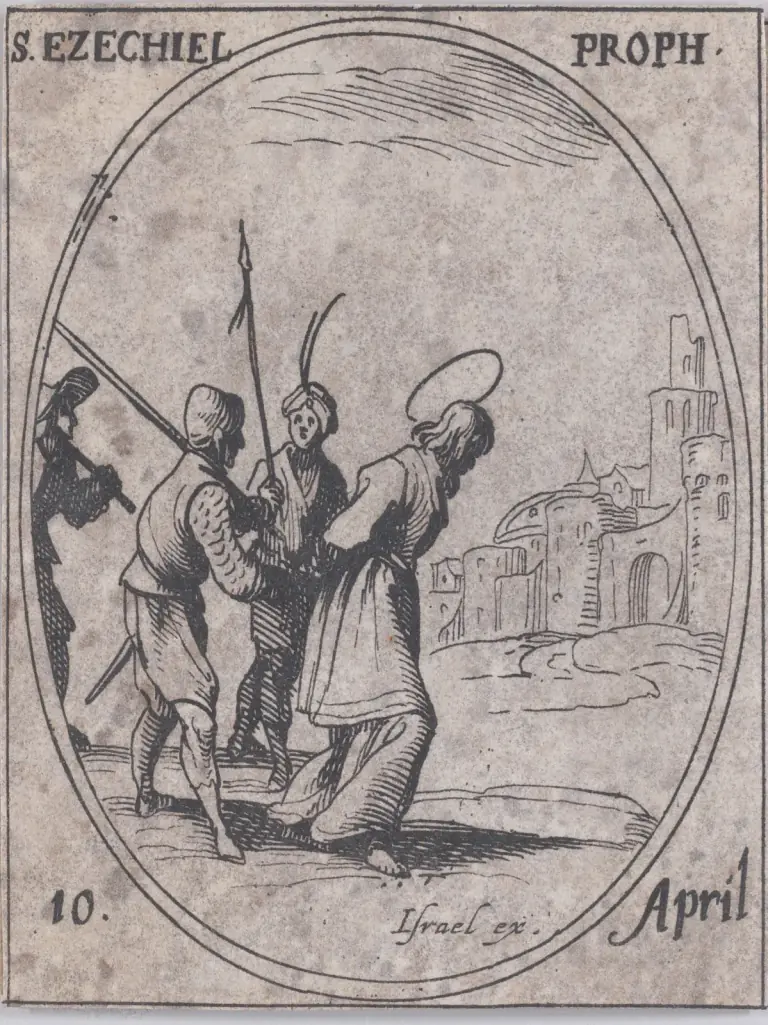
The older Roman Martyrology kept him on April 10, the date in the 1897 English edition and on Callot's plate. 14 Vatican News's saint pages list him on July 21. 15
Praying with Saint Ezekiel
Ezekiel was sent to people who, he was told at the outset, would probably not listen. 45 The measure of his mission was faithfulness, and the promise attached to it was only that they would know a prophet had been among them. 48
His book does not soften what this cost. He sat for seven days in bitterness among the exiles, spent years unable to speak except when God opened his mouth, and was told not to weep when his wife died. 57 The text gives no comfort for that last loss; it records that he did as he was commanded. 7
Yet the same prophet saw the glory of God by a foreign river, and, when there was nothing left of Jerusalem to defend, was asked whether dry bones could live. 310 He did not say yes. He answered, "O Lord God, thou knowest," and then prophesied as he was told. 10
The Church still prays his words at Lauds, asking for a new heart and a new spirit, and John Paul II heard in them the gift of God's own Spirit. 12 The Martyrology remembers him as the watchman who warned his people and then kept their hope alive. 13
Saint Ezekiel, pray for us.
Sources
- 1.Joseph Schets, "Ezekiel," The Catholic Encyclopedia, vol. 5 (New York: Robert Appleton Company, 1909).
- 2.Introduction to the Book of Ezekiel, The New American Bible, as hosted by the Holy See.
- 3.Ezekiel (Ezechiel) 1, with notes, Douay-Rheims Bible, Challoner revision, as hosted by drbo.org.
- 4.Ezekiel (Ezechiel) 2, Douay-Rheims Bible, Challoner revision, as hosted by drbo.org.
- 5.Ezekiel (Ezechiel) 3, with notes, Douay-Rheims Bible, Challoner revision, as hosted by drbo.org.
- 6.Ezekiel (Ezechiel) 18, Douay-Rheims Bible, Challoner revision, as hosted by drbo.org.
- 7.Ezekiel (Ezechiel) 24, Douay-Rheims Bible, Challoner revision, as hosted by drbo.org.
- 8.Ezekiel (Ezechiel) 33, Douay-Rheims Bible, Challoner revision, as hosted by drbo.org.
- 9.Ezekiel (Ezechiel) 36, Douay-Rheims Bible, Challoner revision, as hosted by drbo.org.
- 10.Ezekiel (Ezechiel) 37, Douay-Rheims Bible, Challoner revision, as hosted by drbo.org.
- 11.Ezekiel (Ezechiel) 47, with notes, Douay-Rheims Bible, Challoner revision, as hosted by drbo.org.
- 12.John Paul II, General Audience on the Canticle of Ezekiel 36:24-28, September 10, 2003, Libreria Editrice Vaticana.
- 13.Roman Martyrology, entry for July 23, "Sant'Ezechiele, profeta," Santo del giorno, Conferenza Episcopale Italiana (in Italian).
- 14.The Roman Martyrology, April 10 (Baltimore: John Murphy Company, 1897), Internet Archive.
- 15."s. Ezequiel, profeta," Santos, July 21, Vatican News (in Spanish).
Saints to turn to next
Others in this collection who are turned to for some of the same things.
- Saint CyprianBirth unknown - September 14, 258CourageConversionSuffering and illness
- Saint EustaceMartyred at Rome, in 118 by tradition; other accounts give 140 or 188ConversionCourageSuffering and illness
- Saint Gregory the Illuminatorc. 257 - c. 337 (both dates uncertain)ConversionSuffering and illnessCourage
- Saint John Paul IIMay 18, 1920 - April 2, 2005CourageSuffering and illnessConversion