Saint Eutropius of Saintes
d. c. 250
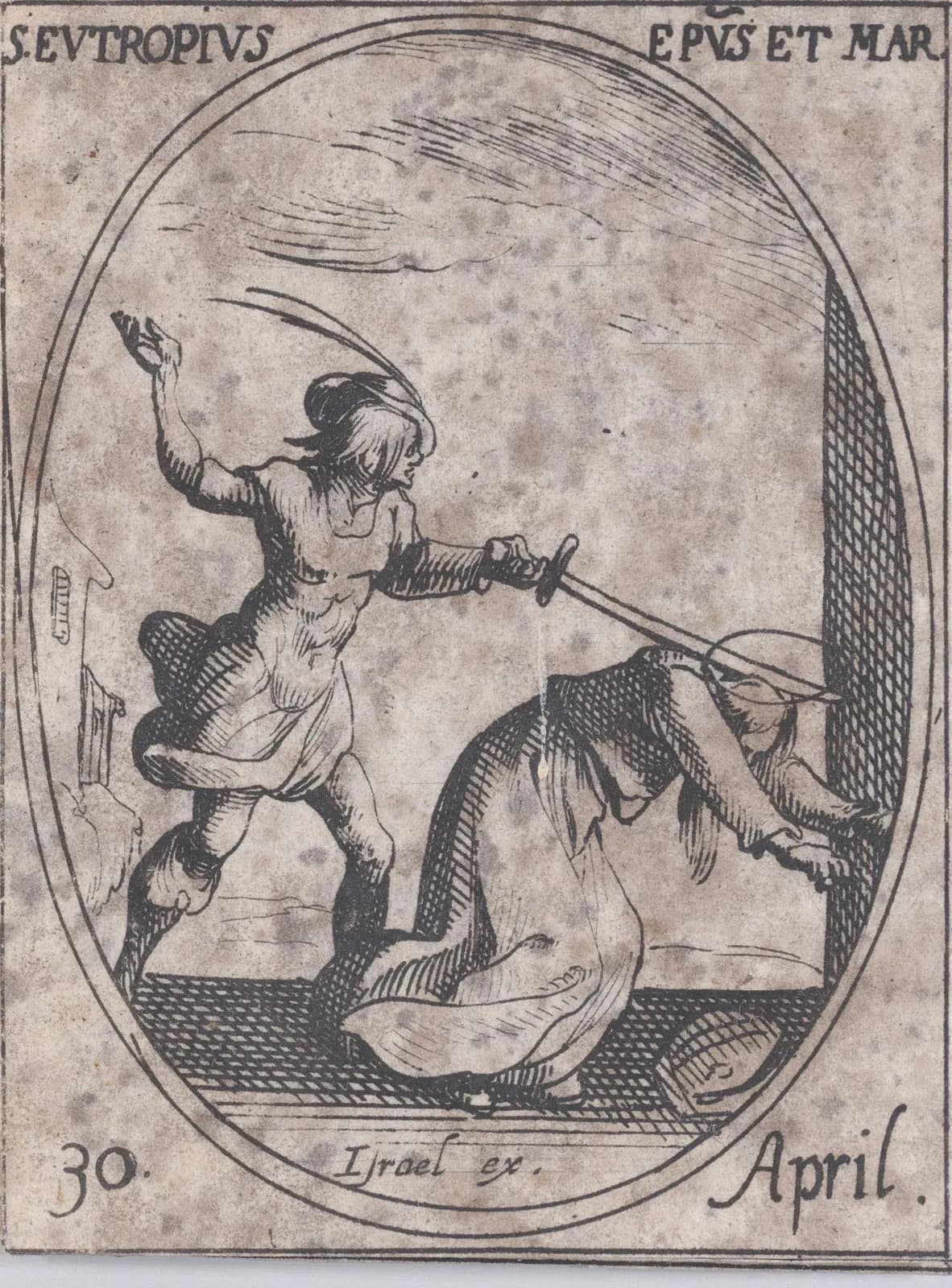
- Also called
- Eutrope, in French 6
Saint Eutropius is remembered as the first bishop of Saintes, in western France, and as a martyr, though almost nothing about him is certain. 56 Gregory of Tours, writing in the sixth century, says he was sent to Gaul by Pope Clement and killed by a blow to the head, but that no one knew he was a martyr until his bones were moved and two abbots saw the scar. 3 His tomb at Saintes later became a stop on the pilgrim road to Compostela. 1
What Gregory of Tours was told
The oldest account is a short chapter in Gregory of Tours's book on the glory of the martyrs. 3 Eutropius, martyr of the city of Saintes, is said, Gregory writes, to have been sent into Gaul by the blessed Pope Clement and consecrated bishop by him. 3 He did the work of his office and preached to the unbelievers, until the pagans rose against him and he died with his head broken, the victor. 3
Because this happened in a time of persecution, Gregory goes on, he was not buried in a worthy place or honored as he should have been, and it was largely forgotten that he was a martyr. 3 Many years later a church was built in his honor. Palladius, then bishop of Saintes, called together the abbots to move his remains into it. 3 When it was done, two of the abbots lifted the lid and looked at the body, and saw a scar on the head where the blade of an axe had gone in. 3
The next night, Gregory says, Eutropius appeared to the same two in a vision and told them that the scar they had seen was the wound by which he had completed his martyrdom. 3 That was how the people learned he was a martyr, Gregory explains, since there was no written account of his passion. 3
What can be known
Georges Goyau, writing on the diocese of La Rochelle in the 1910 Catholic Encyclopedia, notes that Gregory reports the mission from Clement "with a cautious ut fertur," that is, "so it is said," and that this makes Saintes "the only church of Gaul which Gregory traces back to the first century." 5 He then gives the objection of the historian Louis Duchesne: the evidence "is much weakened" by Gregory's own remark that no one knew the history of Eutropius before Palladius moved the relics, "which took place about 590." 5 "At this tardy date," Goyau concludes, "seems to have arisen the account of Eutropius as a martyr." 5
Nominis, the French bishops' site, quotes the diocese of La Rochelle and Saintes to similar effect. A tradition that was abundant and much embroidered in the Middle Ages, it says, made Eutropius the first bishop of the city and a martyr. 6 It calls Gregory's account complicated and Fortunatus's poem more sober and probably closer to the facts. 6 Today, the diocese concludes, he stands for the first preaching of the Gospel in the Saintonge; it is hard to deny that he existed, but nothing is really known of what he did, or even exactly when he lived. 6
The dates the sources give vary accordingly. Gregory's Clement would put him in the first century. 35 katolsk.no gives his death as about 250, and Nominis places him in the third century. 16 The current Roman Martyrology does not commit itself, saying only that he is said to have been sent into France by the Roman Pontiff. 2
The legend of Eustelle
Later tradition filled in the story. Goyau summarizes it: Eutropius "was said to be a Persian of royal descent, ordained and sent to Gaul by St. Clement; at Saintes he converted to Christianity the governor's daughter, St. Eustelle, and like her suffered martyrdom." 5
The diocese, on Nominis, tells it at more length. Eutropius made many converts in the poor quarters of Saintes, among them Eustelle, the governor's daughter, whose father disowned her when she was baptized at thirteen. 6 Unable to bear that his daughter should serve a Christian, the governor paid men to be rid of the bishop. They raised a riot, Eutropius was stoned and struck on the head with an axe, and Eustelle and his disciples buried him that night in her garden. 6 She was beheaded on her father's order and buried beside him. 6
FaithND, at the University of Notre Dame, gives a different version: that he came from Rome in the third century with Saint Denis, was turned away by the people of Saintes, and lived in a cave outside the city teaching anyone who came to him. 7 When the governor learned that Eutropius had baptized his daughter, it says, he drove her from the house and had the bishop killed, and Eustella found him murdered in his cell and buried him there. 7
The church and the shrine
The poet Venantius Fortunatus wrote verses for a Bishop Leontius on the rebuilding of the saint's church, a repair Nominis places in the sixth century. 46 The old hall of the venerable bishop Eutropius was falling apart with age, he says, its walls stripped and its beams bare, ruined less by the weight of the roof than by the rain. 4 The saint came at night to a sleeping servant and made known that Leontius was to restore it. 4 Fortunatus describes the new carved and painted ceiling and states the point plainly: this was the first bishop of the city of Saintes. 4 Goyau cites the poem as an explicit sixth-century mention of him in connection with Saintes. 5
The tomb was rediscovered centuries later, katolsk.no says, and became one of the stations on the pilgrim road to Santiago de Compostela, which spread his fame. 1 In 1081, Goyau writes, William VII gave the church of Saint Eutropius to the monks of Cluny, and its crypt, "one of the largest in France," was consecrated by Pope Urban II on April 20, 1096. 5 Charles VII came on pilgrimage in 1441, and Louis XI "wrote a prayer against dropsy, in honour of St. Eutropius." 5
In 1568, Goyau continues, the Calvinists ravaged the crypt, but the monks had hidden the tomb so well that it was thought lost, and it was found again only on May 19, 1843. 5 Nominis dates the find to 1842 and says the sarcophagus bore the name EUTROPIUS and held the bones of several people, attributed to Eutropius and Eustelle. 6 katolsk.no says that the cathedral of Saintes now has only his head, the Huguenots having destroyed the rest of his remains. 1 Relics of his also rest in the reliquary chapel of the Basilica of the Sacred Heart at Notre Dame, where a stained-glass window shows them carried in procession. 7
What is Saint Eutropius the patron saint of?
Saint Eutropius is the principal patron of the diocese of La Rochelle, the encyclopedia says, the diocese that absorbed the old see of Saintes. 5 Nominis names him patron of the diocese of La Rochelle and Saintes, and adds that he is invoked by anyone about to undergo an operation on the head, which fits the story of his wound. 6 Goyau records the prayer against dropsy that Louis XI wrote in his honor. 5
Saint Eutropius's feast day
Praying with Saint Eutropius
Almost everything said about Eutropius comes from long after his death. Gregory admits as much, and the diocese that keeps his feast says plainly that nothing is really known of his work. 36
What survived was a grave and a church built over it. Gregory's story is about the forgetting as much as the martyrdom: a bishop buried in haste and left without honor, recognized only when someone opened the coffin. 3
The church in his name fell into ruin and was rebuilt, became a pilgrim stop, was ravaged in the wars of religion, and lost his tomb for nearly three centuries. 415 The Saintonge still counts him as the man who first brought it the Gospel. 6
Saint Eutropius of Saintes, pray for us.
Sources
- 1."Den hellige Eutropius av Saintes (biskop) (d. ~250)," Den katolske kirke (katolsk.no), Catholic Diocese of Oslo (in Norwegian).
- 2.Roman Martyrology, entry for April 30, "Sant'Eutropio, vescovo," as printed in "Santo del giorno," Conferenza Episcopale Italiana (in Italian).
- 3.Gregory of Tours, Liber in gloria martyrum (Miraculorum liber I), chapter 56, "De sancto Eutropio," in J. P. Migne, Patrologia Latina 71 (Paris, 1849), as transcribed on Latin Wikisource (in Latin).
- 4.Venantius Fortunatus, Carmina (Miscellanea), Book I, poem 13, "De basilica sancti Eutropii," in J. P. Migne, Patrologia Latina 88, as transcribed on Latin Wikisource (in Latin).
- 5.Georges Goyau, "La Rochelle," The Catholic Encyclopedia, Vol. 9 (New York: Robert Appleton Company, 1910).
- 6."Saint Eutrope, évêque de Saintes et martyr (IIIe siècle)," Nominis, Conférence des évêques de France (in French).
- 7."St. Eutropius," Explore the Saints, FaithND, University of Notre Dame.
Saints to turn to next
Others in this collection who are turned to for some of the same things.