Saints Eustratius and Companions
Martyred c. 302
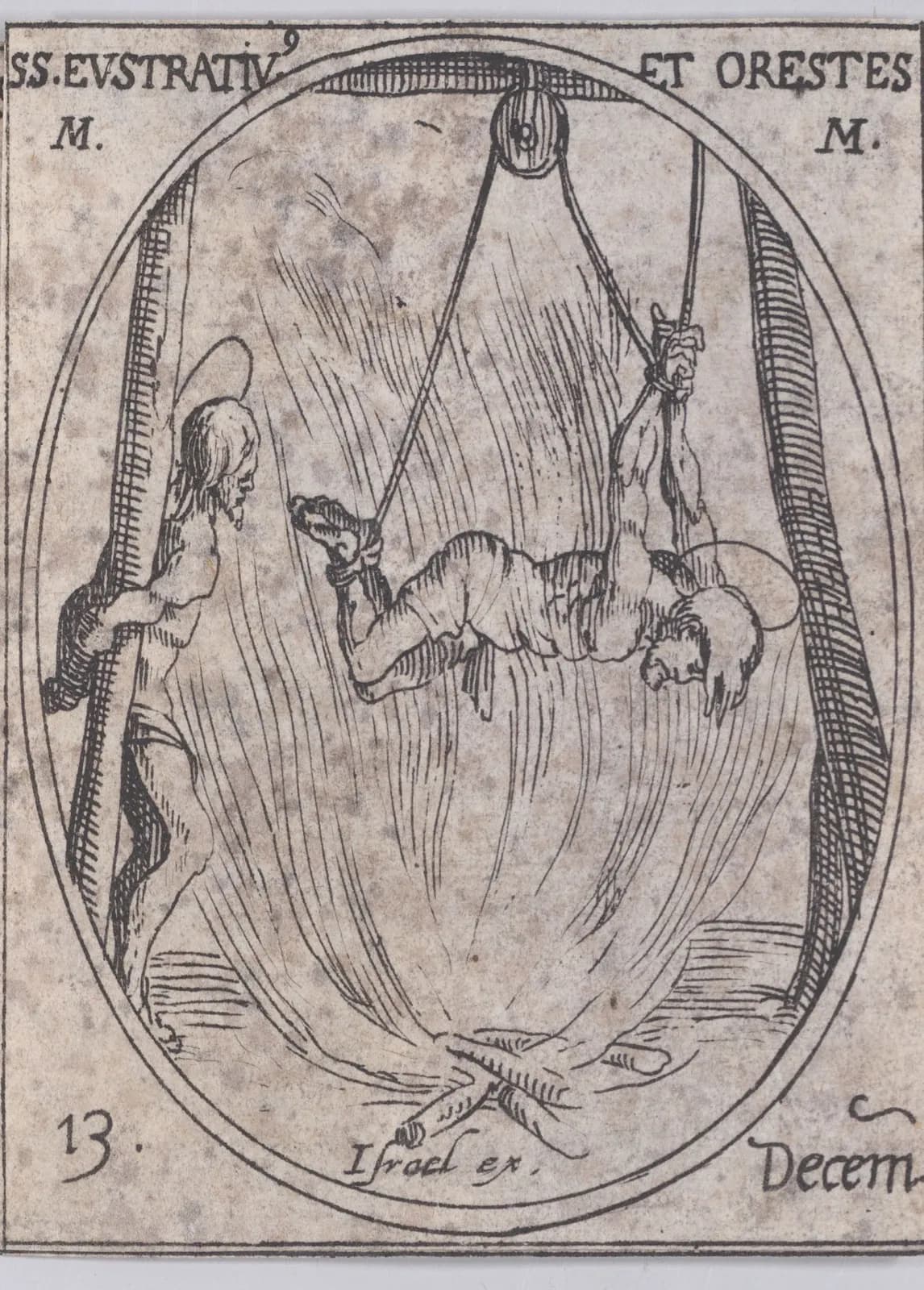
- Also called
- The Five Martyrs of Armenia 1
- Eustratius
- A Christian Armenian of a noble family, from Arauraka, near present-day Şiran in Turkey 1
- Died
- About 302, in the persecution of Diocletian, at Sebasteia in Armenia, today Sivas 1
- Relics
- In Rome, at Sant'Apollinare and Santa Maria in Via Lata 1
Saints Eustratius, Auxentius, Eugene, Mardarius and Orestes are five martyrs of Roman Armenia who died about 302, in the persecution of Diocletian, and are remembered together on December 13. 12 By their passion, Eustratius was a nobleman who defended his faith before a Roman judge from Plato and the poets, and the other four were drawn in one by one as they stood by him. 1 The Byzantine Catholic office for the day calls him "the most eloquent of orators." 3
Eustratius of Arauraka
The Norwegian bishops' saints database (katolsk.no) tells the story as the passion gives it. Eustratius came from Arauraka in Armenia, a place it identifies with Akçalı Köyü near Şiran in modern Turkey, and he was a Christian Armenian of a noble and well-known family. 1 He was also known by the bynames Cyrisices or Striniarius. 1 Suspected of being a Christian, he was arrested by the prefect of Sateleon, and when he would not let go of Christ he was tortured in many ways and then put in prison. 1
His servant Eugene went with him. katolsk.no calls him faithful, and says that he gave himself up as a Christian. 1 The Byzantine office remembers what the first stage cost Eustratius: he was beaten without mercy and made to walk the roads in iron sandals whose nails pierced his feet, then shut in a dungeon. 3
Four companions
When the prefect set out for Nicopolis, he took Eustratius with him by way of Arauraka, his home town, and had him scourged several times on the road. 1 There a fellow townsman named Mardarius looked after him and spoke up for him. 1 When Mardarius then confessed Christ himself, he paid for it with his life. 1 So did Auxentius, a priest of the local church, who had also prayed for Eustratius. 1 katolsk.no says Auxentius was beheaded, and that Mardarius was hung up by the ankles and pierced with red-hot needles. 1
Eugene was then brought out of prison before the prefect. 1 He refused to sacrifice to the gods and was beaten with clubs until he died. 1
Eustratius, meanwhile, endured a public scourging, and salt and vinegar were rubbed into his wounds, without his denying his faith. 1 Among the soldiers was a secret Christian named Orestes, who, seeing the courage of Eustratius under torture, would no longer hide what he believed. 1 He was sent with Eustratius to the prefect of Sebasteia, who had him laid on a red-hot grill, and he died there. 1 The Byzantine office sings of how "Orestes and Mardarius joined the wise Eustratius, Auxentius and Eugene in their glorious struggle." 3
The furnace at Sebasteia
Eustratius was the last. katolsk.no says he received Holy Communion from the bishop of Sebasteia, then walked singing into the furnace that had been prepared for him, and died there. 1 The Byzantine office puts the same death in liturgical terms: "baked in an oven like a pure sacrifice," he offered himself to the one who was sacrificed for him. 3 It also sings of the wounds of his tortures suddenly disappearing. 3
The bishop had the bodies of the five buried at Arauraka, as he had promised. 1 Sebasteia is the modern Turkish city of Sivas. 1
A passion rewritten
katolsk.no is candid about the document behind all this. It calls the passion of these martyrs a good example of how such texts were added to, and even rewritten, in later centuries for teaching purposes. 1 The scenes in which Eustratius argues with the magistrate and discusses passages of Plato and the classical poets are its main instance. 1
It also notes that the story seems to have borrowed from that of the Forty Martyrs of Sebaste, who hold an important place in the Orthodox calendar. 1 Fragments of the passion survive in a ninth-century manuscript, katolsk.no says, but there is no earlier confirmation of the martyrs' names or of what they did. 1
The Eastern liturgy took the scholar's portrait to heart all the same. The hymns for December 13 praise Eustratius for "the brilliance of his invincible words," compare his wisdom to a cup filled to overflowing, and call him the "brilliant commander" of the five. 3 The Gospel appointed for the day in the Byzantine Catholic Menaion is Luke 21:12-19, in which Christ warns his disciples that they will be handed over to kings and governors for his name. 3
From Armenia to Rome
The five were venerated first at Arauraka. 1 From there, katolsk.no says, the cult spread to Cappadocia, then through the Greek and Latin world, and reached Rome in the eighth century. 1 Under Pope Hadrian I (772-95) their relics were brought to the Roman church of Sant'Apollinare; today they rest there and in Santa Maria in Via Lata. 1
katolsk.no also points to an early image of the cult: a depiction of the miracles of Saint Eustratius on the beams of an iconostasis from the first half of the twelfth century at Saint Catherine's Monastery on Mount Sinai. 1
What are Saints Eustratius and Companions the patron saints of?
None of the sources consulted names a patronage for Eustratius or any of his companions. katolsk.no says their cult began at Arauraka, where they were buried, and spread from there to Rome. 1 The Byzantine office asks their prayers for the forgiveness of sins and for the salvation of souls, without assigning them a particular cause. 3
Saints Eustratius and Companions' feast day
The feast day of Saints Eustratius, Auxentius, Eugene, Mardarius and Orestes is December 13, the day of Saint Lucy. 123 The current Roman Martyrology lists them on that day, in its Italian edition, simply as martyrs in Armenia. 2 The Byzantine Catholic Menaion also keeps them on December 13, with a full office of hymns at Vespers and its own readings at the Divine Liturgy. 3 katolsk.no, which heads its entry December 13, says in its text that their day in the Roman Martyrology is December 14. 1
Praying with Saints Eustratius and Companions
Four of the five, in the passion, die because of the first. 1 Mardarius looked after a prisoner from his own town, Auxentius prayed for him, Eugene stayed with his master, and Orestes watched him under the lash and stopped pretending. 1 Each of them was drawn in by standing beside a man who was suffering. 1
katolsk.no says plainly how much of the story is later work, and names the speeches from Plato as an example. 1 What the Church has kept, from Arauraka to Rome and in its Martyrology today, is the memory of five names together. 12
The Byzantine Catholic office for December 13 asks Christ to save our souls through their prayers. 3 One of its hymns names all five and calls them a choir of martyrs "with five-fold brilliance." 3
Saints Eustratius and Companions, pray for us.
Sources
- 1."Den hellige Eustratius av Sebasteia og fire ledsagere (d. ~302)," Den katolske kirke (katolsk.no), Catholic Diocese of Oslo (in Norwegian).
- 2.Roman Martyrology, entry for December 13, "Santi Eustrazio, Aussenzio, Eugenio, Mardario e Oreste, martiri," as printed in "Santo del giorno," Conferenza Episcopale Italiana (in Italian).
- 3."Menaion - December 13," Metropolitan Cantor Institute, Byzantine Catholic Archeparchy of Pittsburgh.
Saints to turn to next
Others in this collection who are turned to for some of the same things.