Saint Eustathius of Antioch
Born about 270; died in exile about 338, or as late as 360
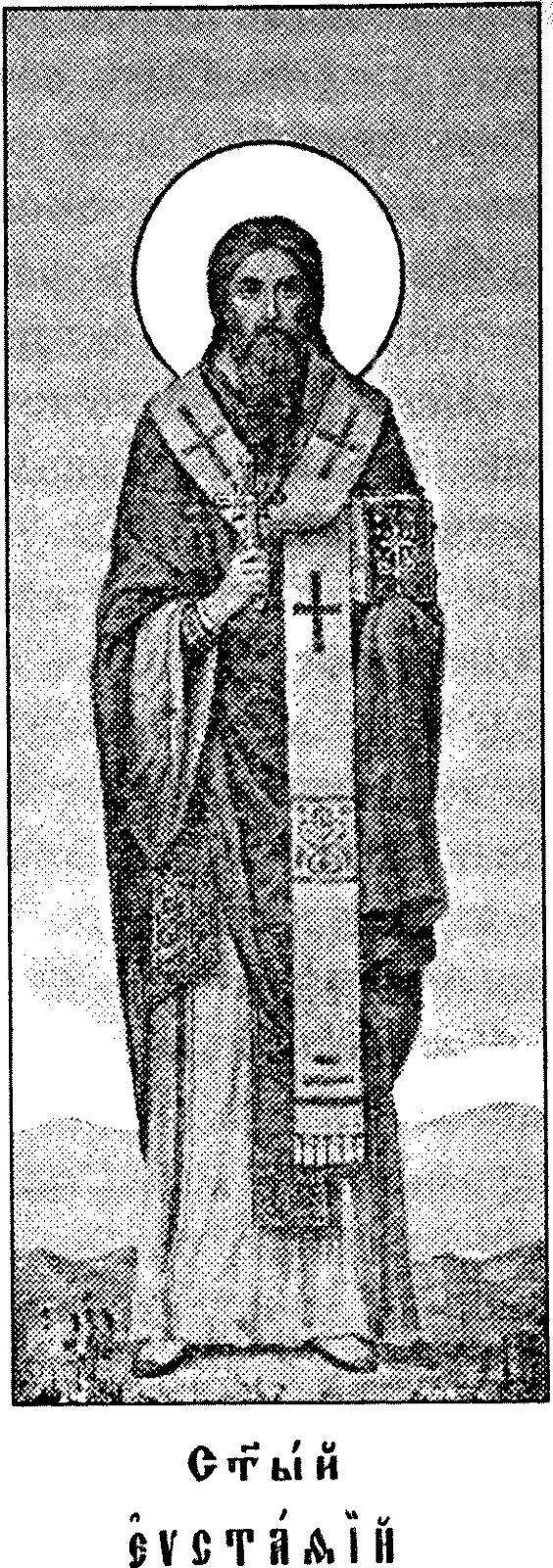
- Known for
- Opposing Arius at the Council of Nicaea in 325, and writing against the Arians afterward 127
Saint Eustathius was bishop of Antioch, then counted the third see of Christendom after Rome and Alexandria, at the time of the Council of Nicaea, where he was among the most outspoken opponents of Arius. 127 Within a few years his enemies had him deposed by a synod at Antioch and banished by the emperor, on charges that the ancient historians cannot agree on and that most of them say were false. 12345 He died in exile, and his feast is February 21. 78
From Side to Antioch
Eustathius came from Side in Pamphylia, and the Catholic Encyclopedia puts his birth about 270. 16 He was first bishop of Beroea in Syria. 16 It was there, Theodoret says, that Bishop Alexander of Alexandria wrote to him about the teaching of Arius. 2
When Philogonius, bishop of Antioch, died, Eustathius was moved to the larger see. The Catholic Encyclopedia dates the move about 323. 1 Theodoret says he "had been compelled reluctantly" to succeed Philogonius "by the unanimous suffrages of the bishops, priests, and of the Christ-loving laity." 2 The Norwegian bishops' saints database (katolsk.no) adds that he objected to being moved because he thought the transfer of bishops opened the door to ambition, and that he gave way in 324. 7
At Nicaea
At the Council of Nicaea in 325, the Catholic Encyclopedia says, he was "one of the most prominent opponents of Arianism." 1 Theodoret gives him a leading place in the opening scene. When the emperor Constantine had taken his seat among the bishops, "immediately rose first the great Eustathius, bishop of Antioch," and praised the emperor for his care of the Church. 2
Theodoret also preserves a passage from his later writing on the council, explaining the text of Proverbs, "The Lord created me in the beginning of His way." 2 In it Eustathius says the Arian party signed the creed only to keep their sees, and went on "sometimes secretly, and sometimes openly" defending what had been condemned. "But we do not believe that these atheists can ever thus overcome the Deity," he wrote. 2
Back in Antioch he would not take Arian clergy into his church. 15 Athanasius says he "would not receive those who adopted its tenets," and that many of the men he turned away were later made bishops by his enemies. 5 katolsk.no adds that he looked carefully into the faith and character of those who asked to be ordained. 7
The quarrel with Eusebius
His chief opponent in writing was Eusebius, bishop of Caesarea, the historian. 347 Socrates says that after Nicaea the bishops fell out over the word homoousios, "of one substance," with one side calling the other Sabellians and the other answering with charges of polytheism. 3 "Eustathius, bishop of Antioch, accuses Eusebius Pamphilus of perverting the Nicene Creed; Eusebius again denies that he violates that exposition of the faith, and recriminates, saying that Eustathius was a defender of the opinion of Sabellius." 3
Socrates did not think either man understood the other. Both confessed the Son of God, he says, and yet "it seemed not unlike a contest in the dark." 3 Sozomen tells the same story in nearly the same terms. 4 katolsk.no notes that Eusebius does not mention Eustathius at all in his own Church History. 7
Deposed at Antioch
About 331 a synod met at Antioch and deposed him. 17 Theodoret tells how it was arranged. Eusebius of Nicomedia, whom katolsk.no calls the leader of the Arians, asked the emperor's leave to visit Jerusalem and set out with Theognis of Nicaea. 27 At Antioch Eustathius "treated them with fraternal kindness." 2 In Palestine they met Eusebius of Caesarea and others of their party, and came back to Antioch together. 27
What happened next is told four different ways. Theodoret says they bribed a woman to appear before the synod with a baby and swear that Eustathius was its father; she had no witness, and they condemned him on her oath. Later, he says, she fell ill and confessed she had been paid, adding that her oath had not been entirely false, because the father was another Eustathius, a coppersmith. 2 Athanasius says the charge was that he had insulted the emperor's mother. 5
Socrates, relying on George of Laodicea, says he was deposed as a Sabellian, but doubts it: the bishop who accused him, Cyrus of Beroea, was himself later degraded for the same error, so "it appears likely therefore that Eustathius must have been condemned on other grounds." 3 Sozomen says the pretext was that he "had defiled the priesthood by unholy deeds," while most people believed he was removed for holding to Nicaea. 4 The Catholic Encyclopedia and katolsk.no list the charges together: Sabellianism, incontinence, cruelty and other crimes, brought by suborned witnesses. 17
Exile
Antioch nearly rose in arms. Socrates says the city split into two parties, one wanting Eusebius of Caesarea as bishop and the other Eustathius back, and that bloodshed was avoided only by the emperor's letters and by Eusebius refusing the see. 3 Sozomen says the riot turned the emperor against Eustathius, whom he now suspected of causing it. 4 The Catholic Encyclopedia says Eustathius himself held the people back, urged them to keep the faith, and went quietly into exile with many of his clergy. 1 Athanasius says "a great number of Presbyters and Deacons" went with him. 5
Sozomen had heard that he "bore this unjust calumny calmly." 4 The Catholic Encyclopedia, Jerome and katolsk.no send him to Trajanopolis in Thrace. 167 Theodoret says he "was conducted across Thrace to a city of Illyricum." 2 Athanasius, the Catholic Encyclopedia and katolsk.no say Constantine banished him; Jerome says it was under Constantius, and the current Martyrology's entry also names Constantius. 15678
The date of his death is uncertain. The Catholic Encyclopedia says most probably 360, though some put it in 336 or 337; katolsk.no says about 338, and notes that some sources say 360. 17 Jerome says only that he was exiled to Trajanopolis, "where he is until this day." 6 katolsk.no says his relics were brought to Antioch in 482. 7
The Eustathians
Those in Antioch who would not accept the bishops who followed him met on their own, and, Theodoret says, "they were called Eustathians." 12 In 360 Arians and Catholics together elected Saint Meletius bishop of Antioch, but the Eustathians would not recognize him. 17 The Catholic Encyclopedia says their stand split the orthodox of Antioch in two, in what is called the Meletian Schism, which lasted into the fifth century. 1
Most of what he wrote is lost. 17 Jerome lists works On the Soul and On Ventriloquism, Against Origen, and "Letters too numerous to mention." 6 The second survives: in it, the Catholic Encyclopedia says, he argues against Origen that the appearance of Samuel to the witch of Endor was a phantasm in Saul's mind and not a reality, and criticizes Origen's allegorical reading of Scripture. 1 Sozomen praises his eloquence, "evidenced by his transmitted works." 4
What is Saint Eustathius the patron saint of?
Saint Eustathius's feast day
Saint Eustathius's feast day is February 21. The current Roman Martyrology, as the Italian bishops publish it, commemorates him that day as the bishop of Antioch, "illustrious for learning," who died in exile in Thrace for defending the Catholic faith. 8 katolsk.no gives the same date and says the Greeks keep it too. 7
The Roman date used to be July 16. The Catholic Encyclopedia, writing in 1909, gives July 16 for the Latin Church and February 21 for the Greek, and katolsk.no says July 16 was the earlier date in the Roman Martyrology. 17 The current Martyrology no longer has him on July 16.
Praying with Saint Eustathius
Eustathius was not a man who kept the peace by giving ground. He said plainly at Nicaea and afterward what he believed the council had settled, and he would not ordain the men who disagreed. 125 The historians who admired him also say his quarrel with Eusebius was partly a misunderstanding. 34
He was brought down by people who did not argue with him on the question at all. Each historian gives a different charge, and none of them believes the charge he reports. 2345 Theodoret ends his account with the woman who swore against him, confessing on her sickbed. 2
Antioch was ready to fight for him. The Catholic Encyclopedia says he kept the people from it and left. 1 Sozomen's word for how he took it is "calmly." 4
He did not come back. He died far from his church, and the people who stayed loyal to him were still keeping apart a generation later, in a quarrel that outlived him by decades. 17
Saint Eustathius of Antioch, pray for us.
Sources
- 1.Michael Ott, "St. Eustathius," The Catholic Encyclopedia, Vol. 5 (New York: Robert Appleton Company, 1909).
- 2.Theodoret, Ecclesiastical History, Book I, chapters 6, 7, 20 and 21, trans. Blomfield Jackson, Nicene and Post-Nicene Fathers, Second Series, Vol. 3 (1892).
- 3.Socrates Scholasticus, Ecclesiastical History, Book I, chapters 23 and 24, trans. A. C. Zenos, Nicene and Post-Nicene Fathers, Second Series, Vol. 2 (1890).
- 4.Sozomen, Ecclesiastical History, Book II, chapters 18 and 19, trans. Chester D. Hartranft, Nicene and Post-Nicene Fathers, Second Series, Vol. 2 (1890).
- 5.Athanasius, History of the Arians, Part I, 4, trans. M. Atkinson and Archibald Robertson, Nicene and Post-Nicene Fathers, Second Series, Vol. 4 (1892).
- 6.Jerome, On Illustrious Men, 85, "Eustathius," trans. Ernest Cushing Richardson, Nicene and Post-Nicene Fathers, Second Series, Vol. 3 (1892).
- 7."Den hellige Eustathios av Antiokia," Den katolske kirke, the saints database of the Catholic Church in Norway, katolsk.no (in Norwegian).
- 8.Roman Martyrology, entry for February 21, "Sant'Eustazio, vescovo," Santo del giorno, Conferenza Episcopale Italiana (in Italian).
Saints to turn to next
Others in this collection who are turned to for some of the same things.